
Paritta (protective chants)
Khandha Paritta — goodwill towards snakes and creatures
KhandhaparittaṃA short chant of goodwill towards snakes and all creatures, which the Buddha allowed monks to use to look afte…


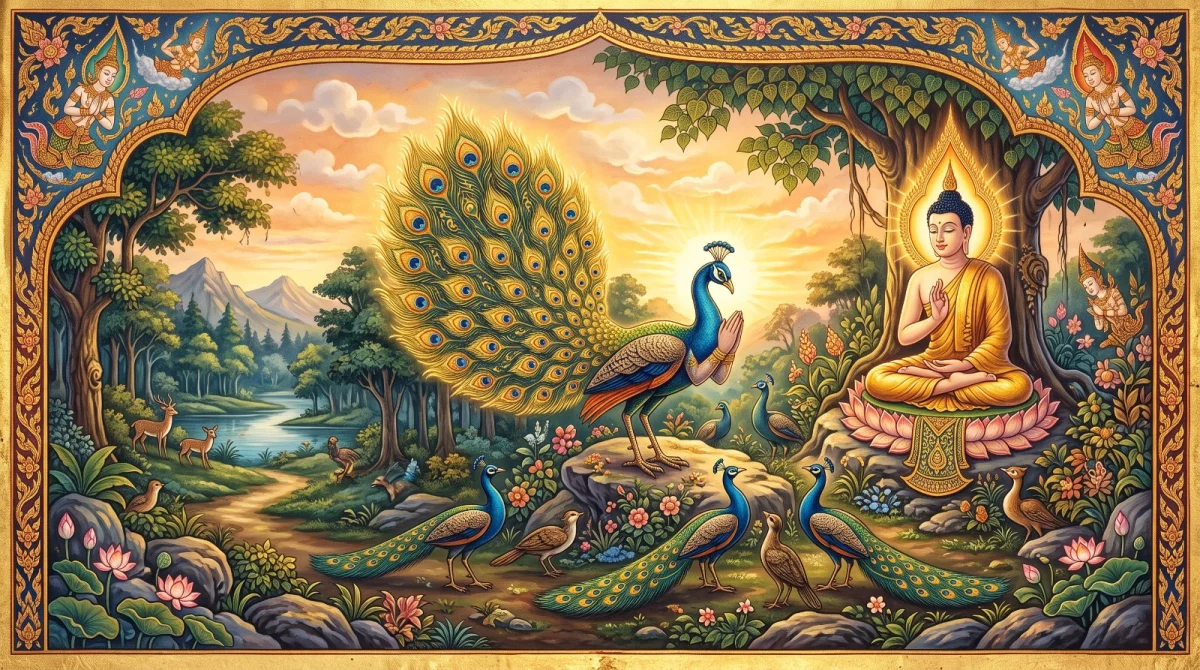
Moraparittaṃ
The verses of the golden peacock in the Mora Jātaka: a morning verse as the sun rises, an evening verse as it sets, both ending in homage to the Buddhas and to liberation.
Part of the traditional set of seven paritta chants, used by monks at auspicious ceremonies, house blessings, and whenever a family asks for the protective chants.
If you chant at home, the first half (Udetayañcakkhumā) is usually chanted in the morning before leaving the house, and the second half (Apetayañcakkhumā) in the evening before sleep, matching the times the verses describe.
When you finish, sit with your own mind for a moment. What you can actually observe is a mind that has found its footing again — not a guarantee that nothing will go wrong.
In the Mora Jātaka the Bodhisatta was born as a golden peacock. For years a hunter tried to trap him and failed, because every morning before going out to feed the peacock would stand on a hilltop and recite verses of homage to the sun and to all the Buddhas, and every evening before returning to his roost he would recite them again.
So the chant is both an act of homage and a daily way of settling the mind. "Cakkhumā ekarājā" — "the one with eyes, the sole king" — is the sun, the eye of the world and the single sovereign of light. But the verses do not stop there: they turn at the end to the Buddhas, to awakening, to those who are freed and to freedom itself, which is the safer refuge.
The Pali here is taken directly from the royal edition of the Tipiṭaka, volume 27, and re-divided into chanting lines.
Click to read the actual page it refers to
A short chant of goodwill towards snakes and all creatures, which the Buddha allowed monks to use to look afte…

The blessing chanted straight after the Jayamaṅgala Gāthā, closing with the verse from the Supubbaṇha Sutta: t…
A short chant for after a bad dream or an unsettling sign, asking that the unease dissolve through the power o…

Homage to the seven Buddhas, an extract from the Āṭānāṭiya Sutta, commonly chanted to close the set of seven p…