
The Discourse on the Abuser: Abuse Not Accepted Stays with the Abuser
AkkosakasuttaṃA brahmin abuses the Buddha with harsh words. The Buddha asks: if guests don't accept the food you serve, whos…


Tilakkhaṇaṃ
Three marks shared by everything — impermanent, unable to hold its shape, and not a self. Visible in the smallest things around you every day.
The three characteristics are the marks shared by everything that arises from conditions — body, feeling, thought, relationships alike: impermanence, unsatisfactoriness, and not-self.
They are not there to make you gloomy but to place the mind correctly, because most of our suffering comes from demanding that changing things stay fixed for our convenience.
Everything arises, remains a while, and passes. Nothing holds its shape: not the body, not feelings, not people, not circumstances.
In good times it reminds you not to be careless; in bad times it reminds you this will pass. One sentence that serves both ends.
Because things are impermanent they are under constant pressure to change and cannot stay in one state. "Dukkha" here does not only mean pain; it means the condition of having to alter.
Don't rest your whole happiness on one thing — one job, one person, one achievement. Spread the base and the mind won't collapse when any single support shifts.
Nothing here is a permanent core that can be commanded at will. If body and mind were truly ours, we could order them not to age, not to sicken, not to spin with worry. In fact they follow conditions.
When you make a mistake, ask "what conditions produced this, and which of them can I change?" instead of concluding "I'm a bad person". The first leads to repair; the second only sinks.
Try them on your own moods first. When anger or sadness comes, tell yourself "this one is impermanent too", and watch how long it actually lasts.
Most people are surprised to find that strong emotions last only minutes. What stretches them into whole days is the thinking we keep adding on top.
Tap to read the actual passage on the page cited.
A brahmin abuses the Buddha with harsh words. The Buddha asks: if guests don't accept the food you serve, whos…
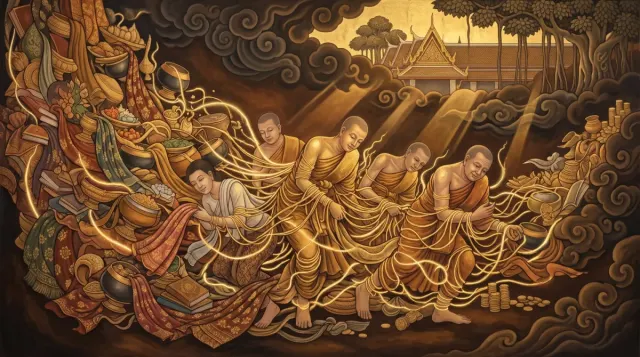
A merchant's son invited a monk to ask for whatever he needed, and was asked for the very cloth he was wearing…
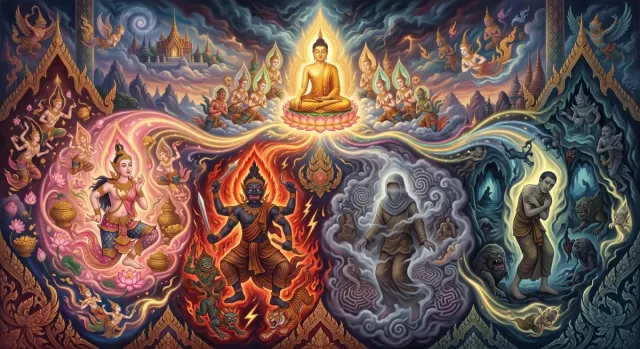
Four kinds of partiality that bend a judgement — out of liking, out of dislike, out of ignorance, and out of f…

Short similes from the Opamma Saṃyutta: rafters converging on the roof peak, dust on a fingernail and the grea…