
The Pāṭaliya Discourse: When Four Teachers Contradict Each Other
Pāṭaliyo gāmaṇīThe headman Pāṭaliya tells how four teachers with utterly opposed views stayed in his rest house, leaving him …



Sārīputtattherāpadānaṃ
Sāriputta's past lives according to the Apadāna: the ascetic Suruci who honoured the Buddha Anomadassī with eight flowers and was foretold as chief disciple, the search for a core not found in a banana tree, gratitude to Assaji, and the humility of one foremost in wisdom.
In the Sāriputta Apadāna of the Khuddaka Nikāya, Sāriputta recounts his past lives in verse; it is one of the longest apadānas in the Buddha chapter. The Apadāna is a collection of verses in which the Buddha, paccekabuddhas, monks and nuns recount good deeds of past lives. Most scholars regard it as a later text within the Tipiṭaka, while the Theravāda tradition counts it as part of the Khuddaka Nikāya.
He tells how, in the time of the Buddha Anomadassī, he was an ascetic named Suruci with twenty-four thousand pupils, living in a hermitage near a mountain called Lambaka, not far from the Himalayas. He honoured the Buddha with eight flowers and praised his knowledge, and was foretold to become the chief disciple named Sāriputta. The verses go on to his search for freedom from suffering, meeting Assaji, bringing his friend Kolita to ordain, and praising the Buddha and his disciples with many similes.
This differs from Sāriputta's verses in the Theragāthā, which focus on practice and his attitude to life and death. The Apadāna focuses on where the aspiration began, reverence for the Buddha, and gratitude to his teacher.
When the Buddha Anomadassī entered the Himalayan forest and sat down, the ascetic Suruci examined his marks, saw the wheels on the soles of his feet and was convinced he was a Buddha. He took a broom, swept the place, brought eight flowers to honour him, placed his hide robe over one shoulder and paid homage.
Respect starts with small things like preparing a clean space. Before welcoming a teacher or guest, try getting the place ready yourself.
The ascetic praised him: the water of the ocean might be measured, the earth might be weighed, the sky might be measured with a rope or fingers, but no one can measure the Buddha's omniscient knowledge. Those holding various views are within the net of his knowledge, like creatures of the water within a fine-meshed net.
When you think you know everything about something, remember there is always more depth than you can see. This attitude keeps the mind open to learning.
The Buddha Anomadassī smiled, and his attendant Varuṇa asked why. The Buddha foretold that the one who honoured him with flowers and praised his knowledge would in his last life be born to a brahmin woman named Sārī, be called Sāriputta and become chief disciple of the Buddha Gotama. Even the sand of the Ganges could be counted to the end, but there would be no end to his wisdom.
People's abilities grow through accumulation. Don't judge yourself or others by where they start; look at the direction they are training in.
He tells how he went forth as a sage for five hundred lives in a row, seeking the unconditioned as a sick person seeks medicine, but did not find it in the doctrines he wandered through, like a man wanting heartwood who splits a banana tree and finds none, because it is empty of heartwood.
When choosing a way of life or taking advice from various sources, ask whether it has real substance and truly reduces suffering, or is just an attractive husk.
In his last life he lived with Sañjaya, saw Assaji on alms round with inspiring deportment, followed and questioned him, heard the verse beginning ye dhammā, and attained the first fruit. Later he said: Assaji is my teacher; in whatever direction he lives, I place that direction above my head, meaning he slept with his head toward it.
Remember the people who opened an important door in your life, even if they held no high position. Try sending a thank-you message to your first teacher or mentor.
He praises the Buddha: the Sindhu, Sarasvatī, Ganges, Yamunā and other rivers, on flowing into the ocean, give up their former names and are known only as the sea. So too people of the four classes who go forth under the Buddha give up their former names and are known as sons of the Buddha.
In a community doing good together, don't divide people by status, background or former rank; look at how they practise now.
He declares that in the Buddha-field, apart from the Buddha, no one equals him in wisdom, yet in the same verses he says he has put down conceit and stiffness, like a snake with its fangs drawn or a bull with its horns cut, approaching the community with deep respect and always supporting his fellow monks with faith.
The more skilled or senior you are, the more you should approach your team with respect, listen to others fully, and never use knowledge as horns to gore anyone.
He says: may no one of evil wishes, lazy, of little learning and without good conduct ever associate with me; but may one who is learned, wise, well established in virtue and devoted to calm of mind stand upon my head. Then he blesses the assembly: be of few wishes, content, and always generous.
Consider where the people you spend most time with are leading you, and practise contentment by asking before every purchase whether you really need it.
This story shows that Sāriputta's wisdom did not begin with brilliance alone but with reverence. An ascetic with tens of thousands of pupils still swept the ground and gathered flowers himself.
What we can use in life is gratitude to those who show us the way. Even as chief disciple, Sāriputta always remembered Assaji as his teacher, and a capable person who is humble lives well within a community.
The simile of rivers losing their names when they reach the sea fits any community that wants people of different backgrounds to live together without division.
Tap to read the actual passage on the page cited.
The headman Pāṭaliya tells how four teachers with utterly opposed views stayed in his rest house, leaving him …
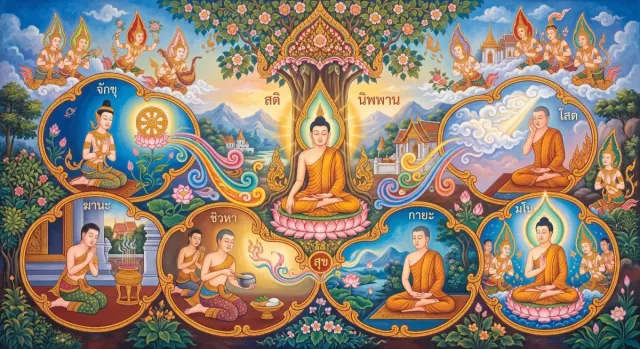
A set of short discourses in the Saḷāyatana Saṃyutta: the eye, ear, nose, tongue, body and mind, untrained, br…
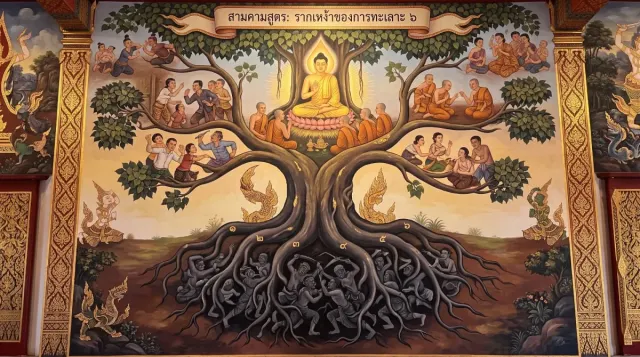
Six traits that split groups apart — from communities of practitioners to families and workplaces — and the te…
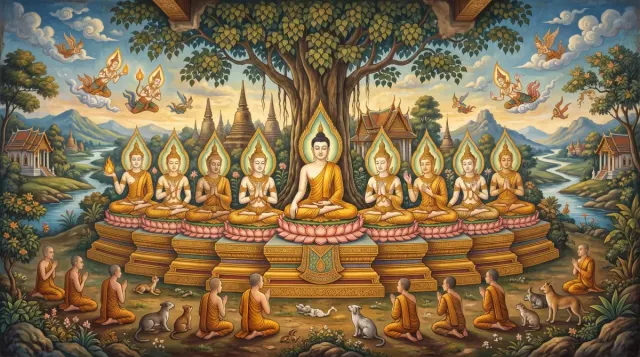
In the Chapter on the Good and the Chapter on the Noble Path, the Buddha teaches the same set again and again,…