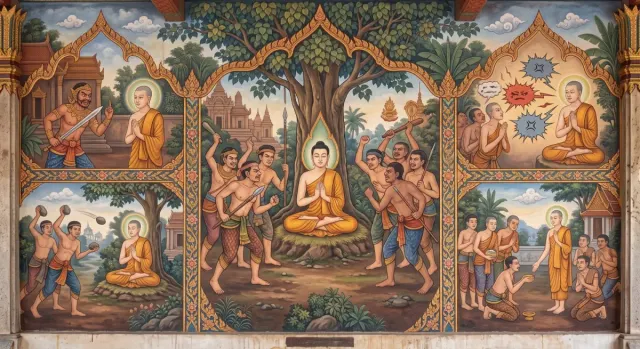
The Discourse on the Cloak: Conduct the Wise Censure
Everyday life

The Discourse on the Cloak: Conduct the Wise Censure

Bāhitikasuttaṃ

King Pasenadi asks Ānanda what kind of bodily, verbal and mental conduct the wise would censure. The answer: conduct that is unwholesome, blameworthy, afflictive, has a painful result, and harms oneself or others.

7 points

In the Bāhitika Sutta of the Majjhima Nikāya, King Pasenadi of Kosala, riding an elephant out of Sāvatthī, sees Ānanda returning from almsround and invites him to sit on the bank of the river Aciravatī. He asks whether the Blessed One would behave in body, speech or mind in a way wise recluses and brahmins would censure. Ānanda says he would not.

The king says that praise or blame spoken by fools who haven't investigated he does not take as essential, but praise or blame from the wise who have investigated he does. He then asks what conduct the wise censure. Ānanda answers step by step: conduct that is unwholesome, which means blameworthy, which means afflictive, which means having a painful result, and which leads to harming oneself, others, or both, so that unwholesome states grow and wholesome states decline. What the wise do not censure is the opposite.

Pleased, the king offers a foreign cloth sent to him by King Ajātasattu. Ānanda first declines, since his set of robes is complete. The king offers a simile: like rain falling on a mountain so that the Aciravatī overflows both banks, Ānanda will make new robes and share his old ones with fellow monks. Ānanda then accepts.

  1. 1

    Heed criticism from those who have investigated Ananuvicca apariyogāhetvā

    King Pasenadi says that fools who are unskilled, who haven't investigated or examined, still speak praise or blame of others; he does not take such words as essential. But when the wise, having investigated and examined, praise or blame, he takes that as essential.

    Applying it in daily life

    When criticised, first ask whether the speaker really knows the matter and has thought it through. If so, listen even if it stings. If not, there's no need to keep turning it over.

  2. 2

    The chain of censured conduct Akusalo sāvajjo sabyāpajjho dukkhavipāko

    The king asks step by step and Ānanda answers step by step: conduct the wise censure is unwholesome; the unwholesome is blameworthy; the blameworthy is afflictive; the afflictive has a painful result.

    Applying it in daily life

    When unsure whether something is right or wrong, go through the questions one by one: is it blameworthy, does it cause anyone distress, is the result painful?

  3. 3

    For body, speech and mind alike Kāyasamācāro vacīsamācāro manosamācāro

    The king asks the same question for bodily, verbal and mental conduct, and Ānanda uses the same criteria for all three. Thoughts in the mind are examined by the same principle as actions others can see.

    Applying it in daily life

    Don't only check what you do or say; look at the thoughts that circle in your mind too. Repeatedly nursing a grudge can harm you even if you never voice it.

  4. 4

    Harming oneself, others, or both Attabyābādhāyapi saṃvattati parabyābādhāyapi saṃvattati

    Conduct with a painful result is conduct that leads to harming oneself, others, or both. In one who behaves so, unwholesome states grow and wholesome states decline.

    Applying it in daily life

    Before an important decision, ask two questions: who does this hurt, including me, and does it make me a better or worse person?

  5. 5

    What the wise do not censure Anavajjo abyāpajjho sukhavipāko

    Conduct the wise do not censure is wholesome, blameless, non-afflictive, with a pleasant result, not leading to harm of oneself or others. In one who behaves so, unwholesome states decline and wholesome states grow.

    Applying it in daily life

    Use the same test to confirm the good you are already doing. If no one is harmed and your mind feels lighter, keep going without waiting for praise.

  6. 6

    The Tathāgata has abandoned all unwholesome states Sabbākusaladhammapahīno kho mahārāja tathāgato

    When the king asks whether the Buddha praises abandoning all unwholesome states, Ānanda replies that the Tathāgata has abandoned all unwholesome states and possesses wholesome states. The teaching is something the teacher himself embodies.

    Applying it in daily life

    When teaching or advising someone, first ask yourself whether you practise what you say.

  7. 7

    The cloth and the overflowing river Bāhitikā

    The king says that if an elephant, a horse or a village were suitable for Ānanda he would give them, but knows they aren't, so offers the cloth instead. Ānanda declines since his robes are complete. The king says Ānanda will make new robes and share the old with fellow monks, so the gift will spread like a river overflowing its banks. Ānanda accepts, and later presents the cloth to the Buddha.

    Applying it in daily life

    When you have more than you use, pass it on to those who need it. One item can help several people when it doesn't stop with you.

Try it in daily life

This discourse offers a test for actions that doesn't depend on rules or majority opinion: does this harm me, does it harm others, does it make bad habits grow or shrink? It works for work matters, posting online, and thoughts that circle in the mind.

The king's point about criticism is also useful. Not all criticism weighs the same. Words from someone who hasn't looked at the facts needn't be carried around, but words from someone who has thought it through deserve serious attention, even when uncomfortable.

The cloth episode at the end shows receiving in moderation. Ānanda declined because he lacked nothing, but accepted once he knew the gift would pass on to others.

Sources in the Tipiṭaka

Tap to read the actual passage on the page cited.

Other principles worth reading

Log in to earn 40 merit points for reading this page