
The Seven Noble Treasures
Satta ariyadhanāniSeven inner treasures no thief can steal and no fire can burn — faith, virtue, moral shame, moral dread, learn…


Nandakovādasuttaṃ
Venerable Nandaka teaches five hundred nuns by question and answer on the impermanence of the sense bases, using the similes of an oil lamp, a great tree and a butcher with a sharp knife, and then the seven factors of awakening. When he teaches again the next day, even the least advanced nun becomes a stream-enterer.
In the Nandakovāda Sutta of the Majjhima Nikāya, Mahāpajāpatī Gotamī comes with about five hundred nuns and asks the Buddha to give them instruction. At that time the senior monks took turns advising the nuns, but Venerable Nandaka did not wish to take his turn. The Buddha tells Nandaka to go and teach them.
Nandaka goes alone to the Rājaka monastery and tells the nuns he will teach by question and answer: whoever knows should say they know, whoever doesn't should say they don't, and whoever is in doubt should ask him. He then questions them on the impermanence of the internal sense bases, the external sense bases and the six kinds of consciousness, uses the similes of an oil lamp, a great tree and a butcher, and ends with the seven factors of awakening.
After the nuns leave, the Buddha says they are like the moon on the fourteenth night — people aren't sure whether it's full, but it is still not full — and tells Nandaka to give the same advice again the next day. Afterwards he compares them to the moon on the fifteenth, which is full, and says that of those five hundred nuns, even the least advanced is a stream-enterer.
Before starting, Nandaka tells the nuns there will be questions: whoever knows should say they know, whoever doesn't should say they don't, and whoever is in doubt should ask him what something is and what it means. The nuns are pleased that he gives them this invitation.
When teaching or holding a meeting, make clear from the start that saying "I don't know" or asking back is welcome. People will be more willing to speak truthfully.
Nandaka asks whether eye, ear, nose, tongue, body and mind are permanent or impermanent; whether forms, sounds, smells, tastes, tangibles and mental objects are; and whether the six kinds of consciousness are. The nuns answer: impermanent. What is impermanent is suffering, and it is not fit to be regarded as "this is mine, this I am, this is my self".
When you cling strongly to an image, sound or thought, ask yourself three short questions: is it permanent, is it truly satisfying, and should I regard it as mine?
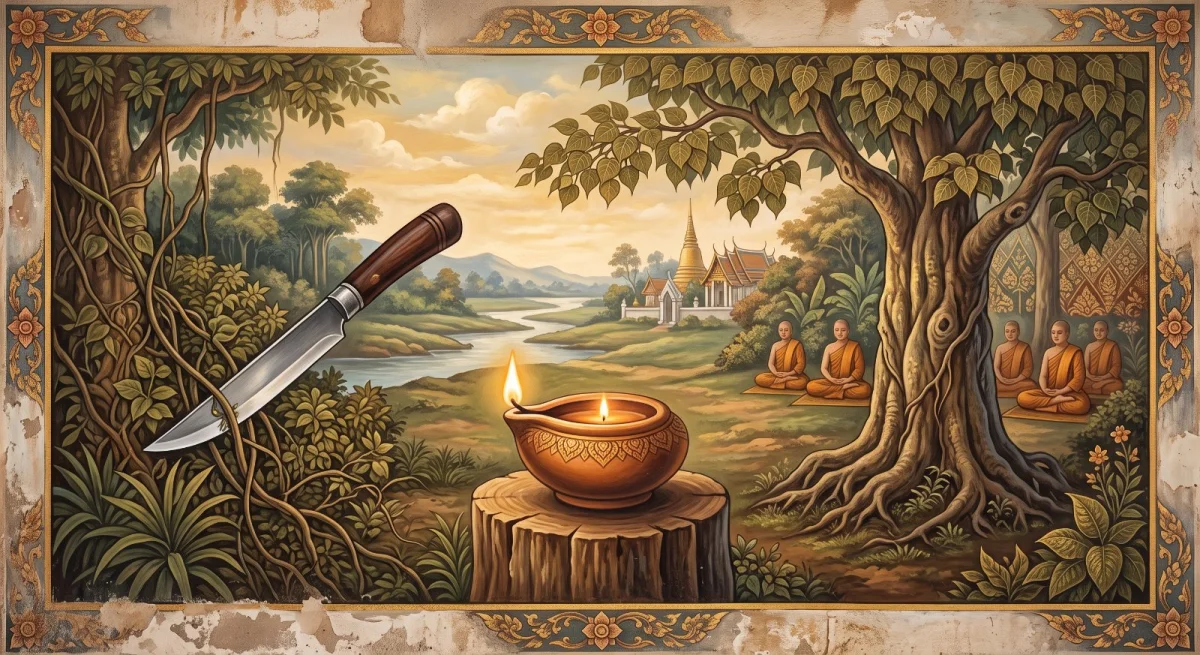
In a burning oil lamp, the oil is impermanent, the wick is impermanent, the flame is impermanent. Anyone who said its light is permanent would be wrong. Likewise, anyone who said the internal sense bases are impermanent but the feeling arising in dependence on them is permanent would be wrong, because feeling arises dependent on conditions, and when the conditions cease, the feeling ceases.
When you want a good feeling to last forever, remember it depends on conditions that are always changing. When the conditions change, the feeling must change too.
In a great tree with heartwood, the roots are impermanent, the trunk is impermanent, the branches and leaves are impermanent. Anyone who said its shadow is permanent would be wrong. Likewise, anyone who said the external sense bases are impermanent but the feeling arising in dependence on them is permanent would be wrong.
When you hope that what you get from possessions, positions or other people will last forever, think of a tree's shadow, which always shifts with the tree and the sunlight.
A skilled butcher uses a sharp knife to separate the inner flesh from the outer hide, cutting through the sinews and ligaments between, then drapes the hide back over. To say the cow is still joined to its hide as before would be wrong. Nandaka explains: the inner flesh stands for the internal sense bases, the outer hide for the external sense bases, the sinews and ligaments for delight and lust, and the sharp knife for noble wisdom that cuts through the defilements and fetters in between.
What binds you to things you like is not the things themselves but the delight in your mind. Notice that delight while scrolling, and use awareness to cut it gradually.
Nandaka ends with the seven factors of awakening — mindfulness, investigation of states, energy, rapture, tranquillity, concentration and equanimity — based on seclusion, dispassion and cessation, maturing in release. When developed and cultivated, they lead to the taintless liberation of mind and liberation by wisdom.
After seeing impermanence, don't stop at understanding. Train mindfulness, calm and balanced equanimity every day so that the understanding becomes stable.
After the first day, the Buddha says the nuns are like the moon on the fourteenth night, when people are unsure whether it is full, though it is still not full. So he has Nandaka give the same advice again. After the second day, he compares them to the moon on the fifteenth, which is full, and says that even the least advanced of the five hundred nuns is a stream-enterer, no longer bound for lower realms, and destined for awakening.
Choose one book or teaching important to your life and go back to read or hear it again. The second time you often see what you missed the first.
This discourse shows that teaching the same thing again is not a waste of time. On the first day the nuns delighted in the teaching, but their understanding was not yet complete. Hearing the same teaching again made it complete. Rereading or relistening to something important is very worthwhile.
Nandaka's teaching method is also worth learning. He doesn't lecture one-way but asks his listeners to answer for themselves, and makes room to admit not knowing. The three similes help us see that if the cause is impermanent, the feeling that arises from that cause cannot possibly be permanent.
Tap to read the actual passage on the page cited.
Seven inner treasures no thief can steal and no fire can burn — faith, virtue, moral shame, moral dread, learn…
Anuruddha's past life according to the Apadāna: seeing the Buddha Sumedha meditating in seclusion at the foot …

The Buddha asks Sāriputta what benefit a monk whose defilements are destroyed sees, that he still shows the ut…

The Buddha set out the procedure for reciting the Pātimokkha one issue at a time: abbreviated recitation only …