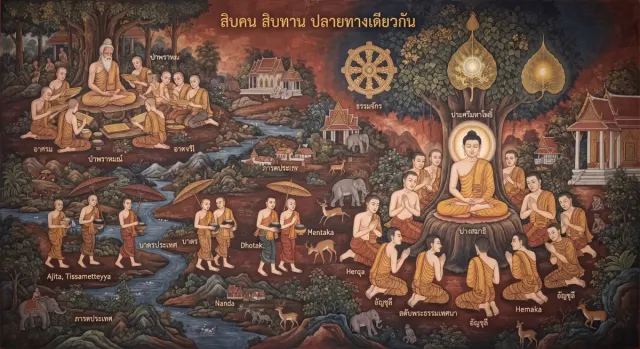
The Apadānas of Bāvarī's Pupils: Ten People, Ten Gifts, One Destination
MetteyyavaggoThe Metteyya vagga collects the apadānas of ten elders who had been pupils of the brahmin Bāvarī. Each recount…


Na diṭṭhiyā na sutiyā na ñāṇena
Nanda asks whom people call a sage: one with knowledge, or one with a strict way of life? The Buddha says it is not by view, learning or knowledge, but by defeating Māra's army, free of affliction and longing. The one who crosses the flood has let go of the belief that purity comes from things seen and heard, precepts and vows, or auspicious rites, and has fully understood craving.
The Niddesa is a canonical text in the Khuddaka Nikāya of the Sutta Piṭaka that explains suttas of the Sutta Nipāta word by word. In the Nandamāṇavapucchā Niddesa of the Cūḷaniddesa, it explains the question of the young brahmin Nanda in the Pārāyana Vagga. Nanda asks: people say there are sages in the world — do they call someone a sage for their knowledge, or for their way of life? The Buddha says the skilled do not call someone a sage because of view, learning or knowledge. Those who have routed the army and wander free of affliction and longing — they are sages.
Nanda asks further whether ascetics and brahmins who say purity comes through what is seen and heard, through precepts and vows, or through many kinds of auspicious rites, and who live restrained in that, have crossed birth and ageing. The Buddha says they have not. When asked who, then, has crossed, he says: I do not say that all ascetics and brahmins are shrouded by birth and ageing. Those who have abandoned what is seen, heard and sensed, all precepts and vows, and all the many auspicious rites, who have fully understood craving and are without taints — they have crossed the flood. Nanda rejoices in these words.
The Niddesa explains that the knowledge Nanda asks about is the knowledge of the eight attainments or the five higher knowledges, and the way of life is the striving of one who lives austerely doing extremely difficult practices. It expands the word "army" with the verses on Māra's army.
Nanda asks whether people call someone a sage for their knowledge or for their way of life. The Niddesa explains that knowledge here means the knowledge of the eight attainments or the five higher knowledges, and way of life means living austerely and doing many extremely difficult practices.
When praising someone as a good practitioner, look at their patience, lack of greed and honesty rather than special abilities or visible strictness.
The Buddha says the skilled do not call someone a sage because of view, learning or knowledge. The Niddesa explains: not because of purity through seeing, through hearing, or even through the knowledge of the eight attainments, nor through wrong knowledge. The skilled here are those skilled in the aggregates, elements, sense bases, dependent origination, the foundations of mindfulness, up to the path, fruit and nibbāna.
Knowing a lot of Dhamma or having good meditation experiences is valuable, but don't wear it as a badge of being above others.
The Buddha says a sage has routed the army and is free of affliction and longing. The Niddesa explains the army as Māra's army: misconduct of body, speech and mind, greed, hatred, delusion, anger, contempt, envy, stinginess, conceit, heedlessness and all defilements. It quotes the verses: sensual desire is the first army, discontent the second, hunger and thirst the third, craving the fourth, sloth and torpor the fifth, cowardice the sixth, doubt the seventh, contempt and stubbornness the eighth, along with gain, praise, honour and wrongly gained fame, and exalting oneself while disparaging others. The coward does not conquer it; the brave conquer it and find happiness.
Write down this list of armies and choose the one that shows up most often this week, such as cowardice or boredom, to watch for especially.
Nanda asks about ascetics and brahmins who say purity comes through what is seen and heard, through precepts and vows, or through many auspicious rites. The Niddesa explains these rites as observances and excitement over many kinds of things taken as auspicious. The Buddha says that even if they live restrained in their own views, they do not cross birth and ageing.
If you find yourself relying on auspicious times, amulets or rituals for peace of mind, ask further whether greed, anger and delusion in your mind have lessened at all, since that is what the discourse measures.
When Nanda asks who, then, can cross, the Buddha begins: I do not say that all ascetics and brahmins are shrouded by birth and ageing. The Niddesa explains that there are ascetics and brahmins who have completely abandoned birth, ageing and death.
When critiquing a belief or group, be careful with the word "everyone". Speak about the standard you are using rather than judging the whole group.
The Buddha speaks of those who have abandoned what is seen, heard and sensed, all precepts and vows, and all the many auspicious rites. The Niddesa explains that what is abandoned is purity through seeing, hearing, sensing, precepts and vows — that is, giving up taking these things themselves as purity and liberation.
Keep the precepts, but stop using them as a ruler to measure whether you are better than others. Use them as a tool for a calmer mind.
Those who have fully understood craving and are without taints have crossed the flood. The Niddesa explains full understanding in three stages: first, knowing "this is craving for forms, sounds, smells, tastes, touches or mental objects"; second, examining that craving as impermanent, suffering, like a disease, like a boil; third, abandoning, dispelling and ending that craving.
When you want something, try three beats: name which sense the wanting comes through, see that it is impermanent and oppressive, then gently put it down.
Today people often measure wisdom by degrees, the number of books read, hours of meditation, or how strict one's practice is. This discourse moves the measure to the mind: how much defilement is still left.
The Buddha's answer is also fair. He doesn't claim that no ascetic at all can cross, but gives a standard anyone can check. It is a model for critiquing beliefs without looking down on people.
The point about abandoning precepts and vows must be understood correctly. The Niddesa explains that what is abandoned is purity through precepts and vows — giving up the belief that precepts and vows by themselves make one pure. It is not an invitation to stop keeping the precepts.
Tap to read the actual passage on the page cited.
The Metteyya vagga collects the apadānas of ten elders who had been pupils of the brahmin Bāvarī. Each recount…

A brahmin who had followed the Saṅgha for two months without getting a turn to give a meal noticed what the re…

Venerable Seyyasaka offended so often that others constantly had to sort things out for him, so the Saṅgha pla…

The Buddha places a little dust on his fingernail and compares it with the great earth: beings who are born as…