
The Ocean and the Fisherman: The Sea of the Senses and Māra's Hooks
Cakkhu bhikkhave purisassa samuddoThe eye, ear, nose, tongue, body and mind are an ocean with waves, whirlpools and sea monsters; one who crosse…
7 points


A gift of the Dhamma, for learning and practice
Search, read, and study the complete Tipitaka — 15 editions in 12 languages, including Thai, Pāli and English, 45 volumes — with AI-generated summaries and illustrations for easy understanding.

What to study today?
สุเมธดาบสพิจารณาค้นหาธรรมบ่มโพธิญาณ พบบารมี 10 ประการ (ทาน ศีล เนกขัมมะ ปัญญา วิริยะ ขันติ สัจจะ อธิษฐาน เมตตา อุเบกขา) ทีละข้อพร้อมอุปมา แล…
Core teachings summarised from the Tipiṭaka, broken into numbered points with a way to apply each one in daily life.
The eye, ear, nose, tongue, body and mind are an ocean with waves, whirlpools and sea monsters; one who crosse…

A monk asks what ignorance is. The Buddha says it is not knowing as it really is that the five aggregates are …

Verses of five elders on gain, fame, praise and blame: praise is empty when your own mind is unsettled; fools …
Chants in everyday use, with the Pali, a pronunciation guide, a translation, when they are chanted, and where they come from in the Tipiṭaka

The passage that closes morning chanting: a review of dukkha, the impermanence of the five aggregates, and a r…
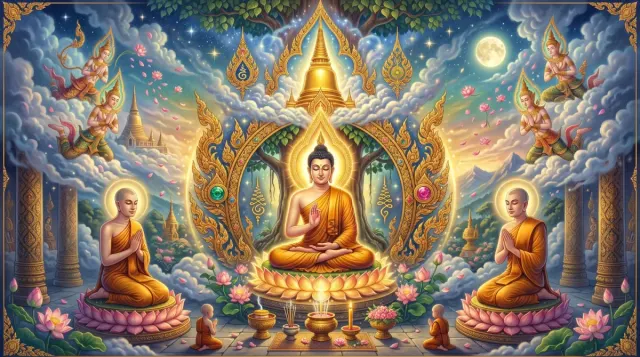
Four verses bowing to the Buddha, the Dhamma and the Saṅgha in images, then dedicating the merit of that homag…

The act of truth of a fledgling quail who could neither fly nor walk, speaking the plain truth to an oncoming …
Read any of 15 editions in 12 languages
The discipline and rules of conduct for monks and nuns (vols. 1–8)
The discourses: the Buddha’s teachings given to many different people (vols. 9–33)
The higher teaching: ultimate realities analysed in fine detail (vols. 34–45)
Thai
Thai
Thai
Pāli in Thai script
Pāli in Roman script
English
Deutsch
Русский
Srpski
Italiano
Lietuvių
Français
Português
日本語
Tiếng Việt
Click an image or clip to enlarge it, with a link to the related text.
Follow Buddhist observance days and holy days, and record your own precept keeping.
Log sitting meditation, walking meditation and chanting, and see your progress.
Join Dhamma practice activities and programmes with others.