
Suttas often chanted
Aciraṃ vatayaṃ kāyo — before long this body
Aciraṃ vatayaṃ kāyoA Dhammapada verse — before long this body will lie on the ground — chanted as a reflection for the living.


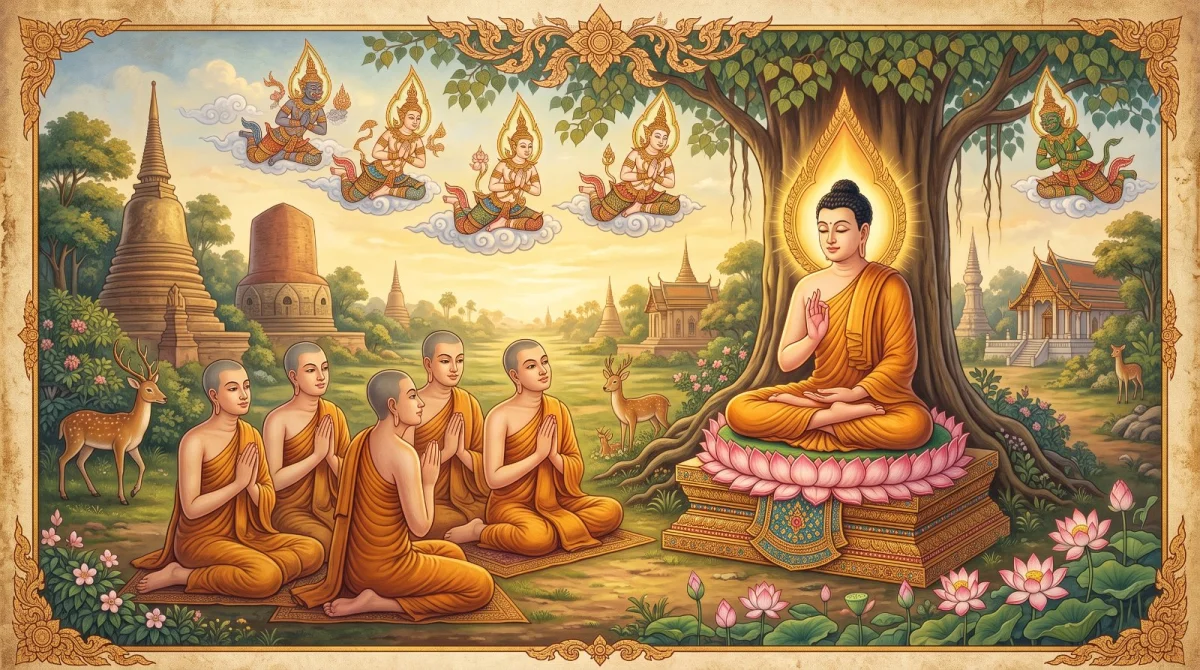
Anattalakkhaṇasuttaṃ
The Buddha's second teaching to the five monks: the five aggregates are not a self we can command, so they should not be taken as 'me' or 'mine'.
Usually chanted right after the Dhammacakkappavattana Sutta, especially on Āsāḷha Pūjā and other major Buddhist days.
Many people chant it at funerals or when facing a loss — not because it removes grief at once, but because it is a chance to review the fact that body and feeling were never under anyone's command.
It also works well before meditation, since it sets the mind to look at body and mind as they actually are.
Five days after the first teaching the Buddha spoke again to the five monks, this time taking up the five aggregates one by one: form, feeling, perception, formations and consciousness.
The reasoning is simple. If these were truly our self, they would not lead to affliction, and we could tell them: let it be like this, let it not be like that. But we cannot. So they are not self. He then asks whether what is impermanent is happiness or suffering, and whether something impermanent, painful and bound to change is fit to be regarded as 'this is mine, this I am, this is my self'.
This is not a claim that nobody is here or that life does not matter. It points out that most of our suffering comes from holding on, as ours, to what was never under our control. When the talk ended, all five monks were fully released.
Click to read the actual page it refers to
A Dhammapada verse — before long this body will lie on the ground — chanted as a reflection for the living.

The verses traditionally held to be the Buddha’s first utterance after awakening, comparing craving to a house…

The Buddha's third great teaching, given to a thousand former fire-worshippers at Gayāsīsa: eye, ear, nose, to…
The Buddha's first teaching to the five monks — the middle way and the four noble truths — chanted in full on …