
Daily chants
Inviting the monks to chant the parittas
ParittaparikammaThe words a lay person says to invite the monks to begin chanting the parittas at a house blessing or other me…


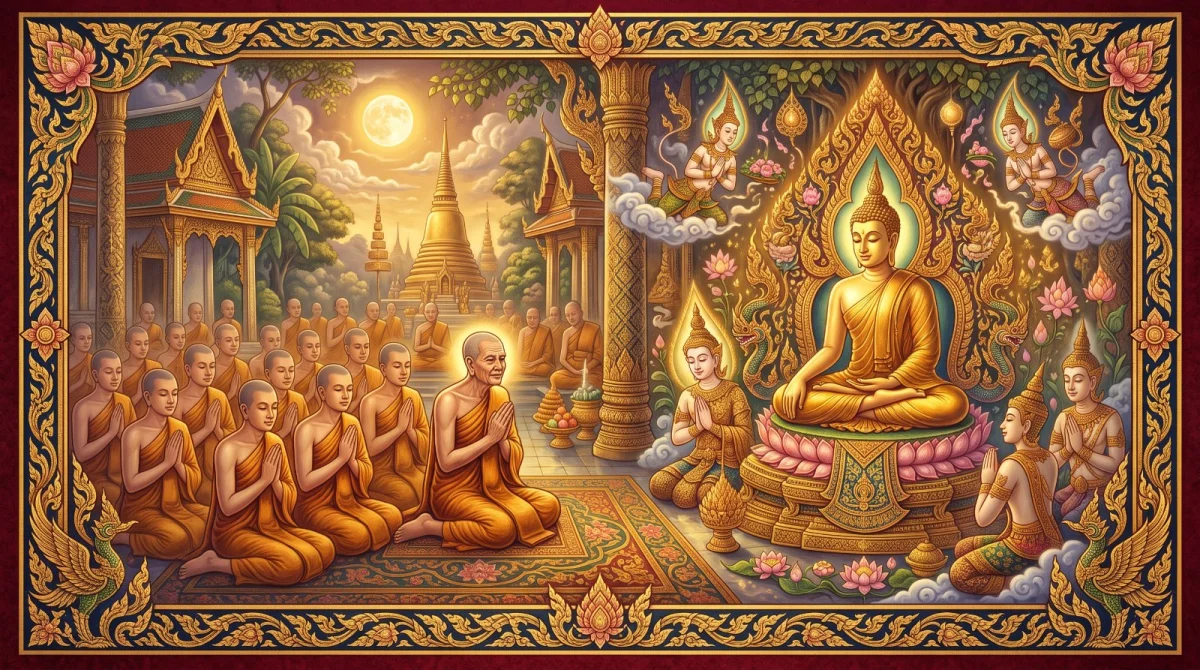
Dhammadesanāyācanā
The formula for asking a monk to give a Dhamma talk, recalling how Brahmā Sahampati asked the Buddha to teach.
Said just before a monk begins a talk — at a ceremony at home, at a temple, or on an observance day — spoken by someone on behalf of the listeners.
Once it is said, the listeners settle and pay attention, since the point of the formula is a request, and a request is only complete if the asker actually listens.
At a small or informal gathering it can simply be left out; nothing is broken by doing so.
After his awakening, the Buddha reflected that what he had understood was deep and ran against the grain of ordinary habit, and he hesitated to teach. The episode is recorded in the Mahāvagga of the Vinaya, volume 4.
The text says that Brahmā Sahampati, knowing this, came before him, raised his hands and asked him to teach, because there were beings with little dust in their eyes who would be lost without hearing it, and who would understand if they did.
The four-line verse used in ceremonies is a later composition summarising that scene rather than a canonical text, but its sense matches the sutta: please teach, out of compassion for those who are listening.
Click to read the actual page it refers to
The words a lay person says to invite the monks to begin chanting the parittas at a house blessing or other me…

Wishing well to oneself and to all beings — usually chanted to close a chanting session or after meditation.

The words for offering a meal to the Saṅgha at a service dedicated to parents and relatives who have died.

Spreading loving-kindness, compassion, gladness and equanimity to all beings — usually chanted to close a sess…