
The Great Forty: Concentration Supported by Seven Path Factors
MahācattārīsakasuttaṃNoble right concentration has the other seven path factors as its supports. In every factor right view leads, …


Sabbamatthītikathā
One side holds that everything exists, including the past that has ceased and the future not yet arisen. The Theravāda asks: if an arahant's past lust still exists, does the arahant still have lust? It then quotes the discourse that what has passed is called 'was', not 'is', and Venerable Nandaka's words that greed once existed, now it does not, and that is good.
In the Sabbamatthīti-kathā of the Kathāvatthu, Tipiṭaka volume 37, chapter 1, the opponent (paravādī) agrees that everything exists. The Theravādin (sakavādī) asks: does everything exist everywhere, at all times, in every way? Does even what does not exist exist? Then he asks directly: since the past has ceased, departed and changed, and the future has not yet arisen or appeared, how can they be said to exist?
The debate goes through the five aggregates one by one, through knowledge, and through the defilements that noble persons have abandoned. Towards the end, the opponent quotes the discourse that any form whatsoever, past, future or present, is called the form aggregate. The Theravādin quotes the discourse on the three pathways of language, the Buddha's reply to Venerable Phagguna, and Venerable Nandaka's words.
The next debates, the Atītakkhandhā-kathā and the Ekaccamatthīti-kathā, continue the same issue: if the past is an aggregate, must it also exist? And does some of the past, such as states that have not yet ripened, still exist? The commentary says the view that everything exists belonged to the Sabbatthivāda school, but the text itself speaks only of sakavādī and paravādī.
The opponent agrees that everything exists. The Theravādin asks further: does everything exist everywhere, at all times, in every way, in all things? Does even what does not exist exist? And does the view that this view is wrong also exist? The opponent says this should not be said. The word exists therefore needs to be pinned down: in what sense?
When you hear sweeping claims like 'everyone is like this' or 'anything is possible', ask back: everywhere, always, in every case? The statement becomes clearer at once.
The Theravādin asks: hasn't the past ceased, departed, changed and gone down? Then it should not be said that the past exists. Hasn't the future not yet arisen, not yet come to be, not yet appeared? Then it should not be said that the future exists. The present is what has arisen, has appeared and has not yet ceased. If past and future existed in the same way as the present, they would have to share the present's features, which cannot be accepted.
When your mind circles back to an old matter, tell yourself briefly: that has ceased. Then come back to what is happening in front of you.
The Theravādin asks: when present form ceases, does it give up being present? The opponent agrees, but not that it gives up being form. He compares this with a white cloth: when dyed, it gives up being white but not being cloth. He then asks: if form does not give up being form, is form permanent, lasting, unchanging like nibbāna? It is because form gives up being form that form is impermanent. This point is for overall understanding.
Labels we put on people, like 'hot-tempered', describe only a state at one time, and states change. Don't judge anyone by the state you saw on a single day.
The Theravādin asks: does an arahant's past lust exist? The opponent agrees. Then is the arahant lustful with that lust? The opponent cannot accept this. He asks the same about hatred, delusion, conceit, views and doubt, and on to the defilements abandoned by non-returners, once-returners and stream-enterers. If the past really still existed, abandoned defilements would still cling to the one who abandoned them.
If you used to be quick-tempered and have trained yourself to change, don't let anyone, including yourself, brand you as still quick-tempered. What has been abandoned is abandoned.
The Theravādin asks: if past knowledge exists, can one do the work of knowledge with it: fully understand suffering, abandon its origin, realise its cessation and develop the path with past knowledge? The opponent says no. Future knowledge cannot do it either. Only present knowledge does this work.
Knowledge you once learned or an intention to act someday helps nothing unless it is used now. Pick one thing you already know and apply it today.
The opponent quotes the discourse that any form whatsoever, past, future or present, is called the form aggregate, and concludes that past and future exist. The Theravādin quotes the discourse on three pathways of language, naming and designation: form that has passed and ceased is said to have been, not to be or to be going to be; form not yet arisen is said to be going to be; form that has arisen and appeared is said to be. Wise ascetics and brahmins do not reject these three pathways.
Watch the language you use about yourself. 'I made a mistake' and 'I am a failure' are different sentences. The first speaks of something that was; the second turns it into something that always is.
The Theravādin quotes Venerable Nandaka: greed existed before, that was bad; now that greed does not exist, that is good. The same is said of hatred and delusion. He also quotes the Buddha's reply to Venerable Phagguna that the eye or mind by which one could describe past Buddhas who have attained final nibbāna does not exist at all.
When you look back and see anger or greed you once had, acknowledge that it was there and was bad, then be glad it no longer exists, rather than blaming yourself again.
In the Ekaccamatthīti-kathā, one side holds that some of the past exists and some does not: past states that have not yet ripened exist, while those that have ripened do not. The Theravādin asks: haven't those unripened states also ceased? That side agrees, so it should not be said that they still exist. Applying the same logic to the future would mean calling what will arise present because it will arise, which cannot be accepted.
The results of kamma can follow without the old deed lingering in front of you. What you can do now is create good new causes, not keep watching old ones.
This debate is closer to home than it seems. Many people carry past mistakes or anger as if they were still right in front of them. The Theravāda quotes Venerable Nandaka: greed existed before, that was bad; now it does not, that is good. What once arose can be called something that was, but need not be counted as still existing now.
Likewise, the future we worry about has not yet arisen. Planning is good, but suffering over the future as if it had already arrived is suffering over something that has not appeared.
Still, that the past no longer exists does not mean it has no effect. Deeds done still bear fruit according to conditions. So take responsibility for what you have done, but don't drown in it.
Tap to read the actual passage on the page cited.
Noble right concentration has the other seven path factors as its supports. In every factor right view leads, …

After awakening, the Buddha inclines not to teach, since the Dhamma is deep and people delight in attachment. …

Mahānāma the Sakyan asks how a wise lay follower should comfort another wise lay follower who is gravely ill. …
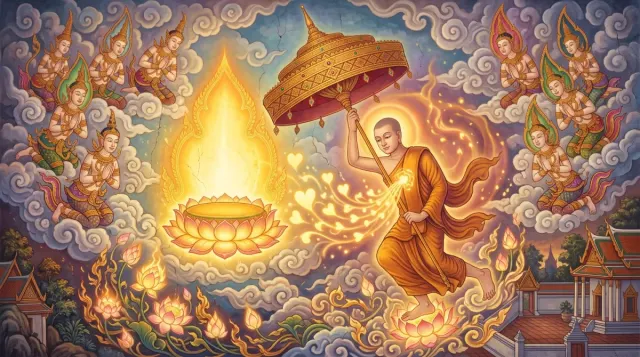
Ānanda's past life according to the Apadāna: he climbed down from an elephant to hold a parasol over the Buddh…