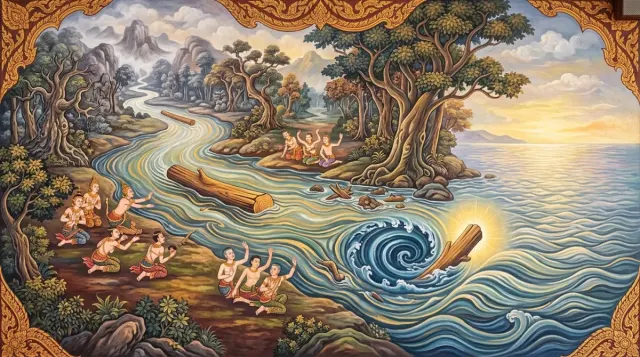
The Log Discourse: A Log Floating to the Sea
DārukkhandhasuttaṃA log carried down the Ganges will reach the sea if it doesn't catch on either bank, sink midstream, run agrou…


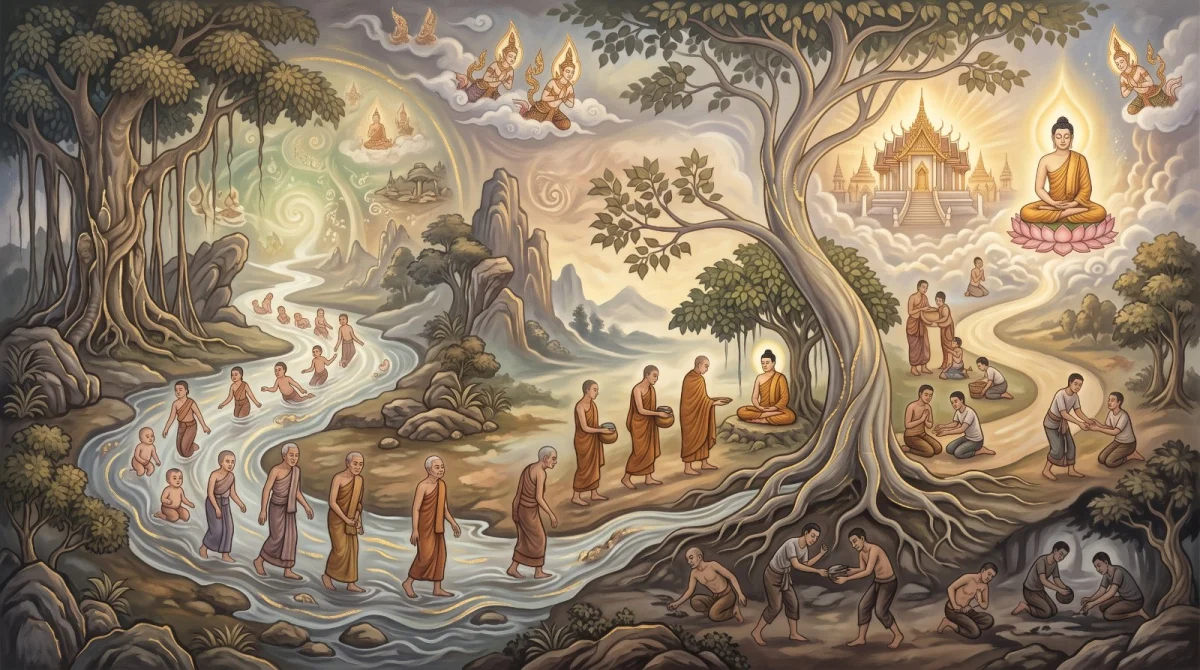
Puggalo sandhāvati asmā lokā paraṃ lokaṃ
Two sections of the Debate on the Person. One side holds that there is a person who journeys from this world to the next, and a doer and experiencer of kamma found in the ultimate sense. The Theravāda asks whether the one who goes is the same person or another: if exactly the same, there would be no death; if cut off, that is the annihilationist view. Yet kamma and its results truly exist.
In the Debate on the Person (Puggalakathā) of the Kathāvatthu, Tipiṭaka volume 37, chapter 1, two sections follow the main question of whether a person is found in the ultimate sense. The first, the Inquiry into Destinations (Gati-anuyoga), has the opponent (paravādī) agree that a person journeys from this world to the other world and from the other world to this one. The Theravādin (sakavādī) asks further: is the one who journeys the very same person, another person, both, or neither? The opponent cannot accept any of these.
The opponent quotes discourses, such as that a person journeys on at most seven times and then makes an end of suffering, and that saṃsāra has no discoverable beginning. The Theravādin accepts that these discourses exist, but points out that if the same person went on without becoming other at all, there would be no death. The section closes with a verse: if the person breaks up along with the aggregates, that is the annihilationist view; if not, the person would be permanent, equal to nibbāna.
The second section, the Good-and-Bad Chapter (Kalyāṇavagga), has the opponent hold that since good and bad kamma are found, a doer and an experiencer of results must also be found. The Theravādin asks in return: then must a maker of that person also be found? This would go on without end. The text itself speaks only of sakavādī and paravādī and names no school.
One side agrees that a person journeys from this world to the other. The Theravādin asks: does that very person journey, or another person, or both that person and another, or neither? The proposer cannot accept any of these, because each answer leads to a contradiction.
When you think of your past self who made mistakes, see it as a continuing stream: not a fixed self, and not someone else unconnected to you.
The opponent quotes the saying that a person journeys on seven times at most and then makes an end of suffering by destroying all fetters, and the saying that the journeying of beings hindered by ignorance and fettered by craving has no discoverable beginning, and concludes that a person really journeys on. The Theravādin accepts that these discourses exist; the issue is how the word person in them should be understood.
When reading teachings in ordinary language, such as that someone was reborn somewhere, understand it as language for communicating. Not every word has to be read as a philosophical definition.
The Theravādin asks whether someone who was human becomes a deva. The opponent agrees. Then is the human the very same as the deva? He points out that if that very person moved from this world to another without becoming other at all, there would be no death, and even killing could not be found. But kamma exists, its results exist, and wholesome and unwholesome deeds still bear fruit. He asks the same about social classes, and whether someone missing a hand must be reborn missing a hand.
If someone says they have been like this since birth and will always be so, recall that even within one life, body, thoughts and roles keep changing with conditions.
The opponent argues that a stream-enterer who passes from the human world and arises in a heavenly world is still a stream-enterer there, which shows that the same person journeys on. The Theravādin asks in return: do you also hold that after arising in the heavenly world he is still a human? That a quality carries over does not mean everything stays the same.
What you develop inside, such as honesty or understanding of the Dhamma, carries over even when outward status changes. Invest in this more than in image.
The Theravādin asks further: if the same person journeys on, does he go with form or without form; does form go or not go? One answer makes the soul and the body the same; the other makes the soul one thing and the body another. The section concludes: if the person breaks up when the aggregates break up, that is the annihilationist view the Buddha rejected; if the person does not break up when the aggregates break up, the person would be permanent, equal to nibbāna. This point is for overall understanding.
When facing a major change, you need not choose between thinking everything has ended meaninglessly and thinking nothing has changed. What was done continues to have effects, even as its form changes.
In the Good-and-Bad Chapter, the opponent holds that since good and bad kamma are found, a doer and maker of that kamma must be found. The Theravādin asks: then must a maker of that person also be found? If so, there must be yet another maker, and there would be no making an end of suffering. He also compares: because the great earth, the ocean, Mount Sineru, water, fire, wind, grass and trees are seen, must their maker be seen too? The same question is applied to the experiencer of results, of heavenly happiness, of human happiness, and of suffering in the lower realms and in hell.
When a problem arises, ask which causes and conditions produced it, rather than rushing to find one person to blame and stopping there. Causes often have more layers than we think.
The Theravādin asks: if a doer and an experiencer are found, does the one who does it experience it himself? If so, pleasure and pain are self-made. If another does it and another experiences it, pleasure and pain are made by another. Accepting both, or rejecting both, gets stuck in yet other ways. The opponent cannot accept these conclusions. Read with the rest of the Debate on the Person, the Theravāda sees kamma and its results as proceeding by causes and conditions, and speaks of doer and receiver in everyday language. This point is for overall understanding.
When facing the results of what has happened, don't blame only yourself or only others. Look at your own actions, the surrounding conditions, and what can be changed from here.
The question of whether the one reborn is the same person or another seems remote, but we can ask the same thing about ourselves ten years ago. The person who made a mistake back then is not exactly the same, yet not a stranger unconnected to us either. What was done then really has effects today.
This debate guards against two ways of thinking. The first is that we are a fixed self that never changes, which keeps us stuck in an old image of ourselves. The second is that no one is connected to the deed, which lets us shrug off responsibility. Neither fits the Theravāda affirmation that kamma exists and its results exist.
In practice, take full responsibility for your actions, and give yourself full room to change as well.
Tap to read the actual passage on the page cited.
A log carried down the Ganges will reach the sea if it doesn't catch on either bank, sink midstream, run agrou…
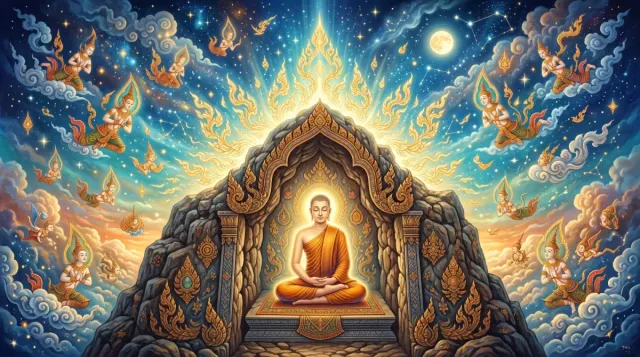
Udāyī asks Ānanda about the god Pañcālacaṇḍa's verse saying the Buddha found the opening in the confinement. Ā…
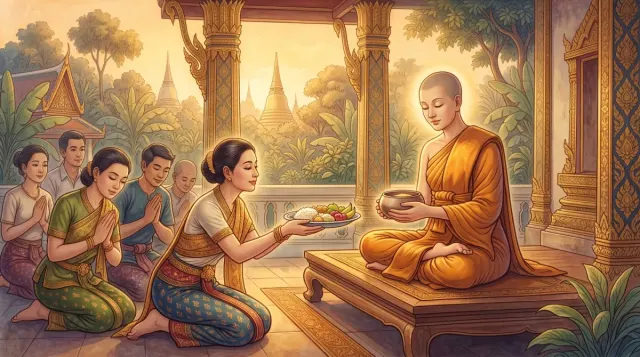
Bowls stored up until people asked whether they were opening a pottery shop; out-of-season cloth declared in-s…
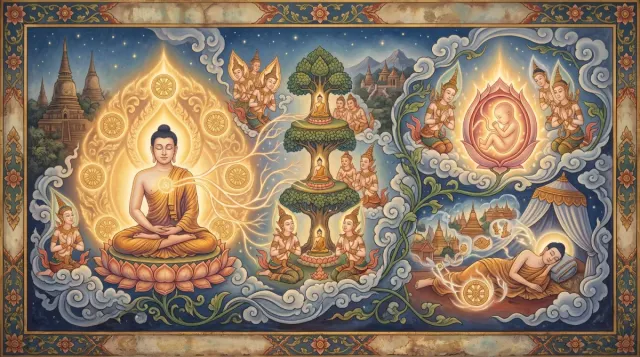
A group of debates in chapter 22 asking whether a being in the womb can realise the Dhamma or attain arahantsh…