
The Treatise on Breathing: The Breath Grows Subtle Like a Fading Gong
ĀnāpānakathāThe Paṭisambhidāmagga explains in detail that as you know the long and short breath, desire and gladness make …


Kathāvatthu
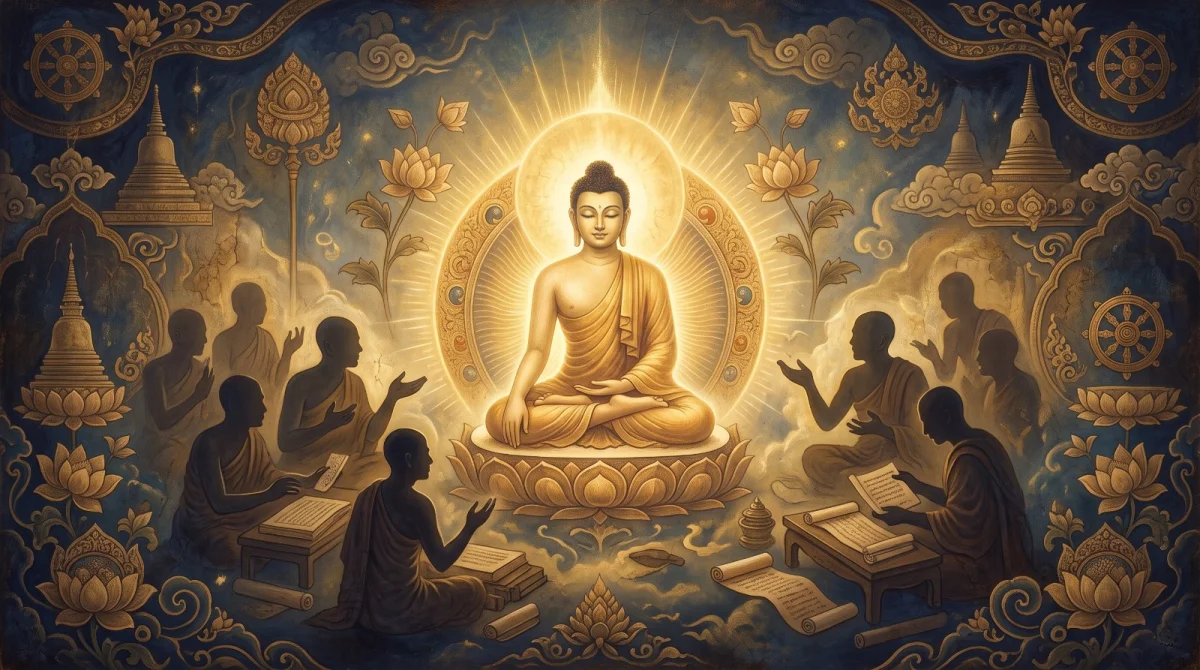
The Kathāvatthu records debates that clear up mistaken views one point at a time. Its first debate asks whether a "person" is found in the ultimate sense, then questions step by step until it becomes clear that a person is a designation based on the aggregates.
The Kathāvatthu is the fifth of the seven Abhidhamma books — Dhammasaṅgaṇī, Vibhaṅga, Dhātukathā, Puggalapaññatti, Kathāvatthu, Yamaka and Paṭṭhāna — and fills volume 37 of the Tipiṭaka. It consists of debates between the Sakavādī (our own side, the Theravāda) and the Paravādī (the side holding a different view), arranged in 23 chapters and covering many topics, such as the person, whether an arahant can fall away, past and future, kamma and realms of existence.
According to the commentary and tradition, the Kathāvatthu is linked to the Third Council in the time of King Asoka, when the Elder Moggaliputta Tissa expounded its headings to clear away the mistaken views of that time. The commentary also names the school holding each view — for example, the view that a person exists in the ultimate sense is attributed to the Vajjiputtakas and Sammitiyas. These details come from the commentary, not from the book itself.
The first debate, the Puggalakathā, is long and serves as the model for the method of the whole book. The Sakavādī asks whether the person is found as a real and ultimate fact (saccikaṭṭha-paramattha), then questions step by step to show that the answers contradict one another. At the end both sides cite discourses; the Sakavādī quotes the verse of the nun Vajirā that when the aggregates are present, the convention "a being" is used.
This page is for overall understanding of the book and does not reproduce every step of the debate.
The Sakavādī opens by asking whether the person is found as a real and ultimate fact. The Paravādī agrees, but when asked further whether the person is found in the same way that real, ultimate things are found, he replies that this should not be said. This mismatch is the starting point of the debate.
Before arguing about anything, agree on what key words such as "fair" or "wrong" mean in this conversation.
The questioner points out that if one accepts the first statement, one must accept the second; accepting one while denying the other is wrong. This is called a refutation (niggaha). The book then lets the other side turn the same form of argument back, called a counter-refutation (paṭikamma), and concludes whether each refutation was well or badly made. This pattern repeats through the eight refutations at the start of the Puggalakathā.
Before pointing out that someone contradicts themselves, apply the same test to your own view.
The following refutations ask: if the person is found in the ultimate sense, is the person found everywhere, at all times, in all phenomena? The Paravādī says this should not be said, and is shown to be inconsistent with what he first accepted. This point is for overall understanding.
When you hear a sweeping claim, ask, "Is it true in every case? At every time?" The limits of the claim will become clearer.
The Sakavādī asks: if the person is found in the ultimate sense just as form is, is form one thing and the person another? The Paravādī will not accept this. The same question is then put for feeling, perception, formations, consciousness, the sense bases, the elements and the faculties. In the same section, the Paravādī also asks back, citing the Buddha's words that there exists a person who practises for his own welfare.
When you say "me", ask whether you mean the body, feelings, memories or thoughts. You will find it hard to locate a self separate from these.
The Paravādī accepts that the person is designated in dependence on form, and on consciousness. The Sakavādī then asks: is a blue person designated in dependence on blue form? And since consciousness is impermanent, conditioned and dependently arisen, is the person too impermanent and conditioned? The Paravādī does not accept this.
A job title or role others call us by is a name placed on something always changing. When those names change, the mind need not be shaken with them.
At the end, the Paravādī cites discourses such as "one person, arising in the world, arises for the welfare of many". The Sakavādī replies with discourses such as "all phenomena are non-self", and the verse of the nun Vajirā to Māra: this is a mere heap of formations, no being is found here; just as the word "chariot" is used when the parts are assembled, so when the aggregates are present, the convention "a being" is used.
Use "I" and "they" as normal, but when you feel angry at being slighted, picture the chariot that is only an assembly of parts.
What we can take from the Kathāvatthu is not a way of beating others in argument but a habit of checking that our own thinking is consistent. If we accept one point, we should see what other points it leads to, and whether we can accept those too.
In everyday conversation, especially online, we often argue because we use the same word with different meanings. Asking clearly what a word means, and whether a claim holds everywhere and at all times, can calm a discussion a great deal.
That "person" is a conventional term does not mean people have no responsibility or that we needn't care for one another. We can say "I" and "you" as usual. But when we suffer because our sense of self feels attacked, seeing that what we call ourselves is made of changing parts helps the mind loosen its grip.
Tap to read the actual passage on the page cited.
The Paṭisambhidāmagga explains in detail that as you know the long and short breath, desire and gladness make …

The Mahāniddesa's explanation of the Duṭṭhaṭṭhaka Sutta: there are two ways a person gets drawn into an accusa…
After the Kosambī monks refused to stop quarrelling, the Buddha visited Anuruddha and his companions, who perc…

Three marks of everything conditioned — its arising is evident, its passing is evident, and while it persists …