
The Treatise on Breathing: The Breath Grows Subtle Like a Fading Gong
ĀnāpānakathāThe Paṭisambhidāmagga explains in detail that as you know the long and short breath, desire and gladness make …


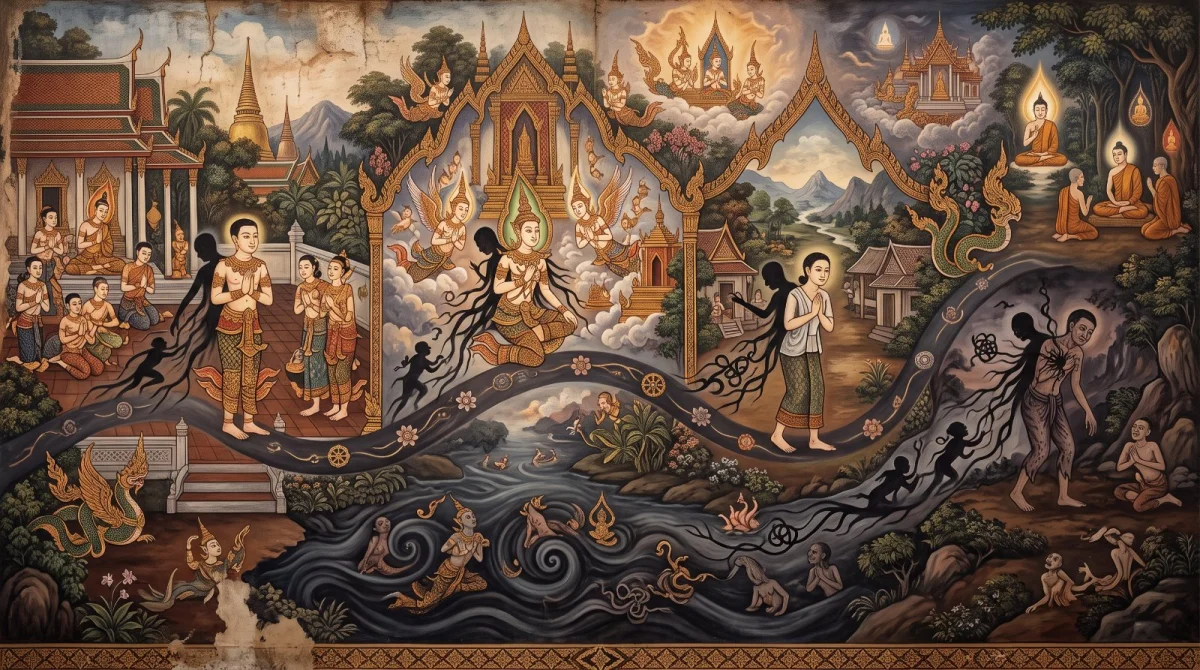
Anusayā bhaṅgā natthi
At the end of the Latent Tendencies Pairs, the text asks: when someone passes away from one realm and is reborn in another, how many latent tendencies lie latent and how many have been dissolved? The answer is seven, five or three depending on the person, and none is dissolved by changing realms. What abandons them is the path, not rebirth in a better place.
In the Anusaya-yamaka (Pairs on the Latent Tendencies) of the Yamaka, Abhidhamma Piṭaka volume 38, after many sections on the tendencies lying latent, on having them, and on abandoning them, there is a section on full understanding (pariññāvāra), asking whether one who fully understands one tendency also fully understands another. The last section of the volume is the realms section (dhātuvāra), which this page focuses on.
The realms section switches from paired questions to counting questions: for someone who passes away from the sense realm, the fine-material realm or the immaterial realm and is reborn in a given realm, how many tendencies lie latent, how many do not, and how many have been dissolved?
Almost every answer in the realms section ends the same way: no latent tendencies have been dissolved. This short phrase says something important. Dying and being reborn, even in a more refined realm, does not remove a single latent tendency.
This point is for overall understanding. The seven tendencies, where they lie and the order in which they are abandoned are covered on the site's earlier page on this section; this page picks only answers not discussed there.
The full-understanding section asks: does one who fully understands the latent tendency to views also fully understand the latent tendency to doubt? Yes, and yes in reverse. Sensual lust and aversion are answered yes both ways, and conceit, lust for existence and ignorance are all answered yes with one another. The text's own answers thus divide the seven into three groups: views and doubt; sensual lust and aversion; conceit, lust for existence and ignorance.
When working on a bad habit, look at what it comes grouped with — irritation and wanting often rise and fall together. Seeing the group saves you from chasing each point separately.
Asked whether one who fully understands the latent tendency to sensual lust also fully understands the latent tendency to conceit, the text answers neither yes nor no. It says one fully understands the defilement that has the same basis as that tendency — that is, only the part of conceit that shares a basis with sensual lust, not all conceit.
Progress is sometimes partial: you may stop getting angry at home yet still get angry on the road. Acknowledge partial progress honestly instead of waiting for the whole thing to go before it counts.
The realms section first sets out all its questions: for one who passes away from the sense realm and is reborn in the sense realm, the fine-material realm, the immaterial realm, or in realms that are not one of these, how many tendencies lie latent, how many do not, and how many have been dissolved? It goes through every possible route, then answers each one.
Before changing jobs or moving house, list clearly which habits will come with you, instead of asking vaguely whether the new place will be better.
The answer: for one who passes from the sense realm to the fine-material or immaterial realm, some have seven tendencies lying latent, some five, some three. Compared with the groups in the full-understanding section, seven means no group has been abandoned; five means views and doubt are gone; three means sensual lust and aversion are gone as well, leaving conceit, lust for existence and ignorance.
People in the same place may carry very different loads in their minds. Don't judge anyone's inner progress by where they happen to be.
For one who passes from the sense realm and is reborn in the sense realm again, the text says only that some have seven and some five. No one has just three. This fits the meaning of the word anāgāmī, "non-returner": one who has abandoned sensual lust and aversion is not reborn in the sense realm.
What is truly abandoned changes the road ahead. If you want to know whether you have let something go, see whether it still leads you back to the same place.
For one who passes from the fine-material realm to the sense realm, the text says only the seven lie latent. For one who passes from the immaterial realm, it says there is no rebirth in the fine-material realm; being reborn lower, one reaches only the sense realm, with all seven lying latent. Those who come down from a higher realm to the sense realm are thus those who have abandoned no tendency, even though they once lived in a refined realm.
The calm you get from a good environment, such as a quiet retreat, does not guarantee that your mind won't return to its old state once you are back in ordinary life.
The answer repeated throughout the realms section is that no latent tendencies have been dissolved, whatever realm one passes from and wherever one is reborn. Even more refined realms such as the fine-material or immaterial realm do not remove a single one. What abandons the tendencies, as the earlier sections show, is the path.
Changing your surroundings — moving house, changing jobs, keeping away from certain people — can help. But without training the mind directly, old habits tend to come along.
A common belief is that if we could only be somewhere better, our minds would improve by themselves. The realms section answers this at the level of rebirth: even reborn in a more refined realm, not one latent tendency is dissolved.
In daily life a good environment really does reduce triggers — staying away from people who draw us into quarrels, or deleting apps that make us want things. But reducing triggers is not pulling out the root. Meet the old trigger again and the old habit returns.
The encouraging part is that the text also counts people with five or three tendencies left. Real abandoning is possible, and what the path has abandoned does not lie latent again, wherever one is reborn.
Tap to read the actual passage on the page cited.
The Paṭisambhidāmagga explains in detail that as you know the long and short breath, desire and gladness make …

A group of debates at the end of chapter 13 asks whether one in jhāna can relish that jhāna at the same moment…

For one without sensual desire or craving, who has crossed over doubt, there is no further liberation to seek.…

The nun Thullanandā taught the Dhamma so well that King Pasenadi of Kosala invited her to ask for anything, an…