
Verses of Mahākassapa: The Happiness of Having Little and Staying Away from Praise
MahākassapattheragāthāMahākassapa's forty verses: not mingling with crowds, seeing homage and veneration as a bog, eating food from …


Nānāvihārehi viharataṃ kena vihārena
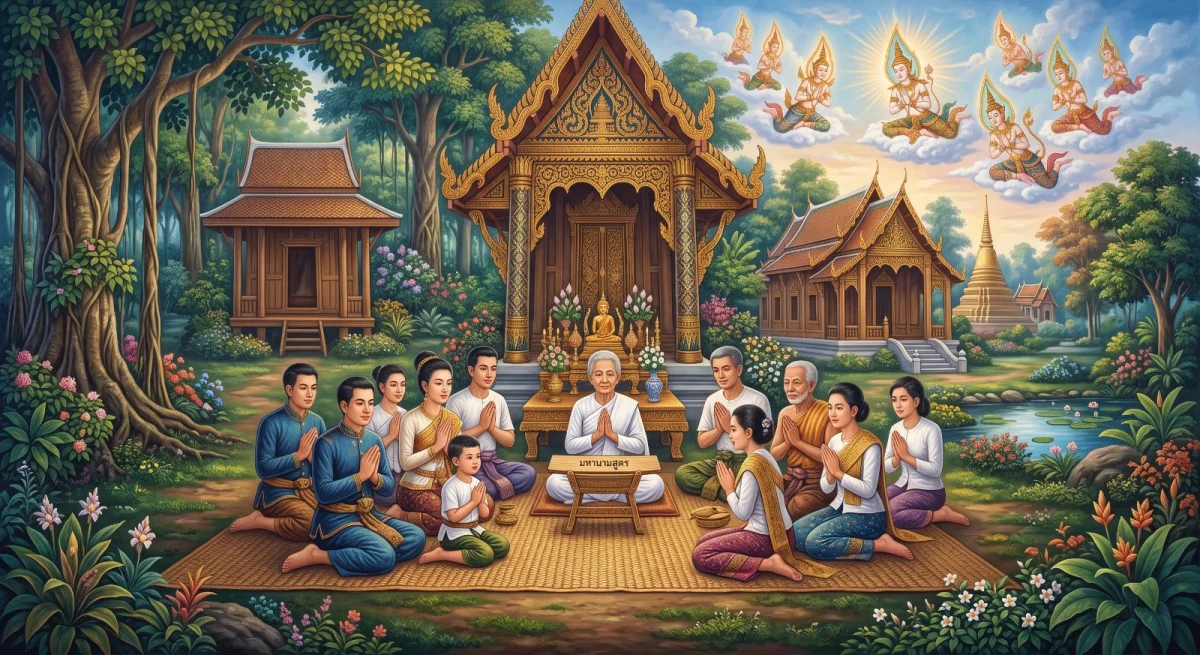
Hearing that the Buddha will soon set out wandering, Mahānāma asks how a householder with many kinds of duties should live. The Buddha tells him to stand on five qualities and develop six recollections — while walking, standing, sitting, lying down, working, and even at home in a bed crowded with children.
In the first Mahānāma Sutta of the Aṅguttara Nikāya, Book of the Elevens, many monks are making robes for the Buddha, since after three months he will set out wandering. Mahānāma the Sakyan hears the news and goes to ask: we who live in various ways — how should we live?
The Buddha says that one who has faith, energy, established mindfulness, a concentrated mind and wisdom succeeds. Standing on these five qualities, one should further develop six: recollecting the Buddha, the Dhamma, the Saṅgha, one's own virtue, one's own generosity, and the deities.
Each recollection ends with the same passage: while recollecting, the mind is not overcome by greed, hatred or delusion; it becomes upright, finds inspiration in the meaning and in the Dhamma, and gains joy connected with the Dhamma. From joy comes rapture, the body becomes tranquil, one feels happiness, and the mind becomes concentrated. Such a person lives at peace among those who are not at peace, and without ill will among those with ill will.
In the second Mahānāma Sutta that follows, when Mahānāma has just recovered from illness, the Buddha gives the same teaching and adds that these recollections can be developed in every posture.
One who has faith succeeds, one without faith does not. One who is energetic, mindful, concentrated and wise succeeds, while one who is lazy, unmindful, unconcentrated or unwise does not. These five are the ground before developing the recollections.
Before training the mind, ask yourself briefly: do I trust this path, do I have the energy for it, and am I ready to be aware?
Recollect his qualities: the Blessed One is an arahant, perfectly self-awakened, accomplished in knowledge and conduct, and so on, up to awakened and blessed. At that time the mind becomes upright; this is recollection of the Buddha.
When you feel discouraged, remember that someone has walked this path to its end, and the path is still open.
Recollect that the Dhamma is well taught by the Blessed One, visible here and now, immediately effective, inviting inspection, relevant, to be known personally by the wise.
Bring to mind one teaching you have actually used with real results. The confidence that comes from direct experience is recollection of the Dhamma.
Recollect that the Saṅgha of the Blessed One's disciples practises well, directly, methodically and properly — the four pairs, the eight individuals — an incomparable field of merit for the world.
Think of people you have actually met who practise well. The heart warms to know such goodness exists in the world.
Recollect your own virtue: unbroken, untorn, unblemished, unspotted, liberating, praised by the wise, not grasped by craving and views, and leading to concentration.
When the mind is in turmoil, think of what you have kept well — for example, not having lied to anyone in a long time. Having nothing to hide makes it easy for the mind to settle.
Recollect: it is my fortune that I live at home with a mind free of the stain of stinginess among people overcome by it, freely generous, with open hands, delighting in giving up and in sharing.
Think of the last time you gave something without expecting anything back. That contentment can serve as a resting place for the mind.
Recollect that there are deities of various realms, and that the faith, virtue, learning, generosity and wisdom by which they were reborn there are also found in oneself. One recollects these qualities in oneself and in those deities.
The core of this point is seeing the good qualities in yourself, whatever you believe about deities. Ask which of your qualities you can be quietly glad of.
In the second Mahānāma Sutta the Buddha says each of these recollections may be developed while walking, standing, sitting or lying down, while working, and even while living at home in a bed crowded with children.
Pick one recollection and tie it to a routine — for example, walking to the bus, or rocking your child to sleep.
Mahānāma's question is a modern one too: when you aren't near a teacher or a monastery, and life is full of work, family and many kinds of duties, how do you look after the mind?
The answer isn't to run away to a quiet place, but to have anchors for the mind that you can carry anywhere. The six recollections bring to mind good things, both outside you and in your own conduct, so the mind has somewhere clear to rest.
The most encouraging line is at the end of the second discourse: this can be done while working, or even in a bed crowded with children. Meditation doesn't have to wait until life becomes free.
Tap to read the actual passage on the page cited.
Mahākassapa's forty verses: not mingling with crowds, seeing homage and veneration as a bog, eating food from …

Four floods that sweep beings along in saṁsāra — and the very first answer in the Saṁyutta Nikāya on how to cr…

When the monk Gagga, who had a mental illness, sometimes remembered the observance day and sometimes did not, …
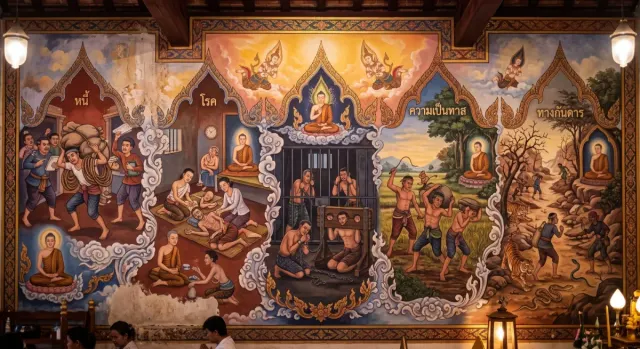
The Buddha compares a mind still holding the five hindrances to a debtor, a gravely ill man, a prisoner, a sla…