
The Bad Principles Discourse: Right and Wrong, Beneficial and Harmful, and Asking at the Source
Adhammo ca bhikkhave veditabbo dhammo caThe Buddha gives a brief outline: one should know what is contrary to the Dhamma and what accords with it, wha…


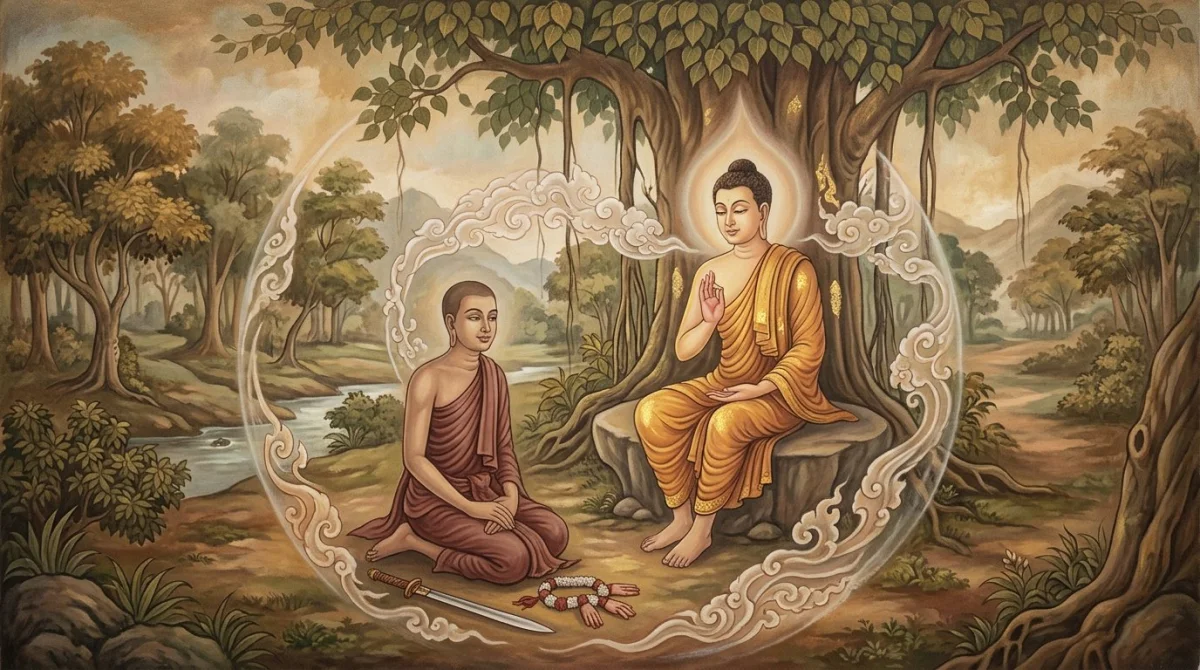
Aṅgulimālasuttaṃ
A bandit who had killed many turned around and reached awakening — "I have stopped, Aṅgulimāla; you stop too." Proof in the Tipiṭaka that no one is beyond change, though the results of past deeds must still be borne.
In the Aṅgulimāla Sutta of the Majjhima Nikāya, Aṅgulimāla was a bandit who killed people and wore their fingers as a garland. One day the Buddha walked along the road where he lived, despite people's warnings. Aṅgulimāla ran after him with all his strength but couldn't catch up, and shouted, "Stop, ascetic!" The Buddha replied, "I have stopped, Aṅgulimāla; you stop too," explaining that he had laid down violence toward all beings, while Aṅgulimāla was still unrestrained toward them.
Aṅgulimāla threw away his weapons and asked to go forth. Later King Pasenadi came with an army to capture the bandit, only to find he had become a peaceful monk.
After ordaining, Aṅgulimāla helped a woman in a difficult childbirth by an act of truth: "Since I was born with the noble birth, I do not recall intentionally depriving any living being of life" — the origin of the Aṅgulimāla protective verse. He later attained arahantship, but people still threw things at him until his head was cut. The Buddha told him to endure: he was experiencing in this life the result of deeds for which he might otherwise have suffered in hell for a very long time.
The Buddha had stopped in the sense of laying down violence toward all beings. Aṅgulimāla, though running, hadn't stopped, because he was still harming beings.
Ask yourself what habit you "haven't stopped" though you know it hurts you or others. Stopping can begin today.
Once he understood, Aṅgulimāla threw his sword and weapons into a chasm and asked to go forth immediately, without waiting to be ready or for the right time.
Important change often starts by "throwing away one weapon" — deleting the number of someone who leads you astray, or pouring out the bottle.
Aṅgulimāla helped a woman in a difficult birth by speaking the truth: since his noble birth — his ordination — he had not intentionally taken any life; by this truth, may she and her child be well.
A reformed person's new life counts from the day they changed. Respect that intention, in yourself and in others.
Even after attaining arahantship, he was attacked and injured. The Buddha told him to endure, as he was experiencing the result now rather than a heavier one later.
When you must bear the consequences of old wrongs, such as people not trusting you, bear them patiently and prove yourself through action, without demanding that people forget.
Whoever was once heedless and later is heedful, whoever covers the evil they did with good, lights up the world like the moon freed from clouds.
Don't judge anyone by their past alone — and don't judge yourself that way either. The good done from now on truly shines.
This story gives two lessons that must go together. First, no one is too late to stop and change. However grave past wrongs, stopping today truly changes the direction of a life. Read alongside "The Salt Crystal Discourse".
Second, changing doesn't erase the results of what was done. Aṅgulimāla still bore the consequences, and bore them patiently. Genuine reform therefore includes accepting what follows, not asking everyone to forget.
Tap to read the actual passage on the page cited.
The Buddha gives a brief outline: one should know what is contrary to the Dhamma and what accords with it, wha…

The Paṭisambhidāmagga describes wrong view as grasping things as "this is mine, this I am, this is my self", a…

The goddess of misfortune and the goddess of good fortune ask to stay at the house of a virtuous merchant, eac…

Ten paths of good conduct covering body, speech and mind — finer-grained than the five precepts, because it in…