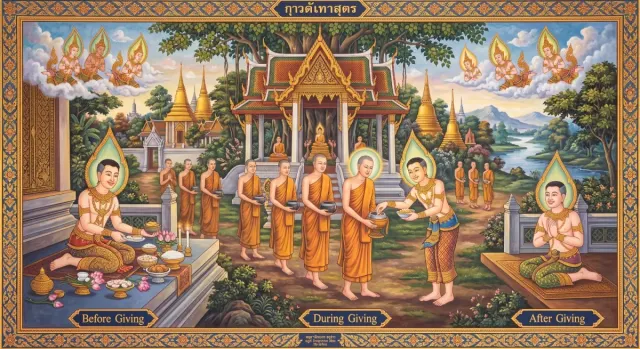
The Kūṭadanta Sutta: Giving Without Regret Before, During and After
Tividhā yaññasampadā soḷasaparikkhārāBefore King Mahāvijita performs his great sacrifice, his chaplain has him consult everyone involved, warns him…


Anupadasuttaṃ
The Buddha praises Sāriputta's wisdom: for half a month he had insight into states one by one as they occurred in the jhānas and formless attainments, knowing them arise, remain and disappear, without attraction or repulsion, up to the cessation of perception and feeling.
In the Anupada Sutta of the Majjhima Nikāya, the Buddha tells the monks at Jeta's Grove that Sāriputta is wise, of great wisdom, wide wisdom, joyous wisdom, quick wisdom, sharp wisdom and penetrative wisdom. For half a month, Sāriputta had insight into states one by one as they occurred.
He relates that in the first jhāna, states such as applied thought, sustained thought, rapture, pleasure, unification of mind, contact, feeling, perception, volition, mind, desire, decision, energy, mindfulness, equanimity and attention were defined by Sāriputta one by one; he knew them as they arose, remained and disappeared, and saw that these states, not having been, come to be, and having been, vanish — without attraction or repulsion. He saw in this way through the remaining jhānas and formless attainments, up to the cessation of perception and feeling, where, having seen with wisdom, his taints were destroyed.
At the end, the Buddha says that if anyone is rightly to be called one who has reached mastery and perfection in virtue, concentration, wisdom and deliverance, it is Sāriputta — the son born of the Dhamma, who rightly keeps rolling the wheel of Dhamma set rolling by the Tathāgata.
The Buddha praises Sāriputta as wise, of great wisdom, wide wisdom, joyous wisdom, quick wisdom, sharp wisdom and penetrative wisdom.
When praising someone, name the quality you actually see, such as "You grasp the point really quickly", instead of "Nice job".
For half a month Sāriputta had insight into states one by one. In the first jhāna he defined the states one at a time — applied and sustained thought, rapture, pleasure, unification of mind, and also contact, feeling, perception, volition, mind, desire, decision, energy, mindfulness, equanimity and attention. The commentary explains that this half month was the period after his going forth until he attained arahantship. This point is for overall understanding.
Sit quietly for five minutes and name what arises in the mind one at a time — "thinking", "sleepy", "pleased", "wanting to get up" — without fixing anything.
He knew those states as they arose, as they remained, and as they disappeared, and saw: "So indeed these states, not having been, come into being; having been, they vanish."
When a heavy emotion arises, remind yourself that an hour ago it wasn't there, and it won't stay in the same form forever.
Regarding those states, Sāriputta dwelt unattracted, unrepelled, independent, unbound, released, detached, with a mind free of barriers — even towards wholesome states like the rapture and pleasure of jhāna.
When you feel great about a success, enjoy it fully, but don't insist on feeling this way every time.
At each stage he understood that there is an escape beyond, and by cultivating it he confirmed that there is. He saw in this way through the second, third and fourth jhānas, the base of infinite space, the base of infinite consciousness and the base of nothingness.
When you reach a certain level of calm or success, don't stop there just because it's comfortable. Ask what more can be let go.
On attaining the base of neither-perception-nor-non-perception, he emerged from it mindfully and contemplated the states that had passed, ceased and changed. On attaining the cessation of perception and feeling, having seen with wisdom, his taints were destroyed; he emerged mindfully and likewise contemplated the states that had passed. This point is for overall understanding.
Some things can't be seen as they happen, so review them mindfully afterwards — for instance, before sleep, look back at how your mind changed today.
The Buddha says that the one who should rightly be called master and perfected in noble virtue, noble concentration, noble wisdom and noble deliverance is Sāriputta — the Blessed One's son, born of his mouth, born of the Dhamma, heir of the Dhamma, not heir of material things, who rightly keeps rolling the supreme wheel of Dhamma set rolling by the Tathāgata.
Ask what inheritance you received from teachers or parents — property, or knowledge and virtue — and choose to pass on what is more valuable.
The attainments in this discourse are far from most people's experience, but the way of observing the mind it shows works on a small scale: watch what arises in the mind one thing at a time, as it actually arises, instead of lumping it together as "a bad mood today".
When you can distinguish that right now there is a thought, a feeling, an intention, a liking — each arising and ceasing — the mind begins to see there is no single big mass of emotion to carry all day.
The Buddha's praise of Sāriputta is also an example of appreciating others specifically and sincerely: saying exactly what is good in them, not praising vaguely.
Tap to read the actual passage on the page cited.
Before King Mahāvijita performs his great sacrifice, his chaplain has him consult everyone involved, warns him…

Upāli asks in how many ways a monk falls into an offence. The Buddha gives two sets of five — one about the mi…

The Buddha sets kinds of happiness side by side in thirteen pairs, such as the happiness of a householder and …

Actions, thoughts and views, and even things, places and people, come in two kinds: those to be cultivated and…