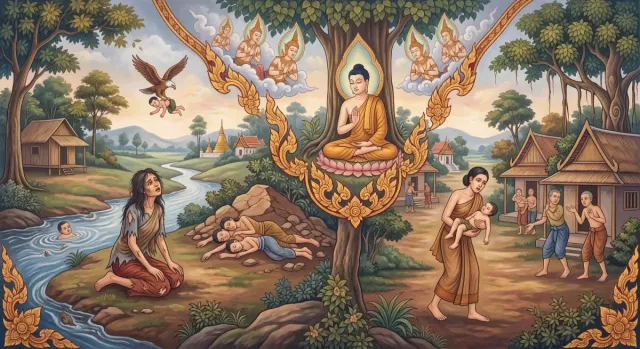
Paṭācārā and Kisāgotamī: When Loss Arrives
Paṭācārā kisāgotamīTwo nuns who went through devastating loss of loved ones. The Buddha did not tell them to stop grieving, but g…


Vihaṅgamena santena subījaṃ ropitaṃ mayā
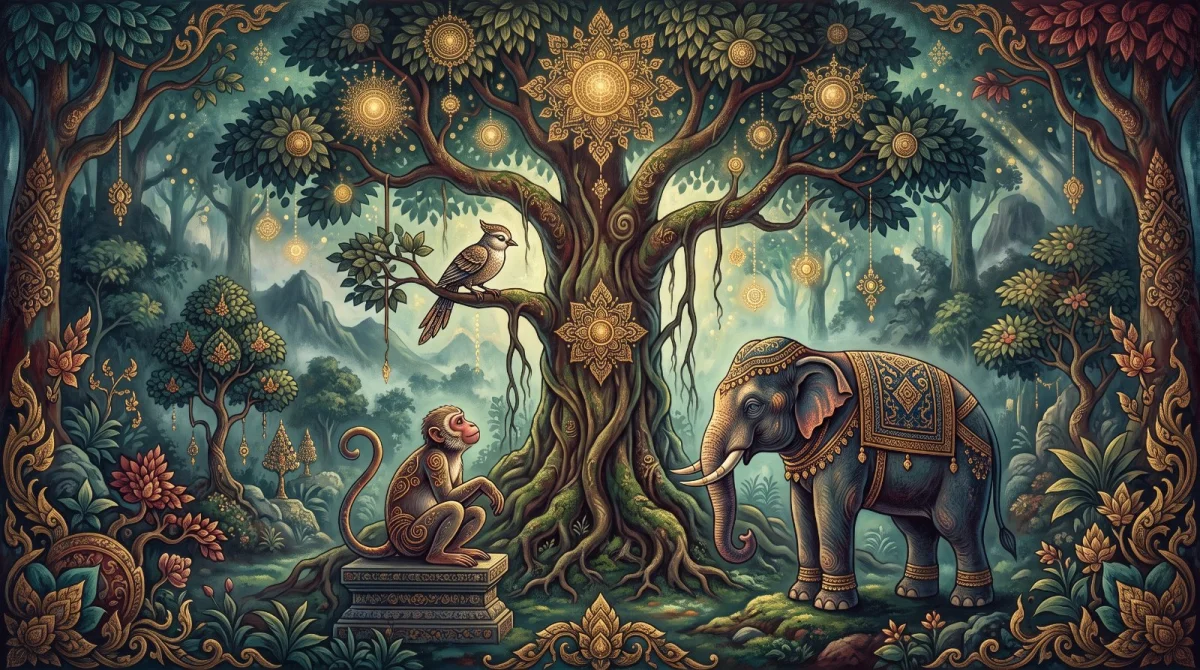
In several Apadāna stories, elders tell how in one life they were a ruddy goose, a king of the garuḍas, a monkey or an elephant. On seeing a Buddha or paccekabuddhas their minds grew bright with faith, and they offered what the forest provided. The lessons: a good heart doesn't depend on form or status, and a single good deed doesn't erase all other kamma.
In the Apadāna of the Khuddaka Nikāya, many elders recount their past lives in verse. Some say that in that life they were not human at all: the Elder Paccāgamaniya was a ruddy goose on the bank of the Sindhu river, the Elder Vatthadāyaka a king of the garuḍas, the Elders Ambadāyaka and Tindukadāyaka monkeys, and the Elder Padumakesariya a bull elephant.
All the stories share one shape: seeing a Buddha or paccekabuddhas, the mind grows bright with faith, and the being offers whatever is at hand — a flower held in the beak, a single cloth, a mango with honey, tinduka fruit, or lotus pollen. Each then says that because of that deed he has not known a bad destination, and ends by saying he has attained the Dhamma and completed the Buddha's teaching.
The results described are the Apadāna's own framing. This page does not present them as a promise that anyone will receive such results, but looks at the deed and the mind behind it for what they can teach us.
The Elder Paccāgamaniya tells how he was a ruddy goose on the bank of the Sindhu river, eating only water plants and well restrained toward living beings. Seeing the Buddha Vipassī travelling through the sky, he took a flower in his beak and offered it.
Restraint begins with eating and living without harming anyone more than necessary. Choose one food or product this week that causes less harm.
The goose says that whoever has unshakeable, well-established faith in the Tathāgata will not go to a bad destination; his coming into the Buddha's presence was a good coming indeed, and even while a bird he planted a good seed.
Don't wait until life is in order before doing good. Whatever state you're in, you can plant a good seed with what you can do today.
The Elder Vatthadāyaka tells how he was a king of the garuḍas. Seeing the Buddha Atthadassī going to Mount Gandhamādana, he gave up his garuḍa form, took the form of a young man, and offered a single cloth. The Buddha accepted it and said that through this gift he would leave the garuḍa birth and delight in the deva world.
When you go to help or give something to someone, put down the air of the powerful first, and approach in a way the other person can comfortably accept.
The Elder Ambadāyaka tells how he was a monkey in the Himalaya. Seeing the Buddha Anomadassī seated among the mountains radiating loving-kindness, he picked a ripe mango and offered it with honey. The prediction said he would delight in the deva world for fifty-seven aeons, but in the remaining aeons would still wander through mixed births, working off his bad kamma before burning up the defilements.
Having done good, don't assume old wrongs vanish on their own. You still need to take responsibility and repair what you did. Goodness and responsibility go together.
The Elder Tindukadāyaka tells how he was a strong monkey. Seeing a tinduka tree in fruit, he remembered the Buddha and set out to search for the Buddha Siddhattha for two or three days. Knowing his intention, the Buddha came with many thousands of arahants, and the monkey joyfully brought the fruit to him.
When you think of someone you want to thank or visit, don't wait for the chance to come to you. Go and find them, even if it takes several days.
The Elder Padumakesariya tells how he was a bull elephant living near a group of sages, the paccekabuddhas. Out of faith he scattered lotus pollen over them in homage, and brightened his mind toward those who had destroyed passion.
Give with what comes naturally to you: if you cook well, cook; if you're good at repairs, help fix things. There's no need to copy how others give.
Stories of animals with faithful hearts may sound like fables, but they invite us to see the animals around us differently. In these stories animals have minds too; they know joy and know how to give. That is one more reason not to harm animals, and to be kind to pets and strays near home.
The stories also say that the starting point of goodness doesn't depend on our station. If today you feel you're in a low place or have nothing to give, a good heart and the small things you do have can be a beginning.
At the same time, the Apadāna of the monkey who offered a mango is honest: one good deed doesn't wipe out all other kamma. There is still a journey ahead and past deeds to work through. Goodness is not a shortcut but a path to keep walking.
Tap to read the actual passage on the page cited.
Two nuns who went through devastating loss of loved ones. The Buddha did not tell them to stop grieving, but g…

Three sets from the section on fours: those who praise or blame, trust or distrust without reflecting; those w…

The wise bear with the faults the young commit out of immaturity. Good people who quarrel are quickly reconcil…

The group of six tickled a monk of the group of seventeen until he was exhausted, could not breathe and died; …