
The Four Bases of Social Harmony
Cattāri saṅgahavatthūniFour ways of holding people together — giving, kind speech, being useful, and being consistent. Works at home …


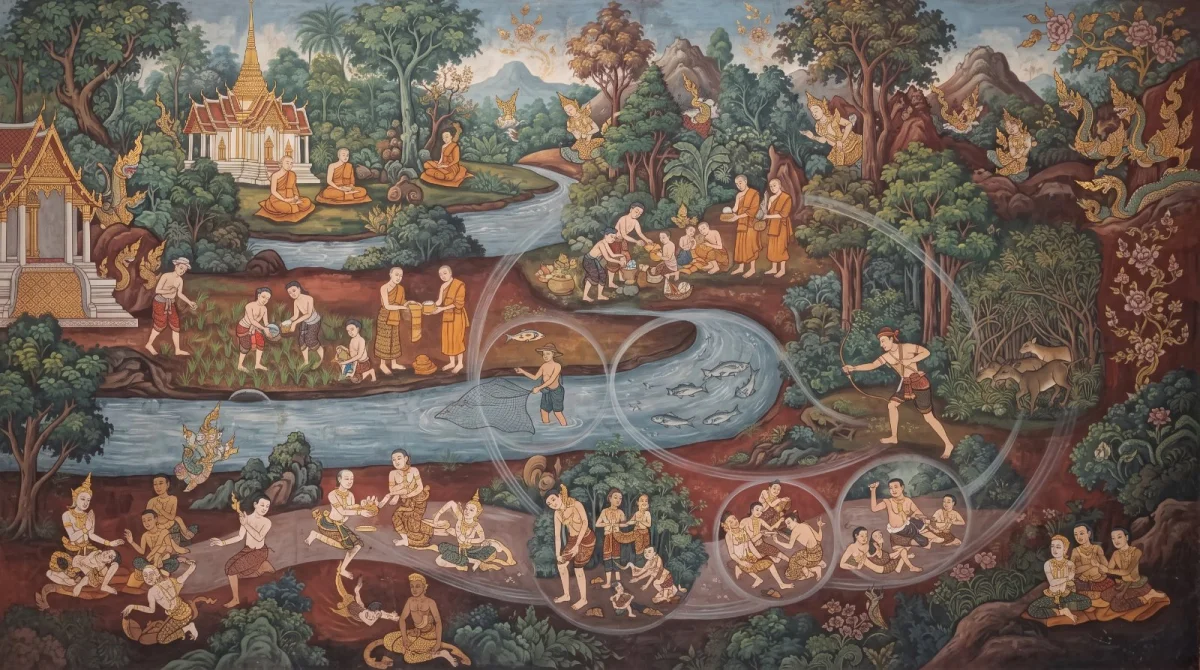
Kusalaṃ me na vijjati
Several elders open their verses by stating that they had been deer hunters or butchers, and say plainly that they had no wholesome deeds to their name, before recounting the point at which their lives turned.
In the Apadāna of the Khuddaka Nikāya a group of verses begins with the same sentence: formerly I was a deer hunter roaming the forest. Some are blunter still — my father, my grandfather and I worked in the forest and lived by slaughtering livestock; I had no wholesome deeds. The Pāli of that last phrase is kusalaṃ me na vijjati.
This page gathers stories from the Kiṅkaṇipuppha Vagga (50th), the Phaladāyaka Vagga (52nd) and the Tiṇadāyaka Vagga (53rd), with one more from the Bhaddāli Vagga (42nd). What they share is that the speakers do not conceal their former trade and do not claim to have been good from the start. The turning point is told as a brief incident: meeting a Buddha in the forest, being moved to confidence, and offering the fruit or flowers that happened to be at hand.
These verses do not say killing carries no harm, nor that one act of giving erases past deeds. What they record is that a person inside a harmful trade can still turn, and that the turn often begins with something entirely ordinary. The grand results described are this collection's idiom of praise, not a guarantee.
Koraṇḍapupphiya Thera (Kiṅkaṇipuppha Vagga, 50th) opens: formerly my father, my grandfather and I worked in the forest and lived by slaughtering livestock; I had no wholesome deeds. Later the Buddha Tissa, out of compassion, left three footprints near his dwelling. Seeing them, he grew confident, gathered the cockscomb flowers growing there into a casket and honoured the footprints with them.
Admitting to yourself exactly what you have done is a more usable starting point than either excusing yourself or hating yourself.
Piyālaphaladāyaka Thera (Kiṅkaṇipuppha Vagga, 50th) says that formerly he was a deer hunter roaming the great forest, and he saw a Buddha free of the dust of defilement. Moved to confidence, he offered piyāla fruit with his own two hands. The verse doesn't say whether he left the trade at once; it says only that on that day the same hands did something else.
Changing one thing your hands do today is worth more than aiming to change your whole life and never beginning.
Kurañjiyaphaladāyaka Thera (Phaladāyaka Vagga, 52nd) opens the same way: formerly I was a deer hunter roaming the forest, and I met a Buddha free of dust who had gone beyond all things. Moved to confidence, he offered kurañjiya fruit with both his hands. The whole verse runs only a few lines.
Chances to do good usually arrive unprepared. Whatever is already in your hands will do; you needn't go back for something better.
Ghosasaññaka Thera (Phaladāyaka Vagga, 52nd) says he was a deer hunter roaming a silent stretch of forest when he came upon the Buddha Sikhī proclaiming the four truths and teaching the deathless state. He heard that beautiful Dhamma and made his mind confident in the sound of the voice. The verse ends: this is the fruit of that perception.
When you happen to hear something that strikes you, stop and listen to the end for once, rather than scrolling past out of habit.
Tiṇamuṭṭhidāyaka Thera (Tiṇadāyaka Vagga, 53rd) says he was a deer hunter in the forest who found the Buddha Tissa walking meditation in the open, so he offered a handful of grass for him to sit on, paid respect and turned back. The verse says he had not gone far before a lion killed him. That handful of grass was the last deed of his life.
No one knows which day is their last, so the good thing you thought of today is not worth postponing.
Girinelapūjaka Thera (Tiṇadāyaka Vagga, 53rd) says that formerly he was a deer hunter roaming the forest and met a Buddha endowed with great compassion, delighting in the welfare of all beings. With a confident and joyful mind he made an offering of blue nela flowers. That phrase, delighting in the welfare of all beings, set inside a hunter's story, is a contrast the verse draws itself.
Notice which qualities in other people make you want to change, then spend more time near people like that.
Madhumaṃsadāyaka Thera (Bhaddāli Vagga, 42nd) opens: I was a pig butcher in the city of Bandhumatī. One day he chose good meat, steeped it in honey, went to the assembly of monks, took a bowl, filled it and offered it to the senior elder. The verse records his thought: by this I shall gain abundant happiness, and in my last existence I shall burn up the defilements.
You may not be able to change your job today, but the part you can choose — where to cause less harm — can start today.
This group does not say that killing carries no fault, nor that one offering makes past deeds disappear, nor that anyone may stay in a harmful trade and offset it with merit. What the verses record is the possibility of turning. The teaching on work itself is right livelihood in the eightfold path, which sets aside trades that cause harm.
If your present work is harmful, plan your exit in stages — build a new skill, reduce that part of the work — rather than deciding overnight at the cost of those who depend on you.
This group speaks to anyone who feels it is too late — who has done harmful things long enough to believe there is no place for them on a good path. The verses don't offer comfort by saying the past doesn't matter. They say the past doesn't close the future.
In practice, right livelihood in the eightfold path still rules out trades that harm: dealing in weapons, in human beings, in animals for slaughter, in poisons and in intoxicants. Anyone working in such a trade who wants to change usually needs time and has people depending on them, so plan it in stages rather than deciding in a single day at the cost of your family.
Most importantly, these are speakers' accounts of themselves, not a tool for judging others. Seeing someone in hardship and concluding it is their own past kamma is not what these verses teach, and it adds to the burden of someone already suffering.
Tap to read the actual passage on the page cited.
Four ways of holding people together — giving, kind speech, being useful, and being consistent. Works at home …
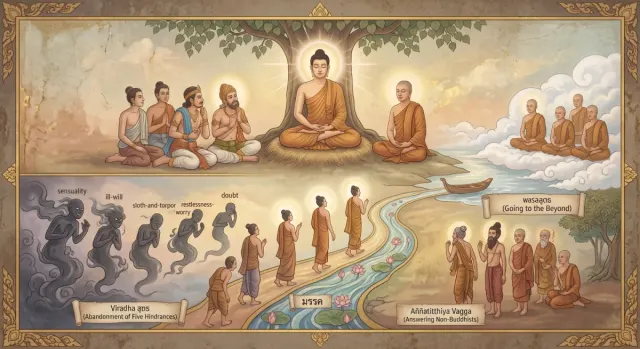
Whoever neglects the noble path neglects the way to the end of suffering; whoever takes it up has taken up tha…
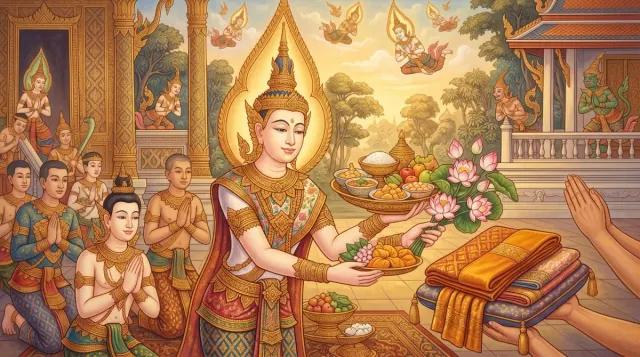
After changing his views, Prince Pāyāsi sets up almsgiving but gives broken rice and coarse cloth he wouldn't …

The nāga king Mucalinda coils around the Buddha to shelter him from the rain, and the Buddha utters a verse on…