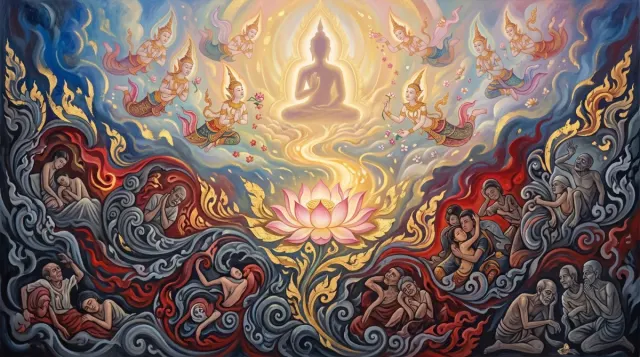
The Discourse on Proximate Causes: Suffering Supports Faith
UpanisasuttaṃA chain of dependent arising that does not end in suffering but continues to liberation: suffering supports fa…


Bhaddekarattasuttaṃ
Don't chase the past, don't long for the future, see clearly what arises now, and make the effort today — a short verse the Buddha himself explained to show what "living in the present" really means.
The Bhaddekaratta Suttas are a set of four discourses in the Majjhima Nikāya explaining the same verse, taught by the Buddha, by Ānanda, by Mahākaccāna, and in connection with the deity Candana. The verse says:
"Let not a person revive the past or build up hopes for the future. The past has been left behind; the future has not been reached. Whoever sees with insight the state that is present, here and there, unshakeable and unmoved — let them develop it. Today the effort must be made; who knows, death may come tomorrow. There is no bargaining with Death and his mighty hosts. One who dwells thus ardently, tireless by day and night — the peaceful sage calls them one who has had a fortunate night."
What sets this discourse apart from ordinary talk of "living in the present" is that the Buddha goes on to explain: chasing the past means delighting in "I had such form, such feeling in the past", and being shaken in the present means taking the five aggregates now present as self.
Not binding delight to the form, feeling, perception, formations and consciousness one had in the past — thinking "I used to look like that, feel like that" and sinking into it.
You can review the past to learn from it, but if you notice you're replaying old images just to wallow in the feeling, close them and return to what you're doing.
Not binding delight to aggregates yet to come — thinking "May I become like that in the future" until the mind drifts off to live in that image.
Plan for the future, then take the first step immediately. A plan with no first step is a dream carrying the mind away from the present.
Seeing what arises now as it is, without taking the present five aggregates as self, so one isn't swept away or shaken.
Living in the present doesn't mean acting on how you feel right now. It means seeing how you feel right now without having to be it.
The effort should be made today; who knows whether death will come tomorrow, since no one can bargain with death for more time.
Pick the good thing you've put off the longest and complete its first step before bed tonight.
One who lives ardently like this, tireless day and night — even with only one night to live, that night is a fortunate one.
Measure a day's worth by the quality of the mind in it, not by the number of days remaining. Read alongside "Mindfulness of Death".
"Living in the present" is often taken to mean never thinking about the past or planning for the future. But the discourse doesn't forbid planning or reflection. What it rules out is delight and attachment — sinking into old images, and dreaming of desired futures until the mind isn't in real life.
The line to use every day is "Today the effort must be made." Read this verse in the morning, then pick one thing you've been putting off for days and finish it.
Tap to read the actual passage on the page cited.
A chain of dependent arising that does not end in suffering but continues to liberation: suffering supports fa…
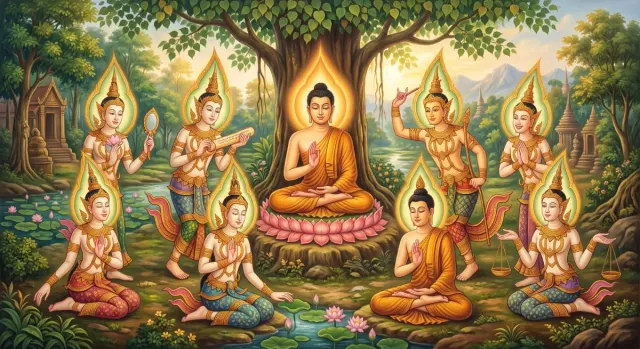
Seven factors that arise in sequence — and a practical tool for knowing whether the mind needs rousing or calm…

Anuruddha, Nandiya and Kimbila live together like milk and water, because their acts of body, speech and mind …
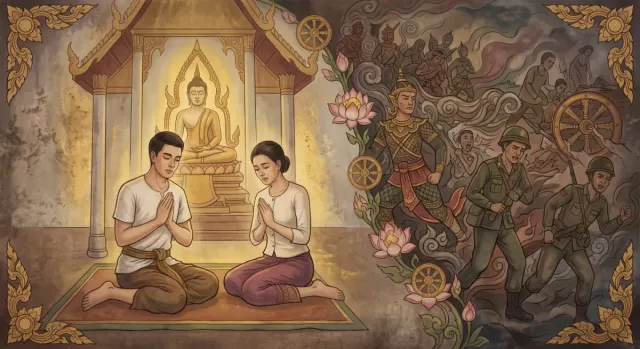
The group of six monks went to watch King Pasenadi's army on the march. The king asked what use it was to look…