
Bhikkhunī Vibhaṅga: Not Leaving Yourself Where No One Can Correct You
Abhikkhuke āvāse vassaṃ vaseyyaSpending the rains where there was no one to teach them; not inviting correction afterwards; refusing to go fo…


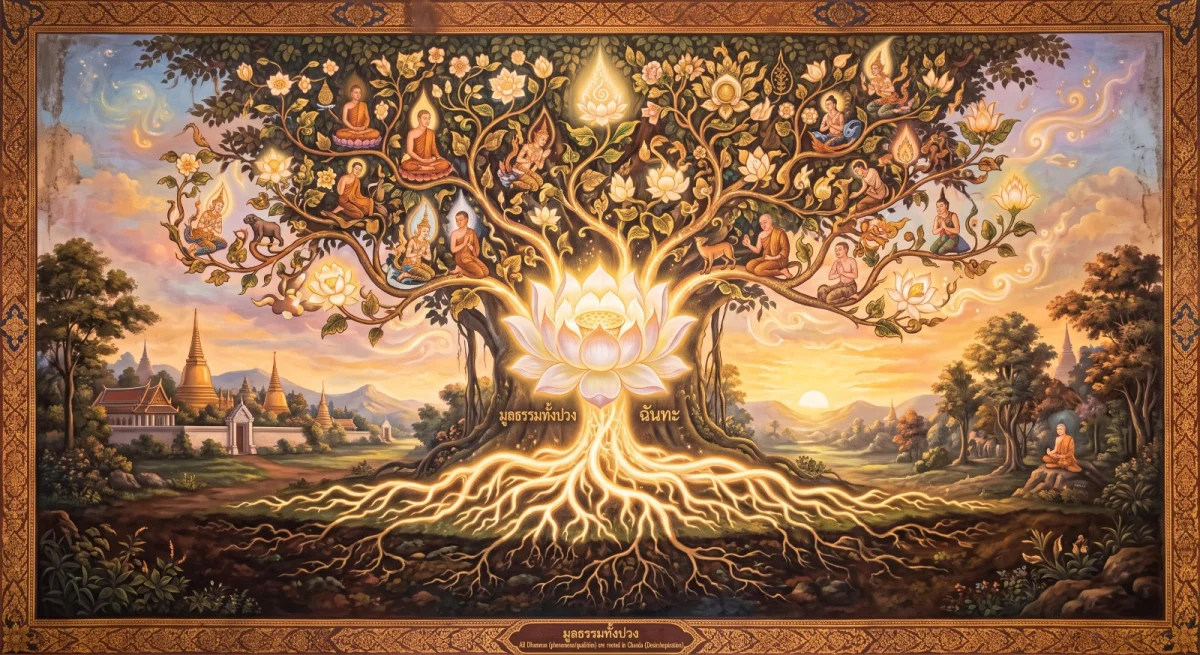
Chandamūlakā sabbe dhammā
If wanderers of other sects ask what all things are rooted in, the Buddha says to answer: they are rooted in desire, born of attention, originate from contact, converge on feeling, are headed by concentration, governed by mindfulness, surpassed by wisdom, have liberation as their core, plunge into the deathless, and end in nibbāna.
In the Mūla Sutta of the Sati Vagga, Book of Eights, Aṅguttara Nikāya, the Buddha asks the monks how they would answer if wanderers of other sects asked: what are all things rooted in, what are they born of, and so on up to what is their core? The monks reply that their teachings are rooted in the Blessed One and ask him to explain. The Buddha then gives an answer in eight parts.
The Mūla Sutta of the Book of Tens has the same question and answer, with two more at the end: all things plunge into the deathless and end in nibbāna, making ten in all.
The sutta gives only a short list and does not explain each term, so the explanations on this page follow the ordinary meanings of the words. Note that chanda here does not always mean craving. Later texts often explain chanda as the wish to act, which can be wholesome or unwholesome.
The first answer is that all things have desire as their root. Wanting, liking, or the wish to act is the starting point of what happens in life. The sutta does not specify whether the desire is wholesome or not.
Before starting something, briefly ask yourself what you want from it. The answer often shows where this will go.
All things come into being through attention. What receives no attention does not become an experience in the mind.
Choose carefully what you attend to, for example by turning off unnecessary notifications, because what we pay attention to grows in the mind.
All things originate from contact: when sense base, object and awareness come together, experience arises.
If you know what triggers a habit you don't want, such as snacks on the desk or an app on the home screen, reduce the contact at the source.
Everything born of contact converges on feeling: pleasant, painful or neutral.
When you feel bad, recognise it as the point where many causes meet, not the whole of who you are. Breathe, then choose how to respond.
All things have concentration at their head, leading the way. A settled mind leads in a clear direction.
Before important work, spend two or three minutes letting the mind settle. Work led by a settled mind usually turns out better.
All things have mindfulness as their governor. Mindfulness oversees and knows what is happening.
Let mindfulness, not emotion, be in charge of the mind; for instance, notice yourself before hitting send on a message written in anger.
Wisdom surpasses what came before, and liberation is the core of it all. Concentration and mindfulness are therefore not goals in themselves, but lead to understanding and freedom.
Ask yourself from time to time whether your practice is making you cling less. If not, it may not yet have reached the core.
These two appear only in the Mūla Sutta of the Book of Tens: all things plunge into the deathless and end in nibbāna. The list is then complete, from desire at the start to nibbāna at the end.
Knowing the destination gives direction to small daily choices. Ask whether this brings you closer to true peace or further from it.
This list is like a small map of mental life. Everything starts from desire, followed by attention, contact and feeling. If it stops there, life circles around likes and dislikes. But the list continues to concentration, mindfulness, wisdom and liberation.
In practice, if you want to change a habit, look upstream: what do we want, and what are we paying attention to? These two shape the experiences that follow.
The list also reminds us that feeling is only the meeting point of earlier causes, not the destination. What should govern the mind is mindfulness, and the core of training is liberation.
Tap to read the actual passage on the page cited.
Spending the rains where there was no one to teach them; not inviting correction afterwards; refusing to go fo…

Shortly after the Buddha's passing, a brahmin asks Ānanda who the successor is. The answer is that there is no…

A set of short discourses in the Saḷāyatana Saṃyutta: the eye, ear, nose, tongue, body and mind, untrained, br…

Seven defilements lying dormant in the mind — they stay hidden until something triggers them, like seeds waiti…