
The Three Characteristics of the Conditioned
Tīṇi saṅkhatassa saṅkhatalakkhaṇāniThree marks of everything conditioned — its arising is evident, its passing is evident, and while it persists …


Ghoṭamukhasuttaṃ
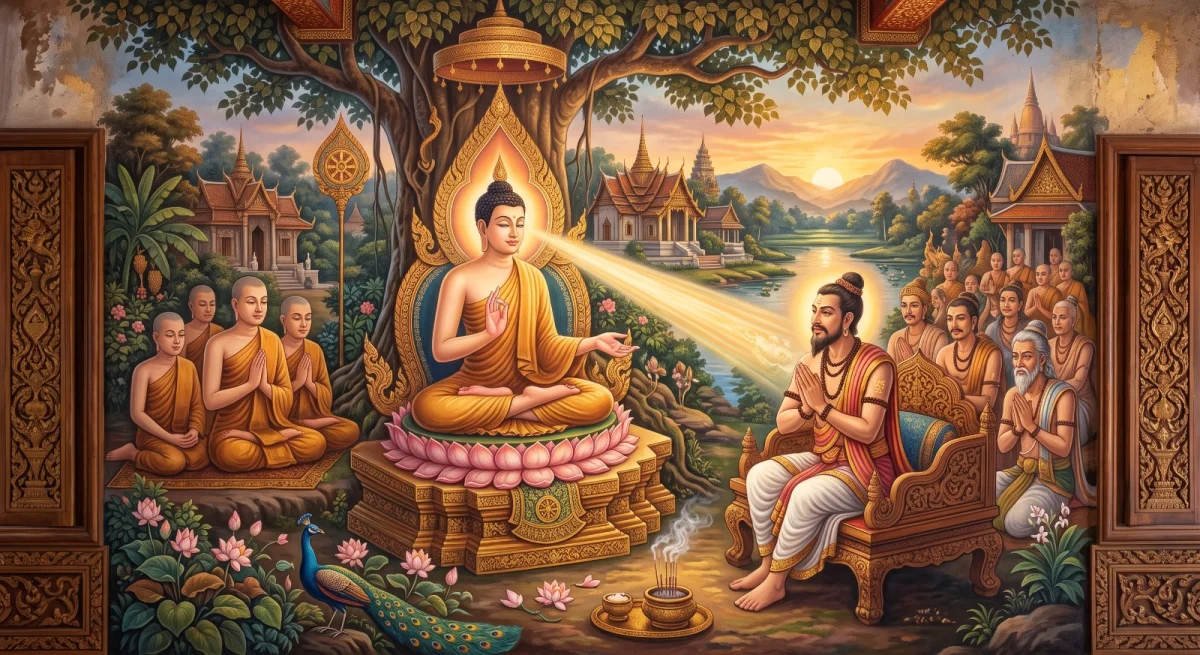
The brahmin Ghoṭamukha holds that there is no righteous going forth. Venerable Udena doesn't argue back directly; he sets ground rules for the conversation and asks questions the brahmin answers himself, until the brahmin changes his view, goes for refuge, and builds a hall for the Saṅgha.
In the Ghoṭamukha Sutta of the Majjhima Nikāya, Venerable Udena is staying in the Khemiya mango grove near Bārāṇasī. The brahmin Ghoṭamukha, out for a stroll, follows him as he walks up and down in meditation and says there is no righteous going forth.
Udena doesn't answer right away but goes into the dwelling and sits down. The brahmin follows and stands waiting until invited to sit. Udena sets a condition: if they are to talk, the brahmin should accept what ought to be accepted, reject what ought to be rejected, and ask about anything he doesn't understand.
Udena asks about four kinds of persons and in which group the person who torments neither self nor others is more often found. The brahmin answers himself — among those who have given up wealth to go forth — and admits that righteous going forth does exist. Udena then explains the four kinds of persons in detail. The brahmin asks to go for refuge to Udena, who tells him to go for refuge to the Blessed One instead. But the Buddha has already attained final nibbāna, so the brahmin goes for refuge to the Buddha, though passed away, to the Dhamma and to the Saṅgha.
Ghoṭamukha follows Udena as he walks in meditation and says there is no righteous going forth, since he doesn't see that someone like Udena sees the truth in this matter. Udena doesn't reply on the walkway but first goes in and sits down.
When someone challenges your beliefs in passing, you don't have to respond at once. A time and place where you can sit and talk is better.
The brahmin waits to be invited before sitting. Udena says a conversation is possible if the brahmin accepts what should be accepted, rejects what should be rejected, and, whenever he doesn't understand something, asks what it means. The brahmin agrees.
Before discussing something you disagree about, agree to hear each other out, to acknowledge where the other is right, and to ask when you don't understand rather than guessing.
Udena names four kinds of persons: one who torments himself, one who torments others, one who torments both, and one who torments neither and lives cooled and happy here and now. He asks which the brahmin approves of. The brahmin chooses the fourth, since everyone wants happiness and dislikes pain.
Use these four to check important decisions: does this choice cause suffering to anyone — yourself or those around you?
Udena then asks: there are two groups. One is infatuated with jewels and earrings and seeks wives and children, slaves, land, gold and silver; the other gives all this up to go forth. In which is the fourth kind of person more often found? The brahmin says among those who have gone forth. Udena repeats the brahmin's original claim, and the brahmin himself admits that righteous going forth does exist.
Instead of telling others they're wrong, ask questions that help them see it for themselves from their own experience.
After hearing Udena's detailed explanation, the brahmin asks to go for refuge to Udena. Udena stops him and tells him to go for refuge to the Blessed One, to whom Udena himself has gone for refuge. The brahmin asks where the Buddha is, saying he would travel even a hundred yojanas to see him. On learning that the Buddha has attained final nibbāna, he goes for refuge to the Buddha, though passed away, to the Dhamma and to the Saṅgha.
When someone praises you for helping them a lot, point to the knowledge or teachers you learned from rather than taking all the credit yourself.
The brahmin offers part of the daily allowance of five hundred kahāpaṇas given him by the king of Aṅga. Udena says accepting gold and silver is not proper for monks. The brahmin then offers to build him a dwelling, but Udena suggests he build an assembly hall for the Saṅgha at Pāṭaliputta instead. That hall came to be called the Ghoṭamukhī.
When someone wants to repay you, invite them to direct that goodwill toward something that benefits many people.
This story is a model for talking with someone who disagrees. Udena doesn't argue back or belittle the brahmin's view. He agrees on clear ground rules first, then asks questions that let the other person think and answer for himself. A view changed because one sees for oneself is far more stable than one changed under pressure.
Udena's humility is also striking. When the brahmin wants to take him as a refuge, he doesn't accept it for himself but points to the Buddha. And when the brahmin wants to give him money, he invites him to use it for the benefit of the whole Saṅgha.
Not accepting gold and silver is part of the monastic discipline. Lay people can take the principles of dialogue and of not keeping credit for oneself.
Tap to read the actual passage on the page cited.
Three marks of everything conditioned — its arising is evident, its passing is evident, and while it persists …

Prince Vessantara gives away the finest elephant and is banished, gives along the way, gives his two children …

Four kinds of people: one who goes with the stream of sensuality, one who goes against it even in tears, one w…
Sāriputta arranges the Dhamma in sets of one, two and three, each with ten functions, such as what is most hel…