
Treatise on Knowledge: From Seeing Dissolution to Reviewing What Was Gained
Ārammaṇaṃ paṭisaṅkhā bhaṅgānupassane paññā vipassane ñāṇaṃThe middle sequence of knowledges in the Paṭisambhidāmagga: seeing the very mind that took an object break up,…


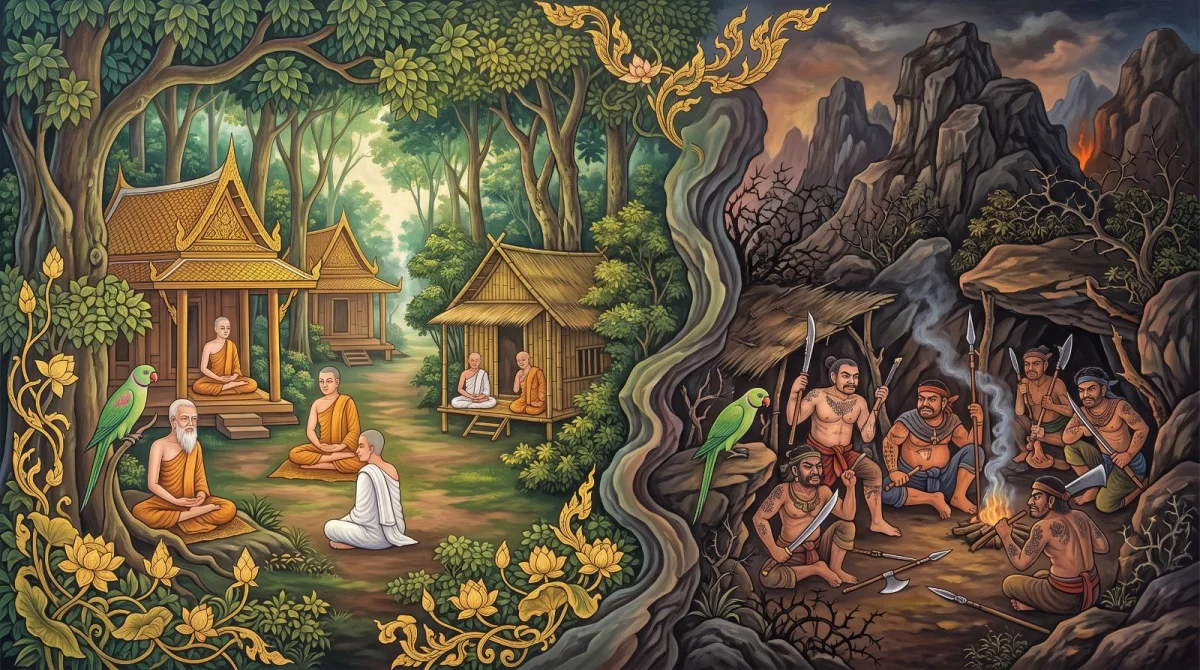
Yādisaṃ kurute mittaṃ
Two parrots are brothers from the same mother. One grows up among robbers, the other in a hermitage. When a lost king arrives, the first cries out to seize and kill him; the second offers him fruit and water. You become like those you keep company with, just as grass wrapped around rotten fish stinks and leaves wrapped around incense are fragrant.
In the Sattigumba Jātaka of the Book of Twenties, Jātaka, Khuddaka Nikāya, the verses tell how the king of Pañcāla, out hunting, is separated from his army and comes to a robbers' village in the forest. A parrot named Sattigumba calls to the robbers to hurry and seize the king's goods and kill him while he sleeps. The king quickly leaves for a hermitage, where a parrot named Pupphaka welcomes him and invites him to eat fruit and drink cool water from a mountain cleft.
The king wonders why these two birds are so different. Pupphaka explains that they are brothers from the same mother, raised in the same tree, but carried off to different places: one grew up with robbers, the other on the laps of the sages, so they differ in character. He then speaks verses saying that you become like those you keep company with, using the similes of a poisoned arrow, grass wrapped around rotten fish, and leaves wrapped around incense.
The story above is in the verses themselves. The commentary adds that Pupphaka was the Bodhisatta, that the king, inspired, invited the sages to live in his royal park, and that he granted protection to all parrots. According to the commentary, the Buddha told this story with reference to Devadatta.
Pupphaka says he and Sattigumba are brothers from the same womb, raised in the same tree, but carried off to different places: one lived among bad people, the other among good people, so they differ in character.
When you see someone with a background like yours take a very different path, notice whom they spend most of their time with, then ask yourself the same question.
Faced with the same stranger, Sattigumba sees prey and cries out to rob and kill him. Pupphaka says, "Welcome, great king," invites him to choose fruit and drink cool water, and asks him to help himself since a bird has no hands to offer them.
Notice the first words you say when you meet someone you don't know — suspicion, taking advantage, or welcome — and practise the last one more often.
Where there is killing, binding, cheating with fakes, open deceit and plunder, Sattigumba learns those things there. No one has to teach him directly; living there is enough for it to sink in.
If your workplace praises small-scale cheating as cleverness, realise you are being taught every day, and draw your own line clearly.
In the sages' hermitage there is only truth, Dhamma, harmlessness, restraint and self-taming. Pupphaka grew up on the laps of sages who always offered a seat and water to visitors, so hospitality became his nature.
A home needn't teach virtue with many words. Let children see adults speak truthfully, harm no one and welcome visitors warmly; they will learn by themselves.
Whomever one associates with, good or bad, virtuous or not, one comes under that person's sway. Whatever kind of friend one makes, one becomes like that, for living together works that way — like a poisoned arrow that taints the other arrows in the quiver.
Think of the five people you've talked with most this month, and see whose words, worries and spending habits yours are coming to resemble.
If someone wraps rotten fish in kusa grass, the grass stinks too; so it is with keeping company with fools. If someone wraps incense in leaves, the leaves become fragrant too; so it is with keeping company with the wise. Knowing that one will change like the wrapping leaf, the wise should associate with good people.
Before joining a new group, an investment scheme or an online community, ask yourself what scent you want to be carrying a year from now.
We tend to think character is inborn, but this jātaka shows brothers from the same mother growing up in different places and turning out completely different. What we are near every day — friends, workplace, what we scroll through on our phones — quietly shapes us.
So the lesson has two sides. One is to choose surroundings for ourselves and our children deliberately. The other is not to judge people by their behaviour alone, since many people are the way they are because of where they grew up.
The jātaka's advice not to associate with fools doesn't mean despising anyone. It means not soaking up ways of thinking and acting that harm others until they become our own.
Tap to read the actual passage on the page cited.
The middle sequence of knowledges in the Paṭisambhidāmagga: seeing the very mind that took an object break up,…

A portion of meat set aside for a monk was given to a crying child, so the householder offered to buy somethin…

Upāli asks how many training rules there are and in how many cities they were laid down. The answer leads into…
The Buddha recounts how, as a Bodhisatta, he dealt with fear in remote forests: from the purity of conduct tha…