
The Ten Recollections
Dasa anussatiyoTen things to recollect when the mind needs something to hold — pick the one that matches the state you are in…


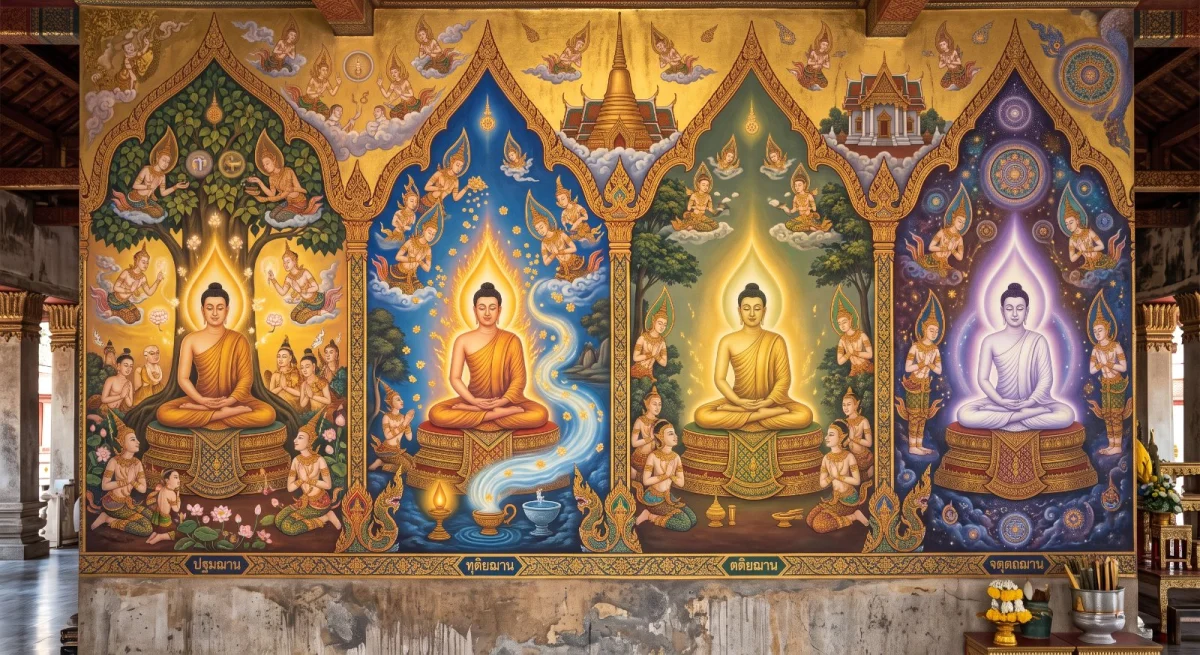
Cattāri jhānāni
Four levels of a collected mind — the right concentration of the eighth path factor, described stage by stage with the factors present in each.
Jhāna is the state of a unified mind. Four levels are described, each with fewer factors than the last, moving from coarse towards subtle. The Buddha identified them directly as right concentration in the Noble Eightfold Path.
The condition for entering is that the five hindrances have settled. He compared one who has abandoned them to a person freed from debt, recovered from illness, released from prison, freed from slavery, and arrived safely at the end of a journey.
Secluded from sensuality and unwholesome states, the first level of calm is entered. Applied and sustained thought are still present, along with the rapture and happiness born of seclusion.
This is the calm ordinary practitioners meet through regular sitting: the mind still talks, but it no longer runs away.
Applied and sustained thought subside; the mind becomes clear and unified from within, with the rapture and happiness born of concentration, no longer needing thought to hold it.
Compare it to work so absorbing that you don't have to keep telling yourself to focus. That points to what calm feels like when thinking isn't propping it up.
The rapture, itself a kind of ripple, fades, leaving a subtler happiness together with clear mindfulness and full awareness.
The usable lesson: even good feelings must be put down. Deeper calm is quieter than people expect.
Both pleasure and pain subside, leaving pure equanimity with luminous mindfulness — the base the Buddha used to go on to true knowledge and seeing things as they are.
For daily life, remember the destination of concentration is not happiness but a mind still enough to see things as they actually are.
Ordinary working people don't need to aim at jhāna, but knowing the sequence helps, because it shows that calm has levels and that each level comes from putting down something coarse, not from adding more effort.
What is practical is to reach the early stages of calm regularly and then notice which factor still pulls the mind outward — usually it is thinking that keeps running the whole time.
Tap to read the actual passage on the page cited.
Ten things to recollect when the mind needs something to hold — pick the one that matches the state you are in…

Some thoughts make us blind, others give us eyes. Greed, hatred and delusion are enemies born within, yet peop…

This body is neither ours nor anyone else's; it should be seen as old kamma, fashioned by conditions. What we …

The text explains that earlier instances are a condition making later instances of the same kind stronger. Its…