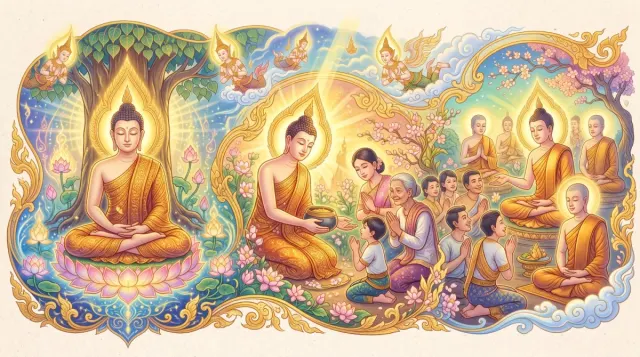
Puggalapaññatti: Practising for Your Own Good, for Others' Good, or for Both
Attahitāya paṭipannoSome have virtue, concentration and wisdom but encourage no one; some encourage others but lack these themselv…


Cattāri kammāni
Dark kamma, bright kamma, kamma both dark and bright, and kamma neither dark nor bright that leads to the ending of kamma — the Buddha's answer to ascetics living like a dog and an ox.
In the Kukkuravatika Sutta of the Majjhima Nikāya, two ascetics come to the Buddha: Puṇṇa, who lives by the ox-duty, and Seniya, who lives by the dog-duty, such as eating food thrown on the ground. Puṇṇa asks where Seniya will be reborn. The Buddha declines twice, but asked a third time, says: if one perfects the dog-duty, one is reborn as a dog; and if one holds the view that this practice leads to rebirth among the gods, that is wrong view, which leads to hell or the animal realm.
He then teaches four kinds of kamma that he has realised himself. Afterwards Puṇṇa goes for refuge, while Seniya asks to ordain and later attains arahantship.
One generates harmful bodily, verbal and mental formations, is reborn in a harmful world, is touched by harmful contacts, and experiences exclusively painful feeling.
Actions that purely harm others build a world full of harm around us. Notice how people who harm tend to live among those who harm each other.
One generates non-harmful formations of body, speech and mind, is reborn in a world without harm, and experiences exclusively pleasant feeling.
Peace around us doesn't appear by itself; it's built from consistently harming no one.
One generates formations that are both harmful and non-harmful, and experiences mixed pleasant and painful feeling — as with humans, some gods and some beings in lower realms.
Most lives are here. The mixed happiness and suffering we meet mirror mixed actions. Reducing the harmful part bit by bit changes the proportions of a life.
The intention to abandon dark kamma, bright kamma, and kamma both dark and bright is kamma neither dark nor bright, with a result neither dark nor bright, leading to the ending of kamma.
This is here for understanding the overall picture: doing good isn't the destination. The destination is a mind that doesn't cling to good or evil as its own. Read alongside "Nibbāna".
This helps us look honestly at our own actions. Most lives aren't wholly dark or wholly bright but mixed kamma, with harmful and harmless parts, so the results are mixed too.
What you can do is gradually shrink the dark part and grow the bright, while understanding that the ultimate aim of this path isn't just accumulating bright kamma, but the intention to go beyond all kamma. Read alongside "The Salt Crystal Discourse".
Tap to read the actual passage on the page cited.
Some have virtue, concentration and wisdom but encourage no one; some encourage others but lack these themselv…

Two debates opening chapter 14 ask whether wholesome and unwholesome roots can follow each other immediately, …
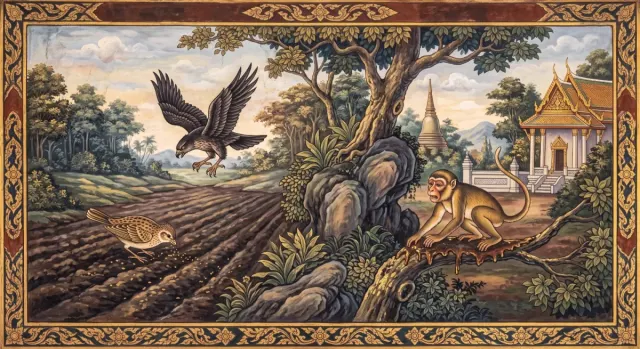
A quail that strayed from its range was seized by a hawk, but escaped once back in its own ploughed field. A g…

Seeing, hearing, gaining, training, serving and recollecting come at many levels. The Buddha doesn't deny the …