
The Manoja Jātaka: When a Friend Leads You Astray
ManojajātakaṃThe lion Manoja befriends a jackal and follows its advice until he is struck by a hunter's arrow, while the fr…



Māghasuttaṃ
Māgha earns wealth honestly and shares it with many people. He asks whether this brings much merit, to whom one should give, and how an offering is purified. The Buddha says it brings much merit, describes the worthy recipient, and teaches keeping the mind clear at all times.
In the Māgha Sutta of the Sutta Nipāta, Khuddaka Nikāya, the young man Māgha visits the Buddha on Vulture's Peak near Rājagaha. He explains that he is a giver who understands those who ask, seeks wealth lawfully, and gives that lawfully gained wealth to one person, two, and up to a hundred or more. He asks whether giving like this brings much merit, and the Buddha confirms that it truly does.
Māgha then asks in verse how the offering of such a generous householder is purified, who the worthy recipients are, and what makes a sacrifice complete. The Buddha describes the worthy recipient over many verses, each ending with the refrain that one seeking merit should give to them at the proper time.
Finally he teaches keeping the mind clear at all times, abandoning ill will and developing boundless loving-kindness, and says that one who performs the threefold sacrifice reaches the Brahmā world. Māgha declares himself a lay follower for life.
Māgha seeks wealth lawfully, then gives what he lawfully gained to recipients from one up to a hundred or more. The Buddha says that one who does this makes much merit.
Before thinking about how much to give, check where the money comes from. Honest income is the foundation of all giving; then set aside a portion to share regularly.
When Māgha asks how a giver's offering is purified, the Buddha says such a giver should gladden those worthy of offerings, and then goes on to describe the qualities of those worthy of offerings.
When donating to an organisation or a person, take a little time to see whether the recipient is honest and uses what they receive well.
Those worthy of offerings are unattached and without possessions, their task done, their minds guarded, wandering in the world; they have cut all fetters, are tamed and released, without suffering and without longing.
Notice that people most worth supporting tend to ask little for themselves. Helping such people lets what you give truly reach the common good.
Those worthy of offerings are also without deceit or conceit, free of greed, taking nothing as "mine", without longing, their taints destroyed, having lived the holy life to the end.
Beware of giving because of an attractive image or persuasive words. The key qualities in a recipient are sincerity and not seeking personal gain.
Every verse describing worthy recipients ends the same way: one seeking merit should give to them at the proper time. The verses also compare them to a shuttle running straight, well restrained, and to the moon shining freed from Rāhu's grip.
Well-timed giving is very valuable: helping a friend when they really need it, or offering what the temple actually lacks, is better than giving what you want to give but the recipient can't use.
When Māgha asks what makes a sacrifice complete, the Buddha says: when you sacrifice, sacrifice, and make your mind clear at all times, for the sacrifice is the support of the one who offers it; established in it, one abandons ill will.
Before, during and after giving, observe your own mind. If regret, irritation or a wish to look good creeps in, set it down first, then give.
One free of lust, who has removed ill will and develops a boundless mind of loving-kindness, heedful day and night, pervades all directions with that boundless mind. Giving doesn't end with things; it widens into goodwill towards everyone.
After making merit or helping someone, use the good feeling as a starting point for loving-kindness: think of the recipient, the people around you, then extend it to people you don't know.
Māgha asks who is purified, who is freed, and how one reaches the Brahmā world. The Buddha says one who performs the threefold sacrifice gladdens those worthy of offerings, is worthy of being asked, and having offered rightly reaches the Brahmā world. The discourse does not spell out here what the three are.
See giving as a whole process to look after — from where the wealth comes from, to the recipient, to your own mind — not just the moment you hand something over.
This discourse doesn't just teach giving a lot. It starts from the root — wealth earned honestly — and ends with the giver's mind, which should be clear, free of resentment, and widen into loving-kindness.
The qualities of recipients described are a high ideal; they don't mean helping ordinary people has no value. The point is that when choosing whom to support, look at their virtue and intentions, not just their image.
Give within your means, without causing hardship to yourself or your family, and there's no need to wait until you are wealthy to begin.
Tap to read the actual passage on the page cited.
The lion Manoja befriends a jackal and follows its advice until he is struck by a hunter's arrow, while the fr…

Five qualities of a Buddhist who is a "jewel" rather than an "outcast" lay follower — faith, virtue, not chasi…
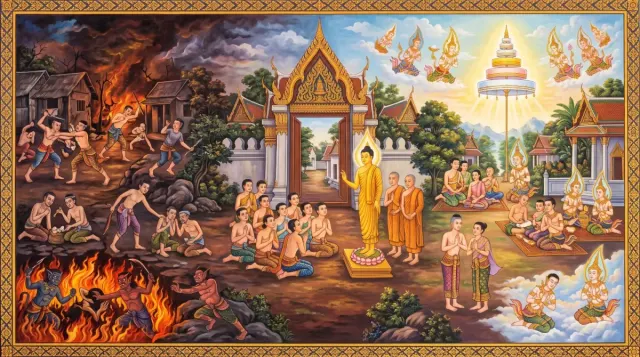
Arriving at Pāṭaligāma, the Buddha tells the lay followers that an immoral person faces five dangers — from lo…

A group of debates at the end of chapter 13 asks whether one in jhāna can relish that jhāna at the same moment…