
The Analysis of the Heart of the Teaching: The Census That Closes the Book
DhammahadayavibhaṅgoThe final Vibhaṅga opens with plain questions — how many aggregates, how many sense bases — then asks the same…


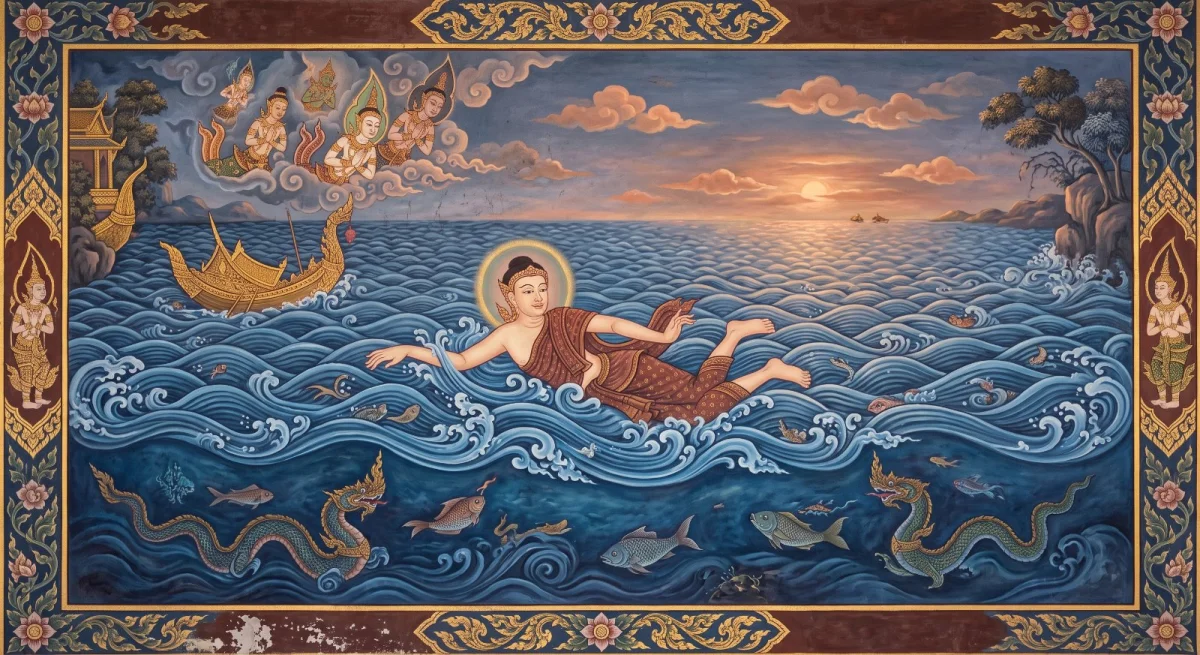
Mahājanakajātakaṃ
Mahājanaka keeps swimming in the middle of the ocean though he cannot see the shore, because he sees the value of effort. Later, as king, he sees a mango tree stripped for its fruit and renounces the throne to go forth. A Jātaka about effort that never gives up and about knowing how to let go.
In the Mahājanaka Jātaka of the Mahānipāta, Khuddaka Nikāya, the canonical text consists entirely of verses; the full story comes from the Jātaka commentary (Jātakaṭṭhakathā). The Bodhisatta is born as Mahājanaka. The heading in the Thai translation says he fulfilled the perfection of energy (viriya-pāramī), following the traditional arrangement of the Ten Great Jātakas.
The first verses are a dialogue at sea. A deity asks why he keeps trying to swim when everyone else has drowned and no shore is visible. Mahājanaka answers that he sees the benefit of effort: one who strives, even if he dies, is not blamed and has no regrets later. The deity then carries him where his heart wishes. There follow verses with a riddle of sixteen treasures, and verses saying that the wise should keep hoping and striving without growing weary.
The second half is about going forth. The king repeatedly muses on when he will leave Mithilā to go forth, and then truly does so. When people report that the treasuries are burning and bandits are plundering the country, he says that we who own nothing live happily. The ascetic Nārada warns him that wearing the ochre robe is not yet crossing over the defilements. He says two mango trees were his teachers, and at the end he cites the words of a girl wearing a single bracelet and of an arrow-maker who closes one eye to sight an arrow, telling Queen Sīvalī they should part ways.
Well-known details, such as his father dying before Mahājanaka was born, sailing off to trade and being shipwrecked, swimming for seven days, the name of the goddess Maṇimekhalā who rescued him, and Queen Sīvalī arranging the reports of fire and bandits to make him turn back, come from the commentary.
The deity asks what benefit he sees in struggling to swim in mid-ocean with no shore in sight. Mahājanaka replies that he sees the way of the world and the benefit of effort. One who strives, even if he dies, is not blamed among relatives, deities and Brahmās, and one who has fully done a man's work has no remorse afterwards.
On days when your work or recovery seems hopeless, do today's part fully, so that whatever the outcome, you won't regret not having tried.
The deity objects that effort in an impossible situation is pointless. Mahājanaka answers that one who abandons effort in such a situation will know the fruit of laziness. People work because they see the result they hope for, whether or not the work succeeds, and the result is already evident: the others have all drowned, while he alone is still swimming and has met the deity.
When people tell you what you're doing can't be done, look for small evidence that you've come further than yesterday, and use it as encouragement to keep going.
Mahājanaka says the wise should keep hoping and striving without growing weary, for he has seen himself carried from the water to land and become king as he wished. The wise, even when struck by suffering, do not cut off hope that happiness will come. He also says that the wealth of a woman or man is not achieved by thinking alone.
Write down your goal, then turn it into things to act on this week, because intentions that are never acted on have never changed anyone's life.
Nārada asks who taught him. Mahājanaka replies that he never went to question any renunciant, but one day in the royal park he saw a mango tree with fruit that people had broken until not a leaf remained, while another without fruit stood green and beautiful. He saw that the wealthy are harassed by enemies like the fruiting mango tree. People kill a leopard for its skin, an elephant for its tusks, a rich man for his wealth, but who would kill one who has no home and no ties?
Before accumulating more things or seeking a higher position, count how much more guarding, protecting and competing it will require of you.
When people report that the treasuries are on fire and bandits are plundering the country, and beg him to return, Mahājanaka says: how happily we live, we who have nothing; while Mithilā burns, nothing of mine is burned. We shall feed on joy like the radiant gods of the Ābhassara realm.
When something you love is damaged or lost, ask whether the core of your life, such as your virtue, love and good intentions, is still intact.
Nārada warns him not to think that merely wearing the ochre robe means he has crossed over the defilements. Many dangers remain: sleep, laziness, drowsiness, discontent and sluggishness after meals. He advises him to perfect virtue and meditative absorption with patience and calm, and not to regard himself as a king.
Changing your outward image, like going to the temple, wearing white or buying Dhamma books, is only a start. Watch the laziness and drowsiness in daily life, which is the real work.
A girl explains that two bracelets on one wrist clink against each other, while a wrist with one makes no sound, like a silent sage. An arrow-maker says that sighting with both eyes blurs so the arrow can't be straightened; closing one eye lets him see the bend. Both say that when two people are together they quarrel, but with whom would one person quarrel? Mahājanaka then tells Sīvalī that they should each take a separate road.
When you need deep concentration, find time alone, turn off notifications and focus on one thing, like the arrow-maker closing one eye to aim true.
The verses at sea are a mainstay for anyone doing hard work without yet seeing results, such as a patient in long treatment, someone starting a business or a student preparing for exams. The effort in this Jātaka is not stubbornness; it is seeing that as long as there is a way to survive, giving up halfway is surrendering to the worst outcome yourself.
The second half teaches the other side. Even someone who has striven and gained everything must know how to let go. The mango tree with fruit was broken by the crowd, while the fruitless one stayed green: having much also brings much danger.
Leaving family to go forth is the way of a renunciant in that context. For those with families, apply this point as loosening attachment to wealth and status, not abandoning responsibilities.
Tap to read the actual passage on the page cited.
The final Vibhaṅga opens with plain questions — how many aggregates, how many sense bases — then asks the same…

Apadānas of people who offered no ornament at all, but built a bridge, levelled a path, made steps up to a shr…

The Buddha places a little dust on his fingernail and compares it with the great earth: beings who are born as…

A wanderer declares, "Nothing is acceptable to me." The Buddha asks whether that view is unacceptable too. One…