
The Eighteen Elements
Aṭṭhārasa dhātuyoPerception broken into eighteen elements — six sets of three (sense faculty, object, consciousness) — showing …


Sāmaññaphalasuttaṃ
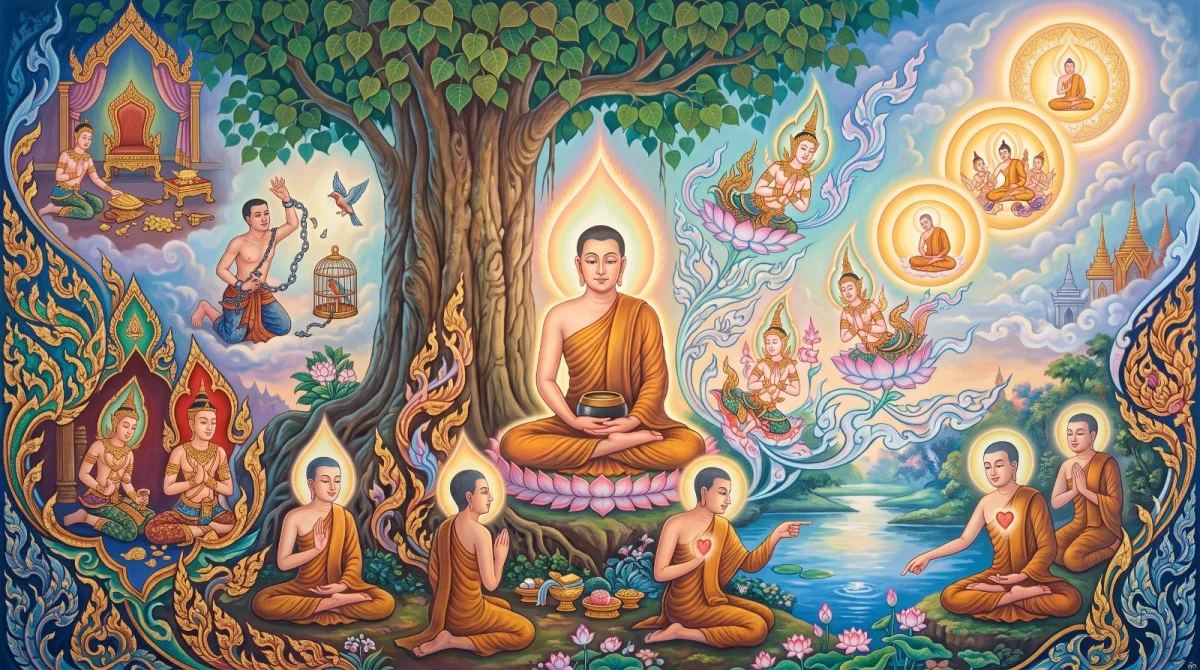
King Ajātasattu asks whether going forth yields any fruit visible in this life. The Buddha answers step by step — from the respect one receives, the happiness of virtue and the relief of abandoning hindrances, up to the knowledge that ends the taints.
The Sāmaññaphala Sutta is the second discourse of the Dīgha Nikāya. King Ajātasattu, who had killed his own father, visited the Buddha in Jīvaka's mango grove on a full-moon night, fearful of a trap, because the many monks were so silent there wasn't a sound.
He asked whether there is a fruit of the contemplative life visible here and now, as with other occupations, and related that he had asked six other teachers, who gave answers that missed the question — like being asked about mangoes and answering about breadfruit.
The Buddha answered in order from the first fruits to the highest. At the end, Ajātasattu declared himself a lay follower and confessed the wrong of killing his father. After he left, the Buddha said that had the king not killed his father, the eye of Dhamma would have arisen in him right there.
A king's slave or worker who goes forth and lives well would be greeted by the king himself, offered a seat, given requisites and protected righteously — the first visible fruit. The same holds for a tax-paying farmer who goes forth.
Good conduct truly changes how others see us, whatever our starting status.
A monk accomplished in virtue sees no danger from any quarter, like an anointed king who has defeated his enemies, and experiences an inner blameless happiness.
Notice the ease of mind on a day you did nothing wrong. That is the immediate fruit of virtue.
Having abandoned the hindrances, one is like someone who has paid off a debt, recovered from illness, been released from prison, freed from slavery, or safely crossed a desert — and gladness, rapture, calm and happiness arise.
When the mind is free even briefly of wanting, irritation, dullness, restlessness and doubt, that relief is a real, visible fruit. Read alongside "The Five Hindrances".
With the mind calm, one attains the four jhānas, each with a simile: bath powder moistened through, a lake fed by a spring from within, lotuses immersed in cool water, a person wrapped entirely in white cloth.
See "The Four Jhānas". The lesson: there is happiness finer than sensual pleasure, born of a calm mind.
With the mind concentrated and pure, one directs it to knowledge: insight knowledge, the mind-made body, psychic powers, the divine ear, knowing others' minds, recollecting past lives, the divine eye, and the knowledge of the destruction of the taints — the most sublime fruit of the contemplative life.
This is here for understanding the overall picture. Read alongside "The Six Higher Knowledges", which notes the most important is the ending of the taints, not powers.
This discourse answers a question many people have: "What does practising the Dhamma give me in this life?" The answer isn't only about future lives, but about fruits visible at once, in order — the ease of having nothing to hide, relief like recovering from illness, and ever-deepening calm.
The end of Ajātasattu's story is a heavy lesson: some grave deeds genuinely close off spiritual opportunities, even after remorse. Read alongside "The Aṅgulimāla Discourse: I Have Stopped".
Tap to read the actual passage on the page cited.
Perception broken into eighteen elements — six sets of three (sense faculty, object, consciousness) — showing …
Sāriputta arranges the Dhamma in sets of one, two and three, each with ten functions, such as what is most hel…
A headman who is a professional warrior asks about his teachers' claim that a warrior killed in battle is rebo…

The discourse on the thirty-two marks of a great man. What can actually be used is the list of deeds the disco…