
Renouncing the Training: Venting and Deciding Are Not the Same Thing
Sikkhaṃ appaccakkhāya dubbalyaṃ anāvikatvāThe Vinaya separates words that merely reveal a weak heart from words that actually count as leaving the train…


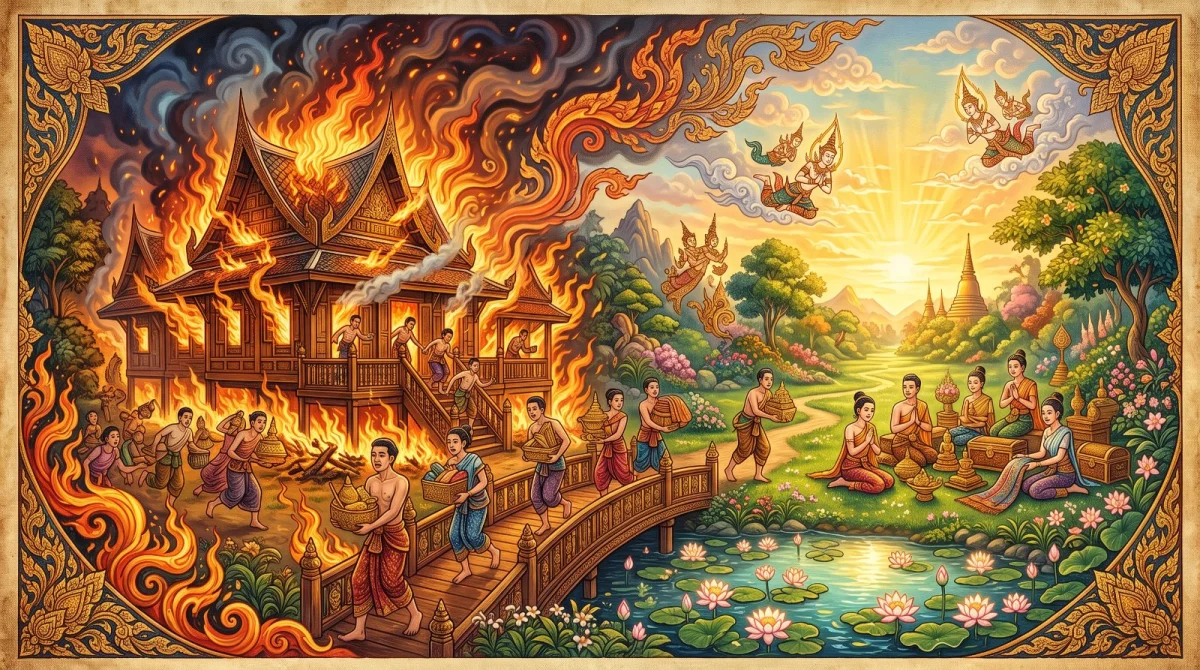
Ādittasuttaṃ
When a house is on fire, only what is carried out can still be used. Life, burning with ageing and death, is the same: what has been given is what has been carried out. The chapter also says what each kind of gift really gives, and whose merit grows day and night.
In the Āditta Sutta of the Devatā Saṃyutta, Saṃyutta Nikāya, a deity visits the Buddha at Jetavana late at night and speaks verses: when a house is on fire, whatever vessel the owner carries out is of use to him, while what is left inside burns. The world, burning with ageing and death, is the same. One should carry out by giving, for what is given is well carried out.
Other discourses in the same chapter extend the picture. In the Kiṃdada Sutta, a deity asks what one gives to give strength, beauty, happiness, sight and everything. The Anna Sutta speaks of giving with faith and a clear, confident mind. The Vanaropa Sutta speaks of those who plant parks and groves, build bridges, and provide water sheds, wells and shelter. In the Jetavana Sutta, a deity says beings are purified by action, knowledge, Dhamma, virtue and a noble life, not by clan or wealth.
The verses of this chapter say that giving leads to heaven and happiness; that is the discourse's own teaching. This page focuses on what can be applied in present-day life.
When a house is on fire, whatever vessel the owner carries out can still be used; the rest burns. The world is likewise burning with ageing and death, so one should carry things out by giving.
Look at what you own and ask: if one day I had to leave all this, which part has already done some good for someone?
What has been given brings happiness as its fruit. What has not been given can still be taken by thieves, seized by kings, burnt by fire, or simply lost.
When you worry about losing your belongings, remember that what you have already used to help others can no longer be lost to anything.
At death we must leave the body along with all we possess. Knowing this, the wise should both enjoy their wealth and give. Having given and used it according to their means, they are beyond reproach.
Divide your income into a part for yourself and your family and a part for giving. It needn't be much, but let it be regular.
In the Kiṃdada Sutta, the Buddha says: one who gives food gives strength; clothing gives beauty; a vehicle gives happiness; a lamp gives sight; one who gives shelter gives everything; and one who teaches the Dhamma gives the deathless.
Before giving, think about what the other person lacks: food, clothes, transport, light, a place to stay, or good advice. Then give what matches that need.
In the Anna Sutta, a deity says that gods and humans alike delight in food. The Buddha replies that for those who give food with faith and a clear, confident mind, that food comes back to support them in this world and the next. So one should remove stinginess, which is a stain, and give.
When you feel reluctant as you are about to give, notice that feeling without blaming yourself, and start with what you can give while your mind stays clear.
In the Vanaropa Sutta, the Buddha says that for those who plant parks and groves, build bridges, and provide water sheds, wells and shelter, merit grows at all times, day and night, because these things go on being useful.
Join in planting trees in your community, repair a footpath, set up a drinking-water point outside your home, or support public projects that many people will use for a long time.
In the Jetavana Sutta, a deity says beings are purified by five things: action, knowledge, Dhamma, virtue and a noble life, not by clan or wealth. So the wise should examine the Dhamma carefully.
When deciding whom to respect, look at their actions and conduct rather than their surname, position or status.
The image of a burning house changes how we see our possessions. Everything we keep is always at risk of being lost, but what we have shared has become a benefit no one can take back. The verses don't ask us to throw everything away; they say "use it, and give" according to our means.
Giving in this chapter is broader than putting money in an envelope at the temple. Planting trees for shade, making a path or bridge for people to cross, setting up drinking water, opening your home to someone who needs a place to stay, or teaching something good to others all count as giving.
Give within your means, without causing hardship to yourself or your family, and without calculating returns. The results of heaven and wealth in the verses are a religious teaching, not a financial guarantee.
Tap to read the actual passage on the page cited.
The Vinaya separates words that merely reveal a weak heart from words that actually count as leaving the train…

By what does one realise, and when are defilements abandoned? Past defilements are already gone, future ones h…

The monks of Campā suspended one another at will — one monk suspending many, a Saṅgha suspending a Saṅgha. The…

Three consecutive debates asking whether an arahant still has ignorance, doubt, or dependence on being instruc…