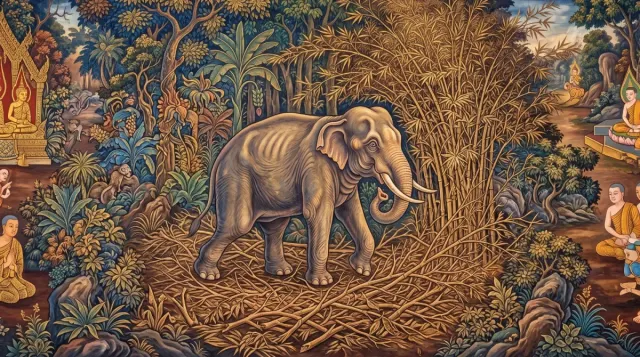
The Dubbalakaṭṭha Jātaka: The Elephant Wasting Away in Fear of Dry Branches
DubbalakaṭṭhajātakaṃAn elephant that had been trained by intimidation escapes into the forest but still startles at every sound. A…


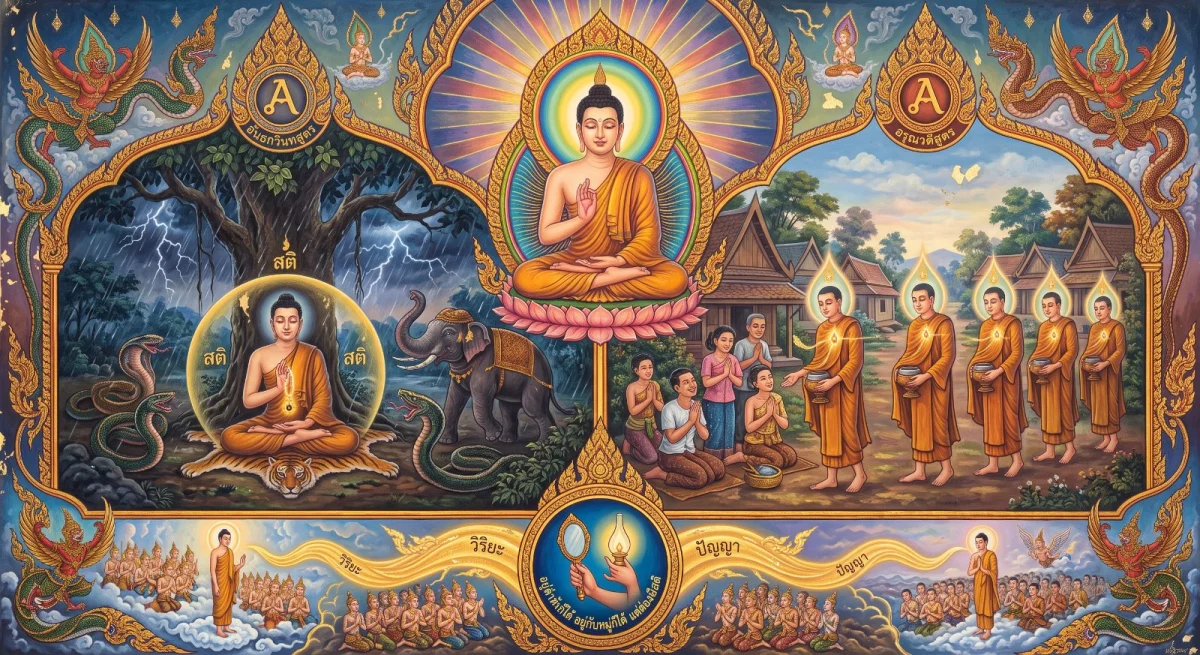
Andhakavindasuttaṃ
Brahmā Sahampati advises resorting to secluded lodgings, and if one finds no delight there, living in the community guarded and mindful. Then there is Abhibhū's verse: rouse yourselves, go forth, apply yourselves; sweep away the army of Death as an elephant crushes a hut of reeds.
In the Andhakavinda Sutta of the Brahma Saṃyutta, Saṃyutta Nikāya, the Buddha is sitting in the open at Andhakavinda in Magadha on a pitch-dark night with rain drizzling down. Brahmā Sahampati comes to him and speaks verses: a monk should resort to secluded lodgings; if he finds no delight there, he should live in the Saṅgha, guarded, mindful and restrained in his senses. The verses then describe a monk sitting without fear even where there are frightening snakes, lightning flashes and rain in the dark night. At the end, Sahampati says he has seen for himself that many have attained the Dhamma, and he cannot count the rest for fear of speaking falsely.
In the Aruṇavatī Sutta of the same chapter, the Buddha tells a story from the time of the Buddha Sikhī, who invited his chief disciple Abhibhū to a Brahmā world and asked him to teach the Dhamma to the Brahmās. The Brahmās grumbled that a disciple was teaching in the presence of the Teacher, so Sikhī told Abhibhū to stir them even more. Abhibhū taught with his body visible and invisible, and then spoke a verse heard throughout the world-system: rouse yourselves, go forth, apply yourselves to the Buddha's teaching.
The verses of these two discourses are addressed mainly to monks, and they include supernormal feats as the discourses tell them. This page focuses on principles lay people can apply.
Brahmā Sahampati says a monk should resort to secluded lodgings and live for release from the fetters. Seclusion is a tool, not an end in itself.
Find a little quiet time each day. Switch off your phone, be with yourself, and notice what the mind does in that silence.
If a monk finds no delight in seclusion, he should live in the Saṅgha, guarded and mindful, walking for alms from family to family. The verse doesn't criticise one who cannot yet live alone; it points out the way that suits him.
If practising alone at home isn't consistent, try joining a meditation or Dhamma study group. Having others around can greatly support your practice.
Whether in the community or in seclusion, a monk should guard his senses, be prudent and mindful. The place can change, but this quality must go everywhere with him.
Among many people, at work or at a party, deliberately notice what you are looking at, what you are listening to, and which way your mind is leaning.
The verses describe a monk freed from fear, inclined to what is fearless, sitting without his hair standing on end even where there are frightening snakes, lightning and rain on a dark night. This matches the scene of the discourse, where the Buddha himself was sitting in the open on such a night.
When conditions aren't ideal, with noise, bad weather or commotion around you, try sitting calmly for a short time in that situation instead of waiting for everything to be perfect.
Sahampati says that what he reports he has seen for himself, not heard by hearsay: over a thousand who have left death behind and many trainees besides. As for the rest of the people who share in merit, he says he cannot count them for fear of speaking falsely.
When reporting numbers or results, state only what has been checked. For what you are unsure of, say plainly that you didn't count it, rather than estimating to look good.
The Buddha Sikhī asked Abhibhū to give a Dhamma talk to the Brahmās. Even when the Brahmās complained that a disciple shouldn't teach in the Teacher's presence, Sikhī didn't step in and take over; he had Abhibhū teach even more fully.
If you are a leader or teacher, let a team member or student present, even while you are in the room, and stand by them when others question whether they are fit to do so.
Abhibhū's verse says: rouse yourselves, go forth, apply yourselves to the Buddha's teaching; sweep away the army of Death as an elephant crushes a hut of reeds.
On lazy days, use these three words as steps: start with a small action, get past the urge to quit, then keep going steadily.
The verse ends: whoever dwells heedfully in this Dhamma and discipline will abandon the round of births and make an end of suffering. The monks in the city of Aruṇavatī told the Buddha Sikhī that they had heard this verse.
Recite this short verse before meditating or before starting a difficult task, as a reminder that heedfulness today is something you can actually do.
Sahampati's advice is very generous. Seclusion is good, but not everyone can be alone and at peace at every stage of life. If being alone leaves you restless or lonely, returning mindfully to a group of good friends is also the right path. What doesn't change is guarding yourself and staying mindful.
For lay people, this might mean setting aside some quiet time, such as walking alone or sitting calmly before bed, and if practising alone feels too hard, joining a meditation group or inviting a friend to practise together.
Abhibhū's verse is a short, memorable call to effort, useful on days when practice feels stuck. If loneliness or low mood becomes heavy enough to affect daily life, talk to someone you trust or to a professional.
Tap to read the actual passage on the page cited.
An elephant that had been trained by intimidation escapes into the forest but still startles at every sound. A…

Dark kamma, bright kamma, kamma both dark and bright, and kamma neither dark nor bright that leads to the endi…
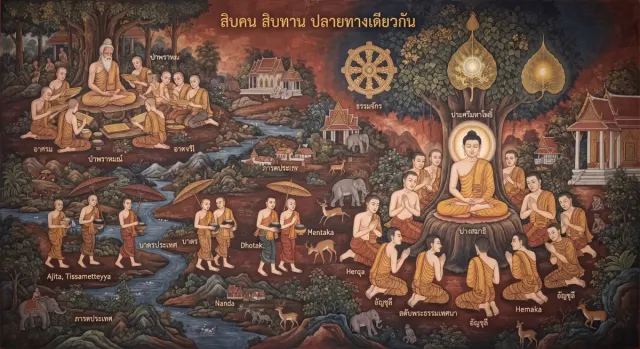
The Metteyya vagga collects the apadānas of ten elders who had been pupils of the brahmin Bāvarī. Each recount…

King Janasandha teaches that there are ten things which, if not done beforehand, cause regret later: not earni…