
Mahānāma and the Ghee He Asked Them to Wait For: When Resentment Hides Inside a Request
Ajjuṇho bhante āgamethaMahānāma the Sakyan invites the Saṅgha to ask him for medicines for four months, then four more, then for life…


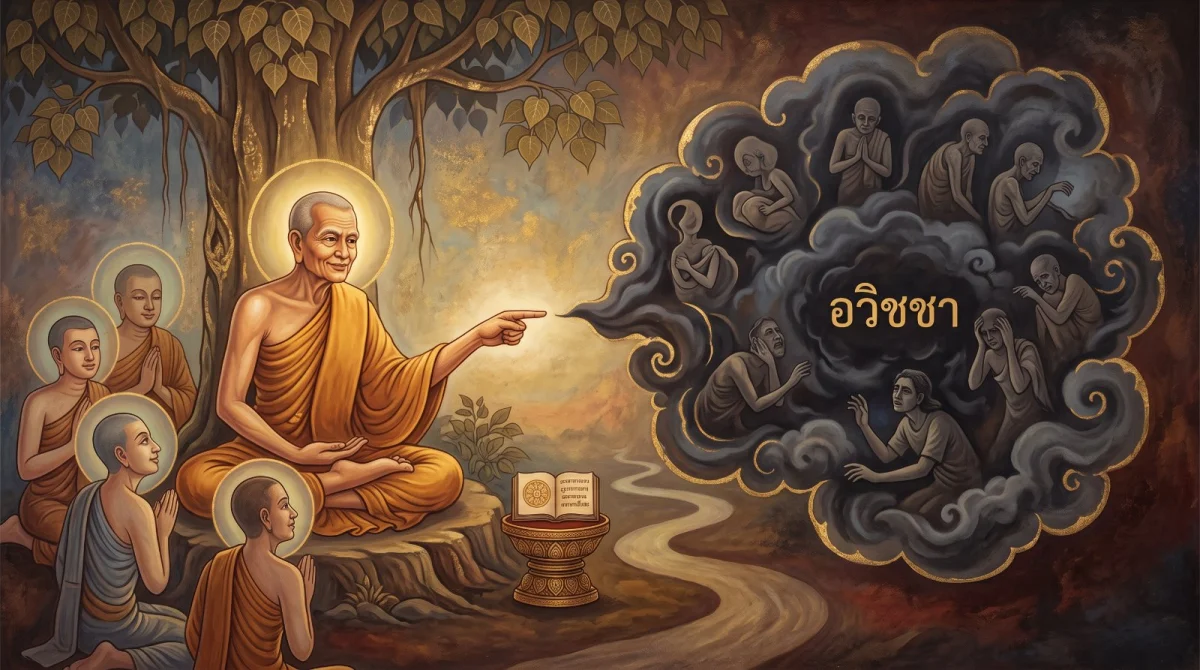
Katamā nu kho bhante avijjā
A monk asks what ignorance is. The Buddha says it is not knowing as it really is that the five aggregates are subject to arising and passing away. Sāriputta and Mahākoṭṭhita then question each other from several angles, and full understanding is measured by the ending of lust, hatred and delusion.
In the Avijjā Vagga of the Khandha Saṃyutta, Saṃyutta Nikāya, a monk asks the Buddha: what is this thing called ignorance, and in what way is one immersed in ignorance? The Buddha says that the uninstructed ordinary person does not understand as it really is that form is subject to arising, subject to passing away, and subject to both arising and passing away, and likewise feeling, perception, volitional formations and consciousness. This is called ignorance. Knowledge is understanding those same things as they really are.
The remaining discourses of the chapter are conversations between Sāriputta and Mahākoṭṭhita in the Deer Park at Isipatana, taking turns as questioner and answerer. They explain ignorance and knowledge in terms of the gratification, danger and escape of the aggregates; in terms of their arising, passing away, gratification, danger and escape; and in terms of the noble truths: knowing each aggregate, its origin, its cessation and the way leading to its cessation.
In the Anta Vagga of the same Khandha Saṃyutta, the Pariññeyya Sutta says that the things to be fully understood are the five aggregates; full understanding is the ending of lust, hatred and delusion; and the one who has fully understood is the arahant. The Chandappahāna Sutta tells us to abandon desire and lust for the aggregates until they are like a palm stump that cannot grow again.
The Buddha answers the monk: the uninstructed ordinary person does not understand as it really is that form is subject to arising, and that feeling, perception, volitional formations and consciousness are subject to arising. This is called ignorance, and in this way one is immersed in ignorance.
When an emotion such as irritation comes up, tell yourself "this has just arisen" instead of feeling it as a self that has always been there.
Besides not knowing that things arise by nature, the ordinary person does not know that they pass away by nature, nor that they both arise and pass away by nature. Seeing only one side is not yet complete.
When happiness or unhappiness passes through, notice both when it begins and when it fades. With practice you will see that everything always has both phases.
The monk then asks what knowledge is. The Buddha says the instructed noble disciple understands as it really is that the five aggregates are subject to arising, to passing away, and to both. Knowledge is not learning some mysterious new thing but seeing correctly what is right in front of us.
When studying the Dhamma, ask whether what you are learning helps you see your own body and mind more as they really are, rather than how much new information you have gained.
Several discourses in this chapter are conversations between Sāriputta and Mahākoṭṭhita in the Deer Park at Isipatana. In some, Mahākoṭṭhita asks and Sāriputta answers; in others, Sāriputta asks and Mahākoṭṭhita answers, with the same question: what is ignorance, and what is knowledge?
Find a friend to review the Dhamma with and take turns explaining what you understand. Explaining to someone else shows you where you are still unclear.
Sāriputta and Mahākoṭṭhita further explain ignorance as not understanding as it really is the gratification, danger and escape of the aggregates. Some discourses add arising and passing away, and the third Koṭṭhita Sutta explains it in terms of the noble truths: not knowing each aggregate, its origin, its cessation and the way leading to its cessation. This point is for overall understanding.
When facing a problem, look at it from several angles: the appeal that keeps you attached, the hidden downside, the way out, the cause, and how to reach the way out.
In the Pariññeyya Sutta, the Buddha says he will teach the things to be fully understood, full understanding, and the person who has fully understood. The things to be fully understood are form, feeling, perception, volitional formations and consciousness.
Start with what is with you every day: your body, feelings, memories, thoughts and awareness. There's no need to look far away for what must be understood.
Full understanding is the ending of lust, the ending of hatred, the ending of delusion, and the person who has fully understood is the arahant. Understanding here is measured by its result in the mind, not by the amount of information.
Check your progress with a simple question: compared with last year, am I less greedy, less angry and less deluded this year?
In the Chandappahāna Sutta, he tells us to abandon desire, lust, delight and craving for form, feeling, perception, volitional formations and consciousness. When these are abandoned, that aggregate is abandoned, cut off at the root, made like a palm stump, no longer subject to future arising.
Choose the one craving that overpowers you most often, and gradually stop feeding it, like not watering a shoot you don't want to grow.
The definition of ignorance in this chapter differs from the everyday idea. Ignorance doesn't mean being illiterate or lacking information. A very knowledgeable person can still be ignorant if they have not yet seen as it really is that their body, feelings, memories, thoughts and awareness arise and pass away by nature.
The Pariññeyya Sutta gives a straightforward measure. Understanding the Dhamma is not measured by how much you remember or how well you explain, but by whether lust, hatred and delusion have really decreased. You can check yourself with it every day.
The picture of Sāriputta and Mahākoṭṭhita taking turns asking and answering is an example of companions on the path reviewing the Dhamma together as equals, not showing off knowledge.
Tap to read the actual passage on the page cited.
Mahānāma the Sakyan invites the Saṅgha to ask him for medicines for four months, then four more, then for life…
Seeing Sāriputta's radiant face, Ānanda asks what he has been dwelling in. He answers that he entered jhāna wi…
In several Apadāna stories, elders tell how in one life they were a ruddy goose, a king of the garuḍas, a monk…

Four matters not to be speculated about — thinking about them brings only exhaustion and vexation, not freedom…