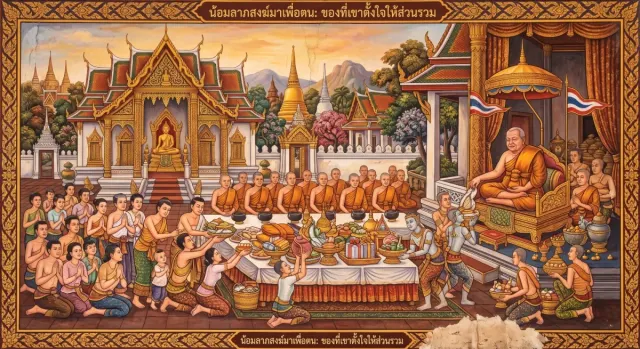
Diverting Offerings for the Saṅgha to Oneself: What Was Meant for Everyone
Jānaṃ saṅghikaṃ lābhaṃ pariṇataṃ attano pariṇāmeyyaA group of lay people prepared a meal with robes for the Saṅgha every year. The group of six monks pressed the…



Anupubbābhisamayakathā
One side held that penetration of the four noble truths happens in instalments, one quarter at a time. The Theravādin accepts that the training is gradual, but holds that in the moment of penetration all four truths are seen together, and that no one is a quarter of a stream-enterer.
In the Anupubbābhisamaya Kathā of the Kathāvatthu, volume 37 of the Tipiṭaka, the opponent proposes that abhisamaya, the breakthrough or penetration of the Dhamma, happens gradually, piece by piece. The Theravādin asks in return: then does one develop the path of stream-entry piece by piece, and realise the fruit of stream-entry piece by piece? The opponent cannot accept that.
The sharpest question comes when the opponent says that the practitioner abandons a quarter of the defilements with each truth seen. The Theravādin replies: then is a quarter of him a stream-enterer and three quarters not a stream-enterer? Is a quarter of him endowed with unshakable confidence in the Buddha, the Dhamma and the Saṅgha, and three quarters not? Again the opponent cannot accept it.
At the end both sides quote discourses. The opponent quotes the passage about the great ocean that slopes, slants and inclines gradually and does not drop off abruptly, likened to gradual training, gradual practice and a gradual path; and the verse about the wise one who removes his own stains little by little, like a smith refining silver. The Theravādin quotes what the elder Gavampati said he had heard directly from the Buddha: whoever sees suffering also sees its origin, its cessation and the way to its cessation; and the passage in which, together with the arising of the dust-free vision of the Dhamma, three fetters are abandoned.
The commentary (aṭṭhakathā) attributes the opponent's view here to the Andhakas, Sabbatthivādins, Sammitīyas and Bhadrayānikas. These school names come from the commentary; the text itself speaks only of the Sakavādin and the Paravādin.
The Theravādin asks whether the penetration of the Dhamma happens gradually, and the opponent agrees. Abhisamaya here means the moment in which path knowledge penetrates the noble truths, not the whole process of training. This point is for overall understanding.
Before arguing about anything, agree on what the key word in the sentence means. A great many disagreements vanish right there.
The Theravādin asks whether one therefore develops the path of stream-entry gradually and realises its fruit gradually. The opponent says that cannot be said, although it follows directly from what he has accepted. The same questioning is repeated for the paths of once-returning, non-returning and arahantship.
When you accept a principle, ask what conclusions it leads to. If you cannot accept the conclusions, reconsider the principle.
The opponent says that one practising for the fruit of stream-entry abandons a quarter of identity view, doubt, clinging to rules and observances, and the defilements of that group, by seeing suffering. The Theravādin replies: then is a quarter of him a stream-enterer and three quarters not, and is a quarter of him endowed with the virtues dear to the noble ones while three quarters is not? The opponent cannot accept it.
Some things do not divide into fractions, such as trust or forgiveness. Saying you have half forgiven someone usually means you have not.
The Theravādin affirms that when suffering has been seen, the four truths have been seen, and quotes the elder Gavampati, who told the monks he had heard it face to face from the Buddha: whoever sees suffering also sees its origin, its cessation and the way to its cessation. The truth of suffering does not become four truths; rather that single seeing covers all four.
When you really understand a problem, you usually see at once what causes it, what ends it and what to do. If you only see one side, you do not understand it yet.
The discourse the opponent quotes says that the great ocean slopes, slants and inclines gradually and does not drop off abruptly, and that in this Dhamma and discipline there is likewise gradual training, gradual practice and a gradual path. The Theravādin does not reject this discourse; he only points out that it is about something other than the moment of penetration.
Do not wait for a burst of inspiration. Take the one step you can actually take today; a gentle slope carries you deep on its own.
The other verse the opponent quotes says that the wise one should remove his own stains little by little, moment by moment, in due order, as a smith removes the stains of silver. This verse speaks of steady self-purification, which is the accumulation of causes, not the dividing of the path moment into fractions.
Set yourself something small you can do daily, such as one minute of noticing your mood on waking. Regularity beats occasional intensity.
The Theravādin closes with the discourse in which the dust-free, stainless vision of the Dhamma arises in a noble disciple — whatever is subject to arising is subject to cessation — and together with the arising of that vision the three fetters of identity view, doubt and clinging to rules and observances are abandoned. It is the word together that tells against realisation in instalments.
When you truly see something clearly, doubt about it falls away by itself. You do not have to force yourself to believe.
The lesson here is not that practice needs no gradual build-up. Both sides accept the discourse on gradual training. What differs is this: what accumulates little by little is the cause, while the result called seeing the Dhamma occurs in a single moment.
Daily life is full of things that work this way. We read, listen and review for months, and then one day the understanding falls into place in a breath. The stretch that felt like no progress was not wasted; it was the cause being built.
On the other side, this debate warns against measuring inner progress in percentages. Telling yourself you are forty percent free of attachment is usually arithmetic rather than honest looking. What you can actually do is take care of the causes today and let results be results.
Tap to read the actual passage on the page cited.
A group of lay people prepared a meal with robes for the Saṅgha every year. The group of six monks pressed the…

The wanderer Vekhanassa exclaims "This is the supreme colour!" The Buddha compares lights from a firefly to th…

Mahāmoggallāna's verses: the happiness of forest dwelling, the body as a hut of bones, a steady mind that can …

Seven contemplations each fulfil a kind of wisdom, and four things, associating with good people, hearing the …