
Mahākaccāna's Verses: Knowing Yourself, Not by Others' Words
MahākaccāyanattheragāthāEight verses of Mahākaccāna: not taking on more work than needed, the subtle dart of honour, no one is a thief…


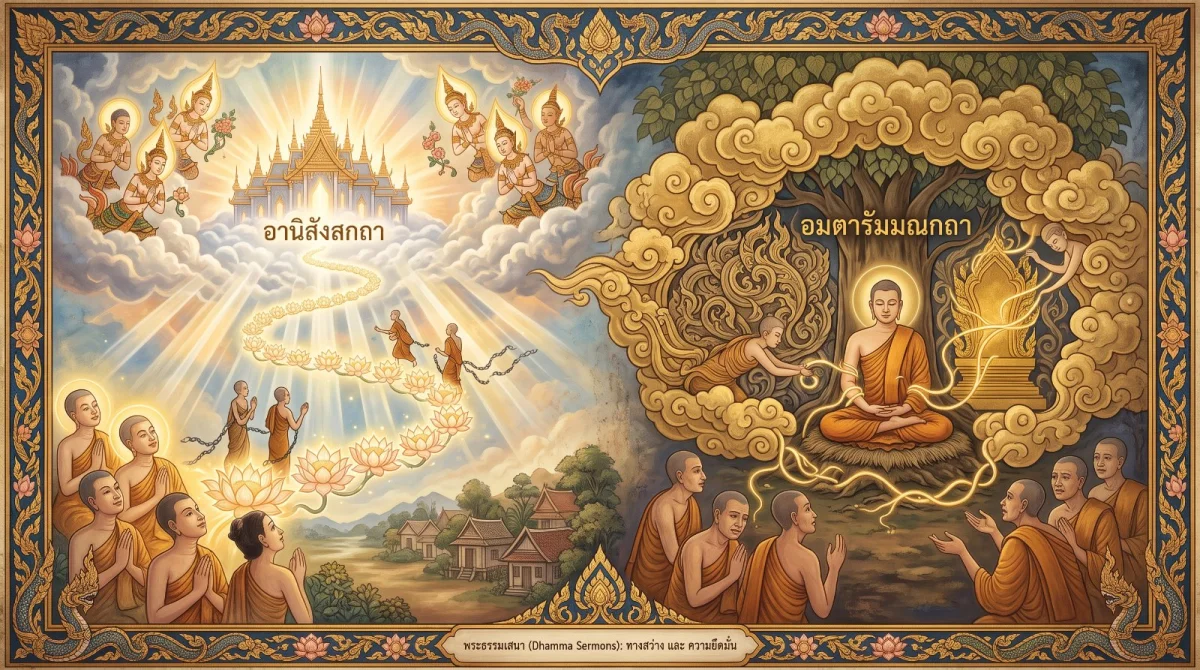
Ānisaṃsakathā
Two debates opening chapter 9. One side holds that one who sees the benefit in Nibbāna abandons the fetters; the Theravādin points out that the fetters are abandoned by attending to formations as impermanent, suffering and not-self, and that one mind cannot do both at once. The second debate asks whether the fetters can have the Deathless as their object, and the other side quotes a discourse saying that an ordinary person can still conceive and delight in Nibbāna.
In the Ānisaṃsa Kathā of the Kathāvatthu, Abhidhamma Piṭaka, Tipiṭaka volume 37, chapter 9, the opponent (paravādī) proposes that one who sees the benefit in Nibbāna abandons the fetters. The Theravādin (sakavādī) asks in return: does not one who attends to formations as impermanent, as suffering, as a disease, a boil, a dart, and so on up to as subject to change, abandon the fetters? When the opponent agrees, he asks further whether one can attend to formations as impermanent and see the benefit in Nibbāna at the same moment. If so, there would be a meeting of two contacts and two minds, which the opponent rejects.
The opponent quotes the discourse in which a monk dwells contemplating Nibbāna as happiness, perceiving it as happiness, constantly resolving on it and plunging into it with wisdom, and so holds that seeing the benefit in Nibbāna does abandon the fetters.
The next debate, the Amatārammaṇa Kathā, asks whether the fetters have the Deathless (Nibbāna) as their object. The Theravādin asks whether the Deathless is a basis for lust, hatred and delusion, as form is. The opponent says no, but quotes the Buddha's words in the Mūlapariyāya Sutta that an ordinary person perceives Nibbāna as Nibbāna, then conceives Nibbāna, conceives it as mine, and delights in Nibbāna. The text ends with this claim and does not resolve it further.
The opponent accepts that one who sees the benefit in Nibbāna abandons the fetters — that is, that seeing the value of the end of suffering is itself what cuts the bonds.
After reading or hearing about peace and feeling good, ask yourself: has that feeling actually changed any of my old habits?
The Theravādin asks: does not one who attends to formations as impermanent abandon the fetters? The opponent agrees, so the Theravādin points out that, having accepted this, one should not say that seeing the benefit is what abandons the fetters.
When you're attached to something, watch it while it changes — an emotion that was strong and is slowly fading — rather than thinking about a distant ideal.
The text lists many ways to attend to formations: as suffering, a disease, a boil, a dart, a danger, unstable, not lasting, no refuge, empty, not-self and subject to change. Every one of them leads to abandoning the fetters.
Pick the aspect that fits what you're stuck on: a craving that stings, see as a dart; something you hope will last forever, see as not lasting.
The Theravādin asks whether attending to formations as impermanent and seeing the benefit in Nibbāna can arise together. If so, two contacts and two minds would meet in one moment, which the opponent rejects. This point is for overall understanding.
When you think you're doing two things at once, the mind is really switching back and forth, one at a time. So know what the mind is doing right now.
The opponent quotes the discourse that a monk contemplates Nibbāna as happiness, perceives it as happiness, experiences it as happiness, constantly and steadily resolves on it without distraction, and plunges into Nibbāna with wisdom. The Theravādin agrees that this discourse exists.
Recalling the value of peace is good encouragement. On days when you're tired of practising, remember what you're walking towards.
The Theravādin asks whether the Deathless is an object of the fetters, ties, floods, hindrances, clinging and defilements, and whether lust, hatred and delusion can arise with the Deathless as object as they do with form. The opponent says no, since the Deathless is not a basis for lust, anger or delusion, but supports wisdom and leads to Nibbāna.
If your practice is making you more irritable, more boastful or more confused, what the mind is holding is not peace itself but your ideas about peace.
The opponent quotes the Buddha: an ordinary person perceives Nibbāna as Nibbāna, then conceives Nibbāna, conceives in Nibbāna, conceives from Nibbāna, conceives Nibbāna as mine, and delights in Nibbāna. So he holds that the fetters can have the Deathless as object. The text ends with this claim.
Beware of wearing Dhamma words as ornaments, such as speaking proudly about letting go. A clinging mind is still a clinging mind, even when what it clings to is a fine word.
These two debates invite us to separate inspiration from the tool. Recalling the peace of liberation gives encouragement, but the Theravādin points out that what actually uproots the fetters is seeing what is arising and passing right in front of us as impermanent, suffering and not-self.
The second debate warns that even the highest goal can become something to cling to in an ordinary person's thinking — for instance, being proud of aiming for Nibbāna, or treating one's own understanding of Nibbāna as a possession. This applies to every ideal: goodness, calm, being a Dhamma person.
Both sides quote the Buddha's words. So the debate isn't saying that someone misread a discourse; it helps us see that the same words can refer to different moments of mind.
Tap to read the actual passage on the page cited.
Eight verses of Mahākaccāna: not taking on more work than needed, the subtle dart of honour, no one is a thief…

Hearing that the Buddha will soon set out wandering, Mahānāma asks how a householder with many kinds of duties…

The story of King Mahāsudassana, who ruled by Dhamma and owned eighty-four thousand of everything but used onl…

Six doors of experience — eye, ear, nose, tongue, body and mind. Everything that enters your life comes throug…