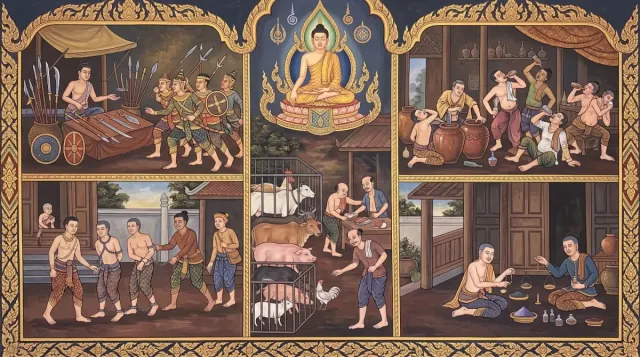
Five Wrong Trades
Pañca vaṇijjā upāsakena akaraṇīyāFive kinds of trade a lay follower should not engage in — weapons, human beings, meat, intoxicants and poison …


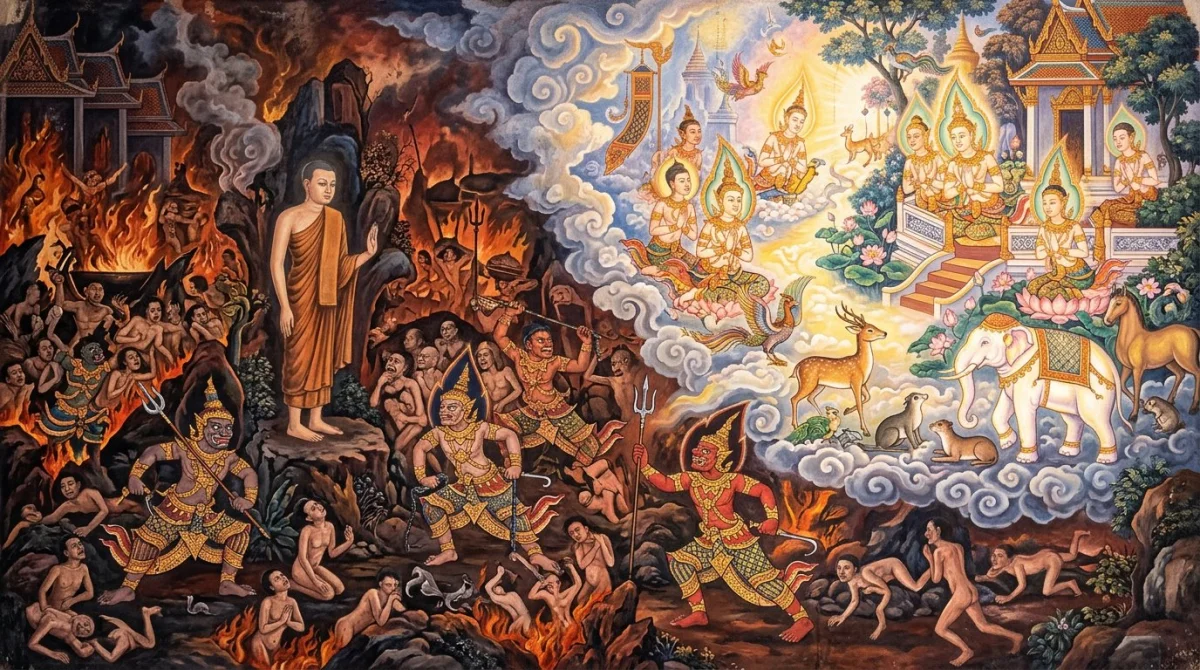
Tiracchānakathā
Two discussions in chapter twenty about how to read descriptions of other realms. One side denies there are wardens in hell; the other holds there are animals among the devas. The Theravāda side tests both with a simple question: if that were so, what else would have to be so?
In the Nirayapāla Kathā and the Tiracchāna Kathā of the Kathāvatthu, volume 37, chapter twenty, two questions are placed side by side, and both concern the same thing from opposite directions: how to read the canon's descriptions of other realms consistently.
In the first, the Paravādin holds that there are no wardens in the hells. The Sakavādin (the Theravāda side) asks whether there is punishment in the hells. When the Paravādin agrees that there is, he is asked why, when among human beings punishment implies someone who punishes, there should be punishment in hell with no one who carries it out.
The second reverses the direction. The Paravādin holds that there are animals among the devas, citing the great elephant Erāvaṇa and a divine chariot yoked to a thousand horses. The Sakavādin asks whether the deva world is then the animal womb, and whether there are also insects, grasshoppers, mosquitoes, flies, snakes, scorpions, centipedes and earthworms among the devas.
By tradition the Kathāvatthu was set out by the elder Moggalliputta Tissa at the third council. The commentary identifies the schools holding these views, but the school names are not in the text itself. This page is for overall understanding, follows the main lines of reasoning only, and does not reproduce the long descriptions of punishment in hell.
The Paravādin holds that there are no wardens in the hells. The Sakavādin asks at once whether there is then no punishment in the hells either. The Paravādin says that cannot be said. This point is for overall understanding.
Before cutting a part out of an account, check whether the rest still stands on its own.
The Sakavādin draws the comparison with human beings: among humans there is punishment and there are those who carry it out. If in hell there is punishment but no one who carries it out, then could there be punishment among humans with no one carrying it out? The Paravādin cannot accept it either way.
The same observation applies at work: if we say there is a task that must be done but nobody owning it, the task usually does not get done.
The Paravādin quotes the Buddha's words: it is not Vessabhū who kills, nor the king of the petas, nor Soma, Yama or Vessavaṇa; it is one's own deeds that strike down there the one driven from this world into the next. The verse is genuinely in the canon, and it stresses that the cause lies in the person's own actions.
When a result you did not want arrives, asking who did this to me helps less than asking which cause you can still change.
The Sakavādin quotes several passages in which the Buddha speaks of the wardens of hell inflicting punishment on beings there, along with the verse describing the great hell with its four corners and four gates, surrounded by iron walls. Since the discourses speak of them, it cannot be said that there are none. This page does not reproduce the descriptions of punishment in full.
When citing a text, read both what supports your view and what tells against it before drawing a conclusion.
The Tiracchāna Kathā opens with this question, and the Paravādin agrees that there are. The Sakavādin asks two questions back: are there then devas among the animals, and is the deva world the animal womb? The Paravādin denies both.
If the relation you are claiming holds one way but not the other, check whether you are using the same word in two senses.
The Sakavādin runs through the list: are there insects, grasshoppers, mosquitoes, flies, snakes, scorpions, centipedes and earthworms among the devas? The Paravādin says that cannot be said — he accepts only the handsome creatures and not the unappealing ones.
Beware of accepting a principle because you like its prettiest example. Test it with the example you would rather not think about.
The Paravādin points to the great elephant named Erāvaṇa and the divine chariot yoked to a thousand horses among the devas. The Sakavādin accepts that the texts speak of them, but that does not mean they are animals born in the deva world in the ordinary sense of the word.
The same name does not always mean the same thing. A rocking horse and a horse share a word and little else.
The Sakavādin's closing question: if there really were animals among the devas, would there also be elephant keepers, horse keepers, grass cutters, foremen and feeders of animals there? The Paravādin says that cannot be said, and the conclusion is that it cannot be said that there are animals among the devas.
The most useful question is often not about the claim itself but about what would have to surround it.
This pair of discussions is not trying to prove whether other realms exist; both sides already accept that they do. What is tested is consistency of speech. Anyone who takes one part of a description literally has to take what follows from it as well, and cannot keep only the agreeable parts.
The method works close to home. When someone tells you something startling, you can ask, in a friendly way, what else would also have to be true if that were. The question does not contradict anyone; it helps both sides see the picture more clearly.
The verse the Paravādin quotes in the first discussion — that it is one's own deeds that strike down the one whose merit is spent — is a direct and immediately useful reminder: suffering that comes of our own actions needs no one to administer it. It follows from the causes we made.
Tap to read the actual passage on the page cited.
Five kinds of trade a lay follower should not engage in — weapons, human beings, meat, intoxicants and poison …

The text explains that earlier instances are a condition making later instances of the same kind stronger. Its…

Three monastic training rules: not to be apart from the three robes for even one night; permission to keep a r…

King Bimbisāra asks that monks gather on the eighth, fourteenth and fifteenth of the fortnight as other sects …