
Divine Eye, Divine Ear, and Knowing How Beings Fare by Their Deeds
DibbacakkhukathāThree consecutive discussions in chapter three. One side held that the fleshly eye, when supported by Dhamma, …



Asañciccakathā
The Kathāvatthu asks whether one who unintentionally causes his mother's death has committed a deed with immediate result (anantariya kamma). Comparing it with the other precepts, the Theravāda side shows that even the gravest deeds require intention, and that in schism one must consider what the person took to be Dhamma.
In the Asañcicca Kathā of the Kathāvatthu, Tipiṭaka volume 37, chapter 20, the Sakavādī (the Theravāda side) asks: does one who takes his mother's life without intending to become one who has committed an anantariya deed? The Paravādī says yes. Anantariya deeds are the five gravest deeds: killing one's mother, killing one's father, killing an arahant, wounding the Buddha so that blood flows, and splitting the Saṅgha.
Tradition holds that the Kathāvatthu was set out by the Elder Moggaliputta Tissa at the Third Council. The commentary says this was the view of the Uttarāpathakas, who held that the objects of anantariya deeds are so weighty that whoever brings such an outcome about, even unintentionally, commits an anantariya deed.
The Sakavādī answers by comparing it with killing a living being, taking what is not given and lying without intention, which do not count as breaking the precepts, and points out that the discourses speak of intentionally taking one's mother's life; there is no discourse saying that doing so unintentionally is an anantariya deed. Towards the end, the debate also asks about schism by one who believes he is acting in accordance with the Dhamma.
The Sakavādī asks whether one who takes his mother's life without intending to has committed an anantariya deed, and the Paravādī says yes. The commentary says the Uttarāpathakas held that these matters are so weighty that whoever brings them about, even unintentionally, commits an anantariya deed.
When judging yourself or others by an outcome, always ask further: was it intended, and was the outcome foreseen?
The Sakavādī asks: does one who kills a living being without intending to become a killer? Does one who takes what is not given or speaks falsely without intending to become a thief or a liar? The Paravādī says no. The Sakavādī then points out that since these deeds require intention, killing one's mother unintentionally should not be anantariya. The commentary explains that an anantariya deed is also a course of action (kammapatha); if it counted without intention, the other deeds would have to count too.
If you accidentally step on an ant or pass on wrong information without knowing, don't sink into guilt, but be more careful and correct it once you know.
The Sakavādī asks: is there a discourse saying that one who unintentionally takes his mother's life commits an anantariya deed? The Paravādī says there is not. Asked whether there is a discourse saying that one who intentionally takes his mother's life commits an anantariya deed, he says there is. So it should not be said that doing so without intention is anantariya.
When someone quotes a teaching to settle a matter, ask whether that teaching really speaks of this case, or whether we are extending it ourselves.
The Paravādī asks: should it not be said that a matricide commits an anantariya deed? The Sakavādī agrees. The Paravādī then asks: has not the mother been deprived of life? The Sakavādī agrees again. The commentary explains that the Sakavādī's agreement refers to a death without intention, such as during medical treatment, but the Paravādī does not accept this explanation and uses the fact of the mother's death to set up his view.
If you cared for a parent at the end of life and feel guilty that you made the wrong treatment decision, remember your intention was to help, and try sharing this feeling with someone you trust.
The Paravādī asks in the same way about one who kills his father, kills an arahant, or causes the Buddha's blood to flow: has not the father been deprived of life, the arahant been deprived of life, the blood been made to flow? The commentary explains that these follow the same principle as the case of the mother: cases with intention must be distinguished from cases without it. This point is for overall understanding.
When reading news of a serious accident, be wary of rushing to judge those involved as bad people before knowing how far it was intended or careless.
The Sakavādī asks: is everyone who splits the Saṅgha an anantariya doer? Is one who splits the Saṅgha believing it to be in accordance with the Dhamma an anantariya doer? He cites the discourse to Upāli: there is a schismatic who is bound for the lower realms, for hell, to remain there for an aeon, incurable, and there is one who is not. The Paravādī cites the verse: one who splits a united Saṅgha burns in hell for an aeon. This point is for overall understanding.
In conflicts within a group or organisation, check your intention honestly: are you acting for what is right, or to win and divide people into sides?
This debate speaks directly to people who care for parents or the elderly. Many still feel guilty when the person in their care dies, even after doing everything with good intentions. The commentary gives the example of a death during medical treatment without intention, which is not an anantariya deed.
The same principle applies widely: moral responsibility is tied to intention. An accident is still a cause for sorrow, and still a reason to learn and be more careful, but it is not the same kamma as intending harm.
If guilt or grief becomes so heavy that it affects eating, sleeping or daily life for a long time, talk with someone you trust or a mental health professional.
Tap to read the actual passage on the page cited.
Three consecutive discussions in chapter three. One side held that the fleshly eye, when supported by Dhamma, …
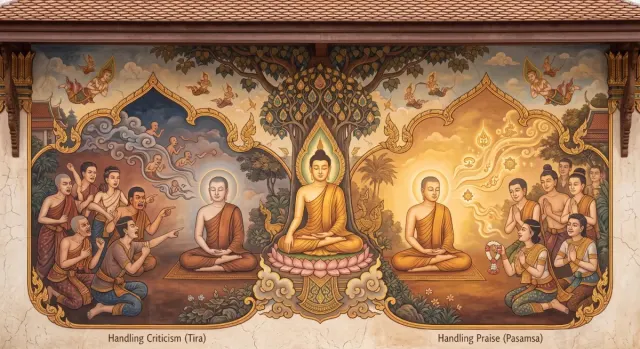
A teacher disparages the Triple Gem while his pupil praises it. The Buddha teaches the monks not to be angry w…
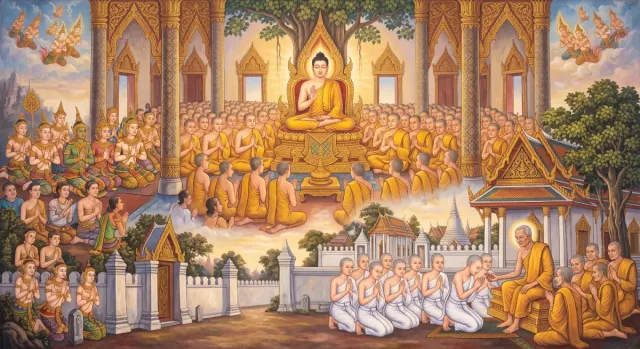
At the end of the Great Lion's Roar, the Buddha says nothing surpasses accomplishment in virtue, mind and wisd…

Ānanda worries that the deceased lay followers of Magadha have not been spoken of, so the Buddha considers the…