
The Sujāta Jātaka: The Son Who Fed a Dead Ox to Draw Out His Father's Arrow of Grief
SujātajātakaṃA father lost in grief for the grandfather came to his senses on seeing his son offer grass to a dead ox. The …


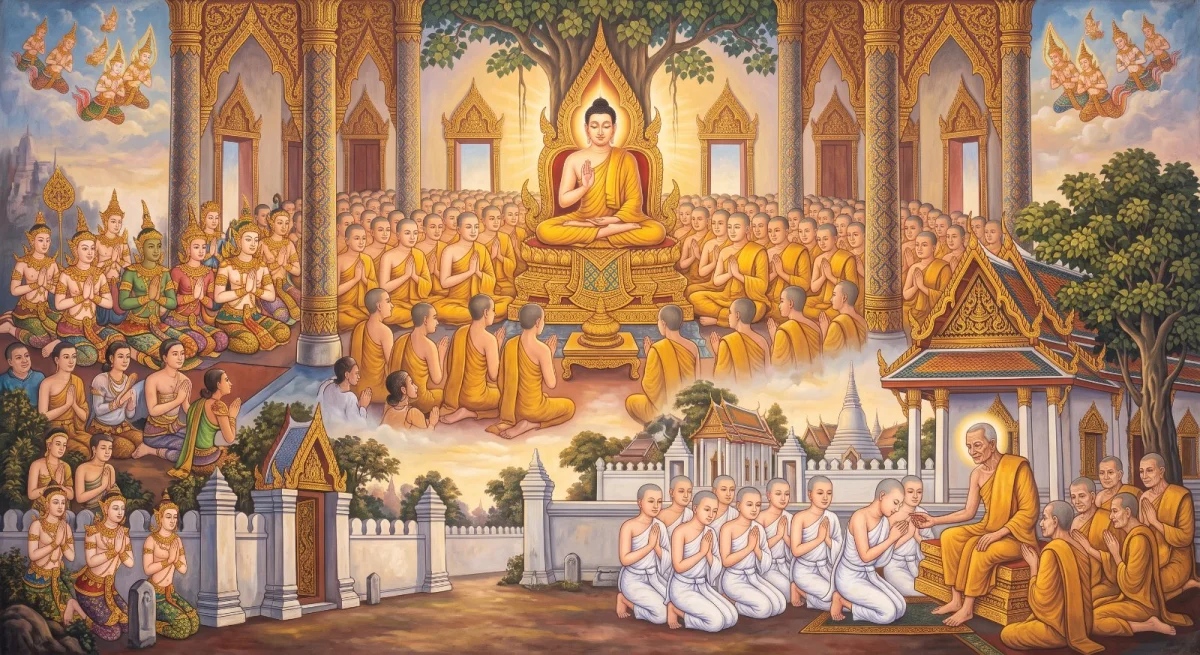
Sīhanādañca samaṇo gotamo nadati
At the end of the Great Lion's Roar, the Buddha says nothing surpasses accomplishment in virtue, mind and wisdom, affirms that his teaching is proclaimed in assemblies where it can be questioned and tested, and the naked ascetic Kassapa asks to ordain, offering to undergo probation for four years.
In the Mahāsīhanāda Sutta, also called the Kassapasīhanāda Sutta, of the Dīgha Nikāya, the naked ascetic Kassapa asks the Buddha about austerities. Earlier in the discourse the Buddha shows that external observances don't make someone an ascetic if virtue, mind and wisdom are undeveloped. This page covers the end of the discourse.
After describing accomplishment in virtue, mind and wisdom up to the ending of the defilements, he says there is no accomplishment higher or finer than these. He notes that some ascetics and brahmins praise virtue, some austerity, some wisdom and some freedom, but in the highest virtue, austerity, wisdom and freedom he sees no one his equal.
He then tells Kassapa that if anyone says the ascetic Gotama roars his lion's roar only in empty huts, Kassapa should say that's not so: he roars in assemblies, confidently; people ask him questions, he answers, listeners gain confidence and practise accordingly.
Kassapa asks to go forth. The Buddha says one formerly of another sect must undergo probation for four months. Kassapa says he will undergo probation for four years. He then receives ordination, lives alone and diligent, and becomes one of the arahants.
Having described accomplishment in virtue, mind and wisdom up to the knowledge of the ending of defilements, he says there is no other accomplishment higher or finer than these.
When choosing where to invest time in self-improvement, ask whether it makes your conduct better, your mind steadier, or your view of life clearer.
Some ascetics and brahmins praise virtue in many ways. The Buddha says that in the highest noble virtue he sees no one his equal: this is higher virtue (adhisīla).
Good virtue isn't measured by how well you praise it, but by keeping it on days when no one is watching.
Some praise austere scrupulousness; here too he has no equal. The Royal Thai edition renders the answer as higher mind (adhicitta), while the Pāli Siam edition reads adhijegucchaṃ, a higher scrupulous shunning of evil — which the earlier part of the discourse has shown is not self-mortification.
Strictness worth having is strictness with your own defilements, such as anger or stinginess — not punishing the body or overworking until you fall ill.
Some praise wisdom, some freedom. He says that in the highest wisdom and the highest freedom he sees no one his equal: higher wisdom and higher freedom.
The goal of studying Dhamma isn't knowing a lot but a mind that is actually freer in daily life. Measure progress by what you can let go of.
He tells Kassapa that if anyone says the ascetic Gotama roars his lion's roar in empty huts and not in assemblies, or roars but not confidently, Kassapa should say that's not so: he roars in assemblies and roars confidently.
If you're confident in what you say, say it where people can question you. Views voiced only in closed groups where no one objects deserve more checking.
He sets out the sequence: gods and humans ask him questions, he answers, satisfying their minds; they think it worth listening, gain confidence, show their confidence, practise accordingly, and having practised are satisfied. He gives the example of the wanderer Nigrodha, who asked about austerity and was delighted with the answer.
Good confidence doesn't stop at enjoying the talks. Check what the things you admire in the Dhamma have actually become in your actions.
When Kassapa asks to ordain, the Buddha says one formerly of another sect undergoes four months' probation, after which the monks, if satisfied, ordain him — but adds that he knows the differences between individuals in this. This is a rule of monastic ordination.
When bringing someone new into a team or group, a clear trial period is good for everyone, but look at each person individually rather than always applying one rule to all.
Kassapa says that if probation is four months, he will undergo four years. The sutta relates that he received the going forth and ordination, then lived alone, withdrawn, diligent, ardent and resolute, and before long realised the goal of the holy life, becoming one of the arahants.
When starting something that matters in your life, such as breaking a bad habit or taking up meditation, be willing to give it more time than you'd like, and keep at it steadily.
What this teaching affirms is not mystery or special powers but openness to scrutiny. A good teacher speaks in the open, lets people question, can answer, and the fruit of practice shows in those who practise.
Kassapa's story is about sincerity. Hearing the four-month condition, he doesn't bargain it down but offers more himself, and once ordained he practises all the way to the goal.
Probation is a rule of the monastic discipline for ordaining as a monk, not a condition for lay people. What lay people can take from it is the attitude towards what they commit to: giving time to prove their own resolve.
Tap to read the actual passage on the page cited.
A father lost in grief for the grandfather came to his senses on seeing his son offer grass to a dead ox. The …
Two young brahmins argue over whose teacher's path to Brahmā is more direct. The Buddha shows that no one in t…

The fourteenth Vibhaṅga asks what the five training rules "are" in the moment of mind that abstains, and answe…

Monks took the Saṅgha's beds and benches out to warm themselves in the sun and left them to be soaked by dew a…