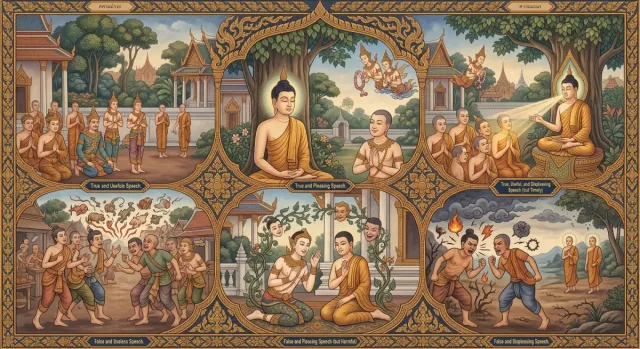
The Discourse to Prince Abhaya: Six Kinds of Speech
AbhayarājakumārasuttaṃDoes the Buddha say things people don't want to hear? He speaks only what is true and beneficial, and knows th…



Purejātapaccayo
The prenascence condition is something that arose earlier and is still present, so it supports what comes after. The book divides it into base-prenascence and object-prenascence. The postnascence condition runs the other way: what arises later supports the body that arose before.
In the Paṭṭhāna of the Abhidhamma Piṭaka, the book opens with the analysis of conditions, giving short definitions of all twenty-four conditions, after which the Investigation Chapter (pañhāvāra) of each triplet and pair supplies concrete examples. This page looks at one pair that speaks directly about the direction of time: the prenascence condition (purejāta) and the postnascence condition (pacchājāta).
A prenascence condition is something that arose earlier and is still present when something new arises, so that it supports the new thing. The text gives the internal and external sense bases as examples: the eye base is a condition for eye-consciousness, and the visible-form base is likewise a condition for eye-consciousness. In the Investigation Chapter this is refined into two kinds: base-prenascence (vatthupurejāta), the physical basis on which knowing occurs, and object-prenascence (ārammaṇapurejāta), something already existing that the mind takes as its object.
The postnascence condition has a single-sentence definition: mind and mental factors that arise afterwards are a condition, by way of postnascence, for this body that arose earlier. Its direction is the reverse of prenascence, and it is the only one of the twenty-four that speaks of turning back to support what already exists.
This point is for overall understanding. The modern examples here are illustrations only; they are not from the text.
The analysis of conditions says the eye base is a condition, by way of prenascence, for the eye-consciousness element and the states associated with it, and runs through all five doors. It adds that visible form, sound, odour, taste and touch are also conditions, by way of prenascence, for the mind element. The emphasis is that these arose earlier and are still standing when the knowing occurs.
Before blaming yourself for not managing something, check whether the prior conditions are in place: do you have the information, the time, the energy?
In the Investigation Chapter the text states that prenascence is of two kinds, object-prenascence and base-prenascence. As base-prenascence: the eye base is a condition for eye-consciousness, the body base for body-consciousness, and the heart basis for the aggregates, by way of prenascence. That is, the physical basis that allows knowing to occur.
Look after the bodily base first — eyesight, hearing, rest — since the quality of perception depends directly on it.
As object-prenascence, the text gives this example: a person contemplates the eye, the ear, up to the heart basis, as impermanent, suffering and not-self; or else delights and takes pleasure in it, and on account of it lust and displeasure arise. What is contemplated arose earlier, so it is both object and prenascent at once.
The same already-existing thing — an ageing body, say — can be looked at and give rise to understanding or to gloom. The difference is the attitude of the mind that takes it up.
In the Accumulation triplet and the Trainee triplet the text includes finer examples: an arahant contemplates the eye up to the heart basis as impermanent, and seeing forms with the divine eye and hearing sounds with the divine ear also count as object-prenascence. Meanwhile visible form is a condition for eye-consciousness and touch for body-consciousness, by way of prenascence.
Whether the perception is ordinary or refined, the structure is the same: something must already be standing there. No knowing simply floats up on its own.
The definition of postnascence is a single sentence: mind and mental factors that arise afterwards are a condition, by way of postnascence, for this body that arose earlier. In the Investigation Chapter the same wording is repeated throughout, for instance that worldly aggregates arising afterwards are a condition for this body that arose before.
Your state of mind this hour really does affect the body that existed before it. Short breaks to settle during the day are not a small matter.
Set side by side, prenascence runs from materiality that arose earlier to mentality that arises later, while postnascence runs from mentality that arises later back to materiality that arose earlier. The text does not explain why it is arranged this way; it states the definitions plainly and applies them consistently throughout. This point is for overall understanding.
When reviewing a problem, ask in both directions: what came before that produced this, and what is happening now that is feeding back into what was already there?
In the Investigation Chapter of many triplets and pairs, when the text reaches dissociation and presence it says that these are of several kinds — for example, of three kinds: conascence, prenascence, postnascence — and then explains each separately. So prenascence and postnascence do not work in isolation; they appear layered inside other conditions too.
One event usually has several mechanisms running at once. Looking for a single cause tends to hide the conditions you could actually change.
What this pair offers everyday life is two different questions. The first: what has to be in place already for this to arise at all? The second: is what is happening now supporting something that was already here?
The first question stops us from always fixing things at the far end. If concentration is not improving, the problem may not be posture but the base that has to come first — sleep, food, or an unfinished conversation. As the text has it, without an eye there is no seeing.
The second question is closest to the postnascence condition: the state of mind right now really does feed back into a body that was here before it. A day of anxious thinking wears the body down, and a settled mind likewise helps carry a tired body through.
Tap to read the actual passage on the page cited.
Does the Buddha say things people don't want to hear? He speaks only what is true and beneficial, and knows th…

Channa claimed the Buddha and the Dhamma were his, so other monks had no right to admonish him. This is the or…

A drove of boars is frightened by a lion's reflection in the crystal at their cave mouth, so they set about ru…

A resident monk carefully looks after visiting monks. Once they are settled, he stops arranging their food, an…