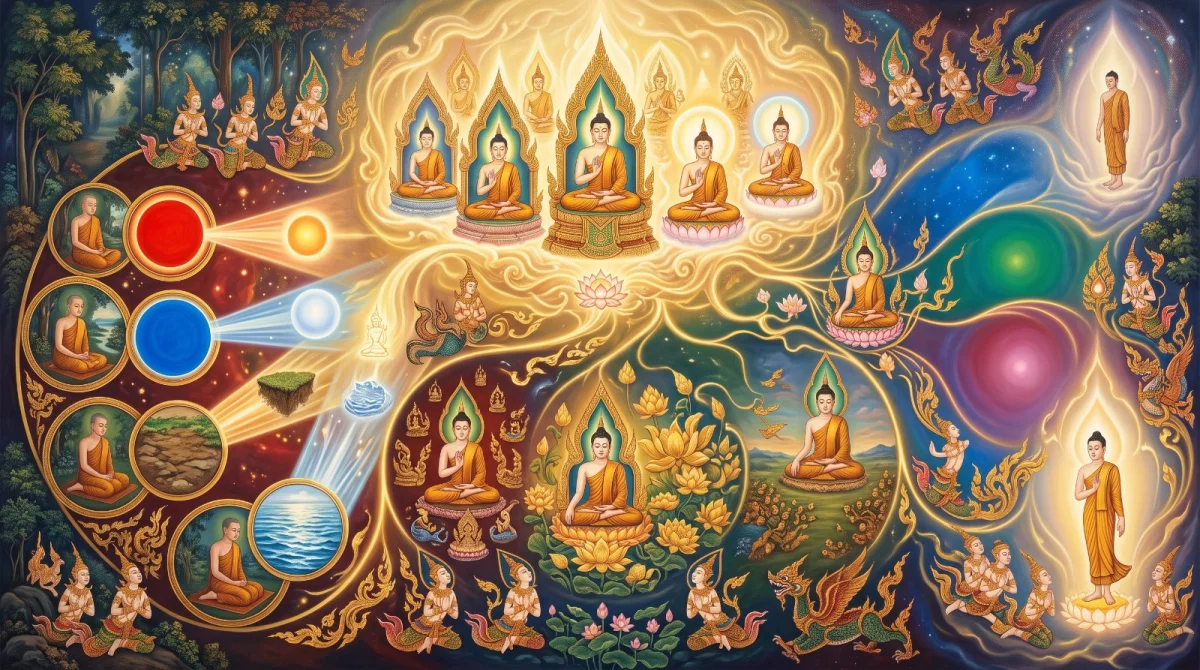

Dhammasaṅgaṇī: Fine-Material Jhāna, Kasiṇas, Bases of Mastery and Liberations
Going deeper

Dhammasaṅgaṇī: Fine-Material Jhāna, Kasiṇas, Bases of Mastery and Liberations

Rūpāvacarakusalaṃ

The Chapter on States of Mind sets out wholesome jhāna consciousness leading to the fine-material realm: two ways of counting the jhānas, the four modes of practice, strength and scope of the object, and then one object after another — eight kasiṇas, the bases of mastery, three liberations, jhānas with the divine abidings, and the ten foulness meditations.

8 points

In the Chapter on States of Mind (Cittuppāda-kaṇḍa) of the Dhammasaṅgaṇī, the first book of the Abhidhamma Piṭaka, after the eight wholesome sense-sphere minds the text moves on to wholesome jhāna consciousness, called fine-material-sphere wholesome (rūpāvacara-kusala). Every entry opens with the same formula: at the time when a practitioner develops the path for rebirth in the fine-material realm and attains such-and-such a jhāna, at that time contact … non-distraction are present; these states are wholesome.

Three things change from entry to entry: which jhāna, counted either in a fourfold or a fivefold scheme; the manner of practice, namely the four modes of progress and the four combinations of strength and scope of the object, which pair up into sixteen; and the object used, from the earth kasiṇa, seven more kasiṇas, the bases of mastery, three liberations, jhānas with the divine abidings, to the ten kinds of foulness. At the end of almost every set the text notes that it is analysed sixteenfold.

This section does not teach kasiṇa meditation step by step. How to make a kasiṇa disc and the details of training come from later works such as the Visuddhimagga. This page is best read to see how the Abhidhamma classifies jhāna-level concentration.

  1. 1

    Four jhānas or five Pañcamaṃ jhānaṃ

    The text presents the jhānas in two ways. In the fourfold scheme, applied and sustained thought subside together in the second jhāna. In the fivefold scheme there is an extra stage with no applied thought but still sustained thought, so the last jhāna becomes the fifth. Both describe the same states, divided more or less finely. This point is for overall understanding.

    Applying it in daily life

    When meditation books count the stages differently, don't rush to decide one is wrong. First see how finely each one divides.

  2. 2

    Four modes: hard or easy, slow or quick Dukkhāpaṭipadaṃ dandhābhiññaṃ

    Each jhāna can be distinguished by four modes of practice: painful progress with slow understanding, painful progress with quick understanding, pleasant progress with slow understanding, and pleasant progress with quick understanding. The text counts all four as equally wholesome.

    Applying it in daily life

    If your practice is hard and slow, that is one of the four modes the text already accepts, not a sign that you are unsuited to practice.

  3. 3

    Limited or great strength, small or vast object Parittaṃ parittārammaṇaṃ

    Another set distinguishes jhāna by its strength (limited or great) and the scope of its object (small or vast), giving four types. Paired with the four modes this makes sixteen, which the text then applies to every kind of object that follows. This point is for overall understanding.

    Applying it in daily life

    When learning anything new, look at two things separately: how steady the mind is, and how wide or narrow the thing it holds. The two need not go together.

  4. 4

    The eight kasiṇas Paṭhavīkasiṇaṃ

    The text starts with jhāna whose object is the earth kasiṇa, then says the same analysis applies to the water, fire, air, blue, yellow, red and white kasiṇas. Eight kasiṇas are given on this page.

    Applying it in daily life

    When the mind is scattered, let your eyes rest on one simple thing for a while, such as the colour of a wall or a candle flame. Simplicity helps the mind gather.

  5. 5

    Bases of mastery: seeing and knowing one can overcome Tāni abhibhuyya jānāmi passāmīti

    Without perception of internal forms, the practitioner sees external forms — limited or vast, beautiful or ugly in colour, or blue, yellow, red, white — resolves to know and see them by overcoming them, and then attains jhāna.

    Applying it in daily life

    When an image or stimulus pulls at you, shift from being pulled along to looking at it from above: it is colour and shape, and the mind need not flow after it.

  6. 6

    Three fine-material liberations Rūpī rūpāni passati

    The liberations on this page are three: one who has jhāna with an internal form as object sees forms; one without perception of internal forms sees external forms; and one intent on a colour kasiṇa as beautiful. These three are also analysed sixteenfold.

    Applying it in daily life

    When you see something beautiful, like the sky or a flower, use it as a brief resting place for the mind instead of immediately wanting it or photographing it.

  7. 7

    Jhāna with the divine abidings Mettāsahagataṃ

    The text sets out jhāna accompanied by loving-kindness, compassion and appreciative joy in the lower jhānas, up to those still with happiness, while jhāna accompanied by equanimity is given only in the final jhāna. All four are analysed sixteenfold.

    Applying it in daily life

    Begin with loving-kindness, which still carries warmth and happiness. Even-mindedness toward everyone is a subtler stage; train toward it step by step.

  8. 8

    The ten kinds of foulness Uddhumātakasaññāsahagataṃ

    The last set of fine-material wholesome states is the first jhāna accompanied by perception of ten kinds of corpse, from the bloated and the livid and the festering to one reduced to bones. Each is given at the first jhāna and analysed sixteenfold.

    Applying it in daily life

    There is no need to look at real corpses. Recalling now and then that this body changes and does not last can loosen infatuation with appearance. If this contemplation makes you low, stop and turn to loving-kindness instead.

Try it in daily life

Most people will not train to jhāna, but the structure of this section teaches something practical: there are many paths in training the mind. Some find it hard but understand quickly, some find it easy but understand slowly. Some anchor the mind with a colour or an element, some with loving-kindness, some by contemplating the body. No single method suits everyone.

Also, although the objects differ widely, the text counts all these minds as the same kind of wholesome. What makes them wholesome is a calm, collected, undistracted mind, not the object being gazed at.

Anyone who wants to train concentration seriously should do so with an experienced teacher, and start with simple things such as the breath or loving-kindness rather than trying to work through the list in the text alone.

Sources in the Tipiṭaka

Tap to read the actual passage on the page cited.

Other principles worth reading

Log in to earn 40 merit points for reading this page