The Debates on Duration of Mind and Hot Embers: Does One Mind Last All Day, and Is Everything Burning?
CittaṭṭhitikathāTwo consecutive debates in chapter 2. The first asks whether a single mind lasts a whole day; the Theravāda qu…



Yo kusalaṃ dhammaṃ bhāveti so akusalaṃ dhammaṃ pajahatīti
The Pairs on Phenomena ask whether wholesome, unwholesome and indeterminate states arise together and in which realms, then close with a development section of just four questions, all answered yes. One who develops the wholesome abandons the unwholesome, and one who does not develop the wholesome does not abandon the unwholesome.
In the Dhamma-yamaka (Pairs on Phenomena) of the Yamaka, Abhidhamma Piṭaka volume 39, the ninth section of the work, the subject is three kinds of state: wholesome, unwholesome and indeterminate (neither wholesome nor unwholesome). The terminology section checks whether "wholesome" and "wholesome state" coincide. The occurrence section asks to whom and in which realm these states arise and cease, and whether together.
The last part is the development section (bhāvanāvāra). It is very short, with only four questions: does one who develops wholesome states abandon unwholesome ones; does one who abandons unwholesome states develop wholesome ones; and two negative questions. All four are answered yes.
In the other sections, reverse questions usually get unequal answers. That the development section answers yes in every direction is therefore striking: developing the wholesome and abandoning the unwholesome are two sides of one practice.
This point is for overall understanding. The examples from the occurrence section are limited to answers that are easy to follow.
The terminology section asks: is the wholesome a wholesome state? Yes, and yes in reverse; the same holds for the unwholesome and the indeterminate. Unlike the Aggregates or Truths Pairs, where the general word is wider than the technical one, here "wholesome" and "wholesome state" match exactly.
Not every word needs fine distinctions. Knowing which words need care and which don't keeps Dhamma discussion from getting stuck on terms.
Asked whether a state is a wholesome state, the text answers that wholesome states are both states and wholesome states; the remaining states are not wholesome states. "Dhamma" here does not always mean goodness: the unwholesome is also a dhamma, and so is the indeterminate.
In the Abhidhamma, dhamma means every phenomenon, including anger and greed. Studying the Dhamma therefore includes getting to know the unwholesome side of your own mind, not only the good side.
The occurrence section asks: in a realm where wholesome states arise, do unwholesome states arise? Yes, and yes in reverse. In the realm of non-percipient beings (asaññasatta), only indeterminate states arise; neither wholesome nor unwholesome states arise there.
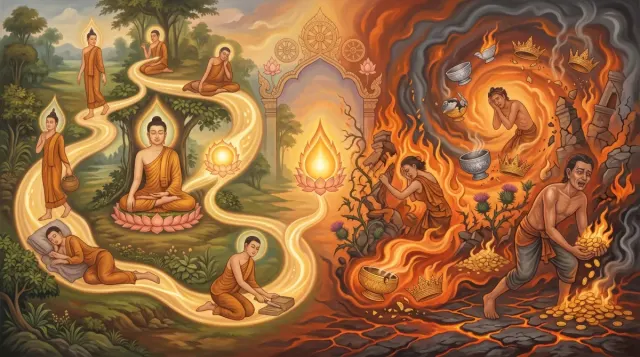
No place guarantees a good state of mind all the time. Even in a temple or retreat centre unwholesome thoughts can arise, so there is no need to panic or blame the place. Look after the mind right there.
But asked whether, for a being in whom wholesome states arise in a given realm, unwholesome states arise in that being in that realm, the text answers no, and no in reverse. In the same person at the same moment, good and bad do not arise together.
When you notice your mind clouding over, deliberately do some small good thing at once, such as wishing others well or helping someone. While the wholesome arises, the unwholesome cannot arise in that same moment.
Asked about the future, the text says that for one possessed of the path of arahantship and for arahants, neither wholesome nor unwholesome states will arise again, while indeterminate states will still arise, up to one possessed of the final consciousness (pacchimacitta). In Abhidhamma terms, an arahant's good actions do not count as kamma that bears fruit but as functional (kiriya).
The aim of doing good in Buddhism is not piling up merit without end but a mind free of defilements. When you do good, notice how much you still hope for something back.
The development section asks: does one who develops wholesome states abandon unwholesome states? Yes. And in reverse: does one who abandons unwholesome states develop wholesome states? Yes. Doing good and giving up the bad are not two tasks competing for time; they are one task seen from two sides.
If you can't seem to break a bad habit, switch from trying to stop to adding something good in its place — instead of trying not to gossip, practise mentioning other people's good points.
The negative side asks: does one who does not develop wholesome states not abandon unwholesome states? Yes, and yes in reverse. There is no neutral middle where one stays idle and the unwholesome goes away by itself. Abandoning always comes with developing.
Merely avoiding bad things without building good ones rarely lasts. Giving up your phone before bed is easier when a book or chanting takes its place.
Many people split practice into two jobs — doing good and giving up bad habits — and feel worn out trying to do both. The development section says they are one job: whenever the wholesome arises, the unwholesome is abandoned in that moment.
The occurrence section adds another angle: wholesome and unwholesome states do not arise in the same person at the same moment. A workable way to meet a bad mood is therefore to turn the mind to some small good act instead, rather than fighting the mood head-on.
The negative questions warn that doing nothing is not a middle way. One who does not develop the wholesome does not abandon the unwholesome. Abandoning always comes with building up something good.
Tap to read the actual passage on the page cited.
Two consecutive debates in chapter 2. The first asks whether a single mind lasts a whole day; the Theravāda qu…

Four things to set firmly in the mind — wisdom, truth, relinquishment and peace. The whole practice condensed …

Some have virtue, concentration and wisdom but encourage no one; some encourage others but lack these themselv…

Verses of elders once looked down on: Sunīta the former flower-scavenger, Cūḷapanthaka the slow learner sent h…