
The Debates on Dependent Origination and the Truths: A Fixed Law and What Is Conditioned
PaṭiccasamuppādakathāOne side holds that dependent origination and the four noble truths are unconditioned, since a discourse says …


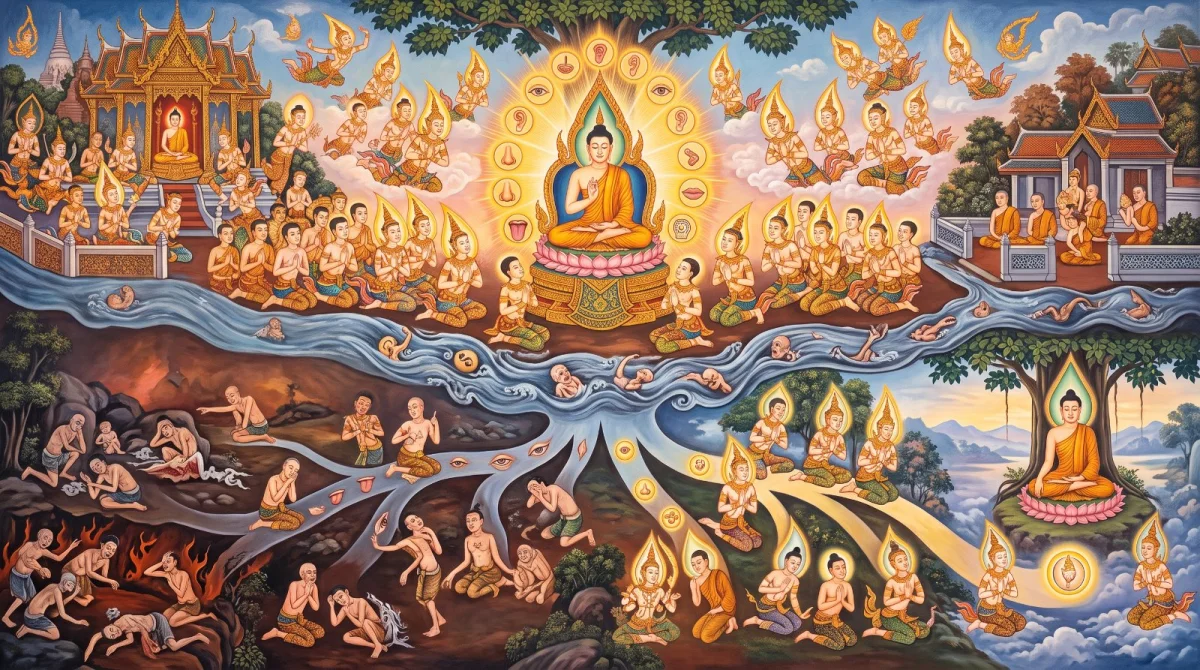
Yassa cakkhundriyaṃ uppajjittha
Asked in the past tense and by person, every pair of faculties the text asks about is answered yes, including femininity and masculinity. Asked in the future tense, the answers start to separate people: those close to final Nibbāna will not have certain faculties arise again.
In the Indriya-yamaka (Pairs on the Faculties) of the Yamaka, Abhidhamma Piṭaka volume 39, the occurrence section is the longest part. It asks: when one faculty arises in someone, does another arise in them too? It asks in six tenses — present, past, future, present with past, present with future, and past with future — and in each tense by person, by realm, and by person and realm together, on both the affirmative and negative sides.
This page looks at the tenses that give the clearest picture: the past section ("has arisen"), the future section ("will arise"), and past combined with future. Their answers differ strikingly.
In the past tense, the pairs asked by person are answered yes. In the future tense, the text has to divide people into groups according to where they will be reborn and when they will attain final Nibbāna.
This point is for overall understanding. Only answers that are easy to follow are given as examples.
The past section asks: in whom the eye faculty has arisen, has the ear faculty arisen? Yes. The pairs with the nose, life, joy, equanimity, faith, wisdom and mind faculties are also answered yes both ways — unlike the present tense, where those with eyes must be separated from those without. This answer fits what the suttas say: saṃsāra has no discoverable beginning.
When you see a weakness in someone, remember that you may have been like that yourself. This thought reduces contempt and increases sympathy.
The text asks: in whom the eye faculty has arisen, has the femininity faculty arisen? Yes. The pair with the masculinity faculty is also answered yes. A being who has had eyes has had both femininity and masculinity in the past.
If you notice bias against a gender, remember that by this answer you have been both. Being female or male is a temporary condition, not a permanent self.
Asked by realm — where the eye faculty has arisen, has the nose faculty arisen there? — the answer is that in the fine-material realm the eye faculty has arisen but the nose faculty has not, while in the sense realm both have. What is true when asked by person need not be true when asked by realm.
The same question can have a different answer when you switch from "who" to "where". When analysing a problem, ask from both angles.
The future section asks: in whom the eye faculty will arise, will the nose faculty arise? The answer: for those who will be reborn in the fine-material realm and attain final Nibbāna there, the eye faculty will arise but the nose faculty will not; for others, both will. And in the pair of the life faculty with the eye faculty, for those who will be reborn in the immaterial realm and attain final Nibbāna, the life faculty will arise but the eye faculty will not.
Everyone's past is much alike, but the future depends on the path you choose. Looking at your own road ahead is more useful than comparing your past with others'.
For the eye and femininity faculties in the future, the text answers that for those who will be reborn in the fine-material realm and attain final Nibbāna, and for men who will be reborn in that same state of manhood for only a few more existences and then attain final Nibbāna, the femininity faculty will not arise again. Conversely, for women who will be reborn in that same state of womanhood for a few more existences and then attain final Nibbāna, the masculinity faculty will not arise again.
Sex is no obstacle to awakening. The text speaks of both women and men attaining final Nibbāna as they are.
Combining past and future, the text asks: in whom the life faculty has arisen, will the faith faculty arise? The answer: for one possessed of the final consciousness (pacchimacitta), the life faculty has arisen, but the faith faculty will not arise again; for all others it will. According to the commentaries, the final consciousness is an arahant's last moment of mind before final Nibbāna.
Everything that has arisen has an end. Understanding this helps you not cling to what you have now as if it will last for ever.
With the same pair of questions, changing the tense changes every answer. In the past the answer is yes; in the present one must separate those who have a sense base from those who do not; in the future one must separate people by where they will be reborn and when they will attain final Nibbāna. Asking in every tense stops an answer for one tense being applied to another. This point is for overall understanding.
When you say "he's an angry person", ask yourself whether you mean was, is, or always will be. Those three words mean very different things.
The answers about the past invite humility. Looking back far enough, everyone has been through all sorts of states, including being female and male. Looking down on someone for what they are now is like looking down on what we ourselves once were.
The answers about the future, by contrast, separate people. The future depends on the path each person takes; it is not fixed by the past alone.
When you speak about yourself or others, keep "was", "is" and "will be" clearly apart. Someone who once made mistakes is not necessarily making them now, nor bound to keep making them.
Tap to read the actual passage on the page cited.
One side holds that dependent origination and the four noble truths are unconditioned, since a discourse says …

A monk asks what ignorance is. The Buddha says it is not knowing as it really is that the five aggregates are …
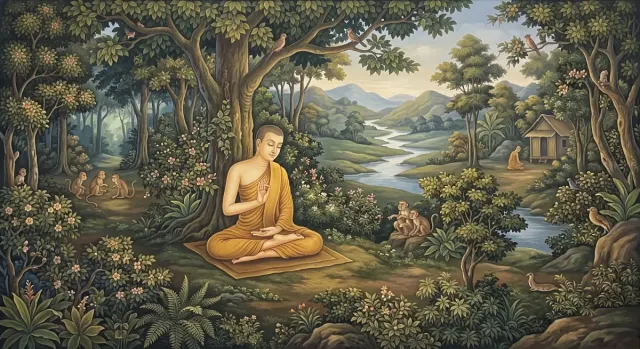
Subhūti's past life according to the Apadāna: a matted-hair ascetic living alone on Mount Nisabha, living on w…

King Pasenadi asks the nun Khemā whether the Tathāgata exists after death. She answers with the similes of cou…