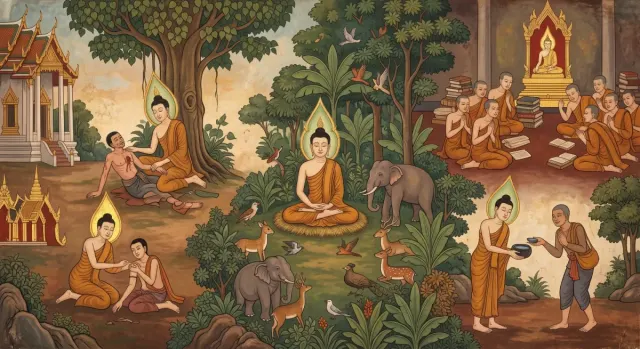
The Exposition of Nanda's Question: A Sage Is Not Measured by Knowledge
Na diṭṭhiyā na sutiyā na ñāṇenaNanda asks whom people call a sage: one with knowledge, or one with a strict way of life? The Buddha says it i…


Akkosakasuttaṃ
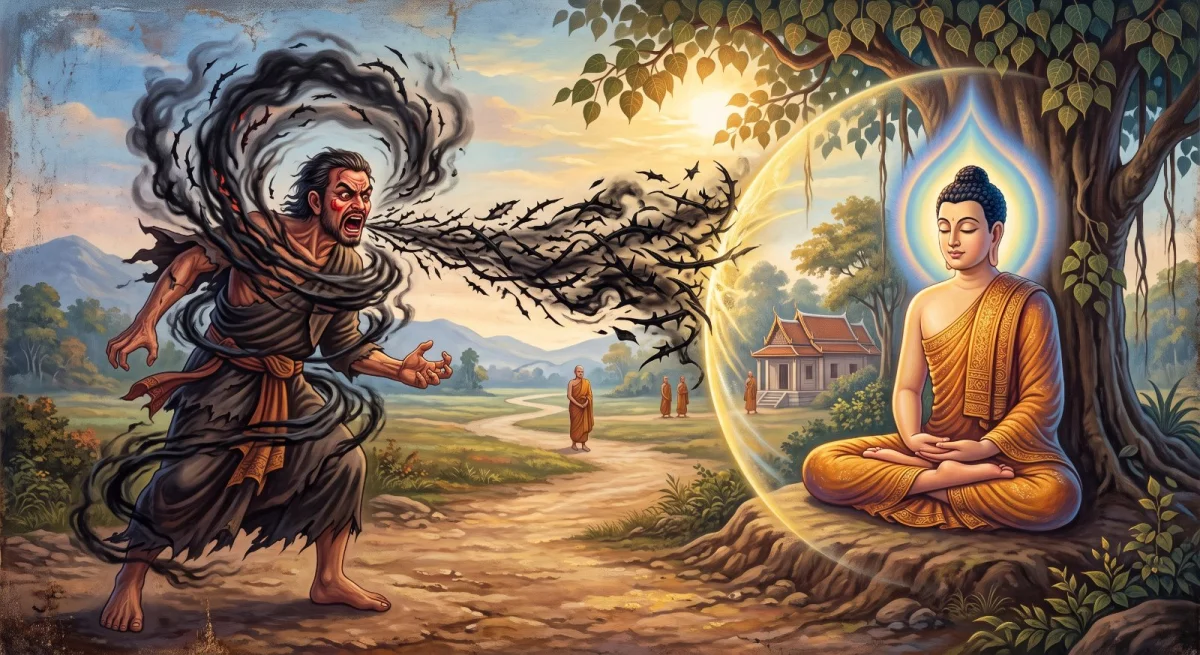
A brahmin abuses the Buddha with harsh words. The Buddha asks: if guests don't accept the food you serve, whose is it? Abuse not accepted still belongs to the abuser. One who returns anger is worse than the one who began, and one who doesn't retaliate wins a battle hard to win.
In the Akkosaka Sutta of the Brāhmaṇa Saṃyutta, Saṃyutta Nikāya, the Buddha is staying at the Bamboo Grove near Rājagaha. The brahmin Akkosaka Bhāradvāja hears that a brahmin of the Bhāradvāja clan has gone forth under the Buddha. Angry and displeased, he comes and abuses the Buddha with rude, harsh words.
The Buddha doesn't abuse him back but asks: when guests visit, do you serve them food? If they don't accept it, whose is it? The brahmin replies that it remains his. The Buddha says that in the same way, the abuse he doesn't accept belongs to the brahmin alone. When the brahmin asks whether an arahant still gets angry, the Buddha answers in verse: for one without anger, where could anger come from?
The next suttas in the same chapter tell similar stories. In the Asurindaka Sutta another brahmin abuses the Buddha, who stays silent, and the brahmin declares he has won. In the Bilaṅgika Sutta another brahmin comes angry but stands silent, and the Buddha, knowing his mind, teaches him. At the end of all three, the brahmin asks to go forth and becomes an arahant.
The Buddha asks: if friends, relatives or guests don't accept the food you serve, whose is it? The brahmin says it remains his. The Buddha says: just so, you abuse me who don't abuse, are angry with me who am not angry; I don't accept it, so it belongs to you alone.
When you receive a rude message or comment, picture a tray of food set back in front of the sender, and choose not to pick it up to reread or keep mulling over.
One who abuses the abuser, is angry with the angry, and quarrels with the quarrelsome, the Buddha says, is like eating together and exchanging dishes. He neither eats with nor exchanges with the brahmin at all.
When someone posts something to provoke you, ask before replying whether you are about to sit down to the same meal. If you must reply, keep to brief facts.
The brahmin asks why, if people know him as an arahant, the Buddha is still angry. The Buddha replies: for one without anger, tamed, living evenly, released through right knowledge, peaceful and steady, where could anger come from? Not retaliating doesn't mean being angry and holding it in.
Lasting calm comes from daily training, not holding back in the moment. Note what made you angry easily this week, and prepare your mind before meeting that situation again.
Whoever returns anger to one who is angry is worse than that person because of it. One who doesn't return anger to the angry wins a battle hard to win.
Redefine winning. In your next argument, count it as a win if you say nothing you'll regret later, not if you silence the other side.
One who knows the other is angry and mindfully stays calm acts for the good of both, himself and the other. Yet those unskilled in the Dhamma may think such a person a fool.
When someone at home or at work is angry, lower your own voice and pace first. Even if some see it as giving in, ignore that; calm helps both of you.
In the Asurindaka Sutta a brahmin abuses the Buddha, who stays silent, and the brahmin says, "I have beaten you." The Buddha says the fool thinks he wins by speaking harshly, but patience is the victory of the one who understands.
You don't need the last word in every argument. Let the other person think they've won, if the matter doesn't truly harm anyone.
In the Bilaṅgika Sutta another brahmin comes angry but stands silent. Knowing his mind, the Buddha says: whoever wrongs an innocent person, pure and without blemish, the evil comes back on that fool, like fine dust thrown against the wind.
Before venting anger on someone who has done nothing wrong, such as a service worker or someone at home, picture dust blowing back into your own eyes.
We can't always stop others from speaking harshly, but we can choose whether to take their words into our minds. Not accepting them doesn't mean suppressing feelings; it means seeing that the anger is theirs and not adding our own anger to it.
Not taking abuse into your heart doesn't mean you must stay in a situation where you are hurt again and again. If you are regularly abused or bullied — by family, at work or online — set boundaries, step away, and seek help from people you trust or those responsible for your safety.
The calm in this discourse is not responding with anger; it isn't allowing others to keep hurting you.
Tap to read the actual passage on the page cited.
Nanda asks whom people call a sage: one with knowledge, or one with a strict way of life? The Buddha says it i…

The nāga king Mucalinda coils around the Buddha to shelter him from the rain, and the Buddha utters a verse on…
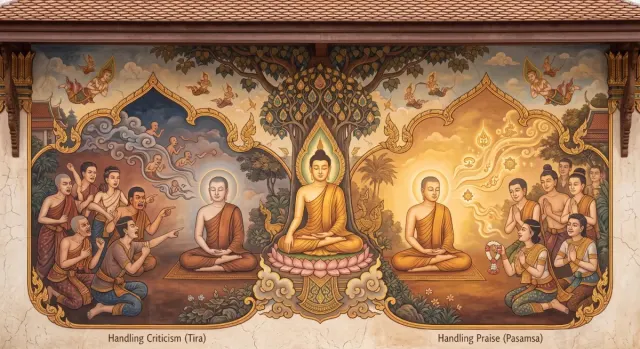
A teacher disparages the Triple Gem while his pupil praises it. The Buddha teaches the monks not to be angry w…

The Cittayamaka asks whether a mind that is arising has already arisen. Answering forces you to separate the m…