
The Five Aggregates
PañcakkhandhāThe five heaps that combine into what we call "me" — look at them one at a time and no single heap turns out t…



Iṭṭhā kantā manāpā dullabhā lokasmiṃ
Ten things everyone wants but that are hard to find in the world — wealth, beauty, health, virtue, friends, learning, wisdom and more. Each has an obstacle that blocks it and a "food" that nourishes it: diligence feeds wealth, and not deceiving feeds friendship.
In the Iṭṭha Sutta of the Aṅguttara Nikāya, Book of the Tens, the Buddha says there are ten things that are likable, desirable and agreeable, yet hard to find in the world: wealth, beauty, health, virtue, the spiritual life, friends, learning, wisdom, good qualities, and a final item that the Siamese edition reads as beings, while some other Pali editions read heaven.
He then shows that each has an obstacle (paripantha) that blocks it and a food (āhāra) that nourishes it, the two being opposites. For example, laziness is the obstacle to wealth, and diligence is its food.
The Thai translation used for reference does not list every obstacle, but the Pali edition gives all ten pairs, and the Thai translation's list of foods is complete.
Laziness and not getting up to work are obstacles to wealth; not being lazy and being diligent are the food of wealth.
Instead of hoping for luck, check whether you have work habits that bring in income steadily.
Not grooming and adorning oneself is the obstacle to beauty (vaṇṇa); grooming and adorning oneself is its food.
Keep yourself clean and suitably neat. It honours yourself and the people you meet, without needing to become infatuated with looks.
Doing what is unsuitable is the obstacle to health; doing what is suitable is the food of health.
Health doesn't come from one formula for everyone. Notice which food, sleep and exercise actually suit your body.
Having bad friends is the obstacle to virtue; having good friends is the food of virtue.
If you want to drop a bad habit, look at whether the people you spend most time with help you or drag you down.
Lack of sense restraint is the obstacle to the spiritual life; sense restraint is its food.
Choose what you let your eyes and ears take in — for example, unfollow channels that stir up craving or irritation.
Speaking falsely — deceiving or breaking one's word — is the obstacle to friends; not deceiving is the food of friends.
Friendship isn't sustained by treating each other, but by keeping your word: turn up when you said you would and do what you promised.
Not reciting and reviewing is the obstacle to learning; reciting and reviewing is its food.
Review what you read or study, or explain it to someone, within a week — otherwise you'll forget nearly all of it.
Not listening well and not asking questions are obstacles to wisdom; listening well and asking questions are its food.
In meetings or classes, listen to the end, then ask about what you still don't understand. Don't keep doubts to yourself for fear of looking ignorant.
Not applying oneself and not reflecting are obstacles to good qualities (dhammā); applying oneself and reflecting are their food.
After hearing or reading the Dhamma, try putting one point into practice, then come back and reflect on how it worked.
Wrong practice is the obstacle and right practice is the food. The Siamese edition and the Thai translation read this item as beings, but some other Pali editions read heaven, which fits the context of right practice leading to a good destination.
Whichever reading you take, the point is that a good life, now and hereafter, has to be nourished by right conduct day by day.
This discourse answers a question everyone has: what does it take to get the good things in life? The answer is not to look only at the result you want, but at what feeds it, and to keep feeding it steadily.
It's worth noticing that the Buddha doesn't deny that wealth, beauty or health are desirable. He places them alongside virtue, wisdom and Dhamma, and shows the causes of each in a reasoned way.
It makes an easy exercise: pick the one item you want most this year, write down what its food is, and what in your life right now is blocking it.
Tap to read the actual passage on the page cited.
The five heaps that combine into what we call "me" — look at them one at a time and no single heap turns out t…

The Nikkhepakaṇḍa arranges paired categories into clusters and defines the same set of defilements again and a…
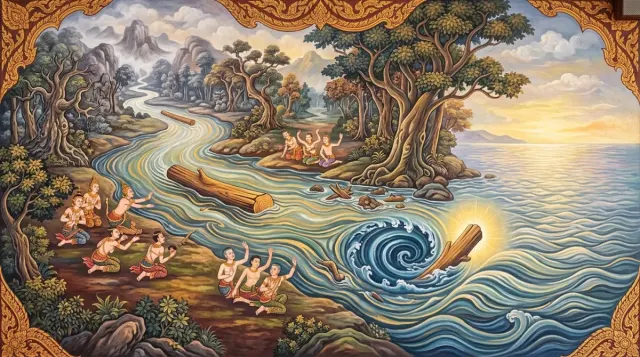
A log carried down the Ganges will reach the sea if it doesn't catch on either bank, sink midstream, run agrou…

Waste tipped over the wall onto a passer-by's head, waste dumped into a neighbour's rice field, and relieving …