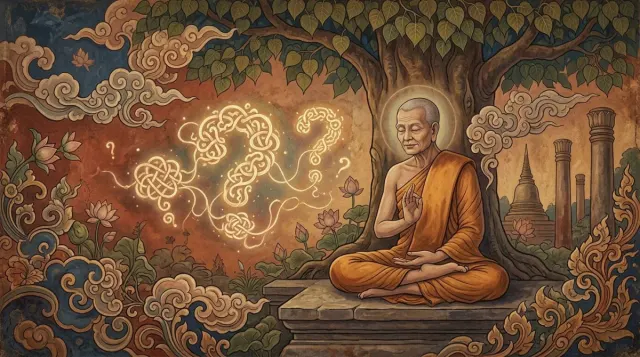
Dhotaka: No One Can Free Us from Doubt
DhotakamāṇavapucchāDhotaka asks the Buddha to free him from doubt. The Buddha says he cannot free anyone from doubt; by knowing t…



Sacittasuttaṃ
If you can't yet read other people's minds, become skilled in your own — ten questions for checking the mind as one checks one's face in a mirror: am I mostly covetous, ill-willed, dull, restless, doubting, angry, defiled, tense in body, lazy, or unconcentrated?
In the Sacitta Sutta of the Aṅguttara Nikāya, Book of the Tens, the Buddha says that if a monk is not skilled in the ways of others' minds, he should train thinking: "I will be skilled in the ways of my own mind."
He compares this to a young man or woman fond of adornment who looks at their own face in a clean, clear mirror or a bowl of clear water. If they see dust or a blemish, they try to remove it; if they see none, they are glad that their face is clean. In the same way, reviewing oneself with ten questions about how one mostly lives is very helpful for wholesome qualities.
If on review one finds that one mostly still has these states, one should apply extra zeal, effort, enthusiasm, persistence, mindfulness and clear comprehension, like someone whose clothes or head are on fire. If one finds that one mostly does not, one should stand on those wholesome qualities and keep striving for the ending of the defilements.
The same set of questions appears again in the Sāriputta Sutta and the Ṭhiti Sutta that follow in the same chapter.
Ask yourself: do I mostly live with covetousness (abhijjhā), or without it?
Notice how often today you browsed things you want, or compared yourself with what others have.
Ask: do I mostly live with a mind of ill will towards others, or with a mind free of ill will?
Before sleep, count how many times today you inwardly wished someone harm.
Ask: do I mostly live overcome by dullness and drowsiness (thīnamiddha), or free of it?
See whether the sluggishness comes from a body that truly needs rest, or from a mind that doesn't want to start. If the latter, begin with the smallest task.
Ask: do I mostly live restless, or not restless?
Count how many times you pick up your phone for no reason. It's a simple gauge of restlessness.
Ask: do I mostly live in doubt, or have I gone beyond doubt?
If you keep circling the same doubt, write the question down clearly and take it to someone who really knows, instead of going round in circles alone.
Ask: do I mostly live as an angry person, or without anger?
Ask the people at home directly whether you've been irritable lately. Sometimes the best mirror is the people closest to you.
Ask: do I mostly live with a defiled mind, or with an undefiled mind?
Check whether what you take in all day — news, clips, conversations — leaves the mind murky or clear.
Ask: do I mostly live with a tense, agitated body, or with a body at ease? The Thai translation renders this as a body of strong exertion.
Check your shoulders, jaw and forehead during the day. If they're tight, breathe out slowly and release each part.
Ask: do I mostly live lazy, or with energy aroused?
Look at what you meant to do this week: how many items were postponed, and why?
Ask: do I mostly live with an unconcentrated mind, or with a concentrated mind?
Work on a single task for twenty minutes and see how long the mind stays with it before it slips away.
The key word in the discourse is "mostly". The questions don't ask whether you have ever been angry, since everyone has; they ask what state you are mostly in these days. Asking this way shows your tendencies instead of catching yourself out every minute.
The mirror simile also sets a good attitude. Someone who sees dust on their face in the mirror simply wipes it off; they don't abuse themselves for having a dirty face, and when the face is clean they can be glad. Checking the mind should be like that, not a form of self-punishment.
If some questions, such as those about a defiled or dull mind, get a "yes" for a long stretch, to the point of affecting your eating, sleep or work, talk with someone you trust or a mental health professional alongside this practice.
Tap to read the actual passage on the page cited.
Dhotaka asks the Buddha to free him from doubt. The Buddha says he cannot free anyone from doubt; by knowing t…

Four kinds of effort from the Cara Vagga — restraining, abandoning, developing and guarding — and the meal des…
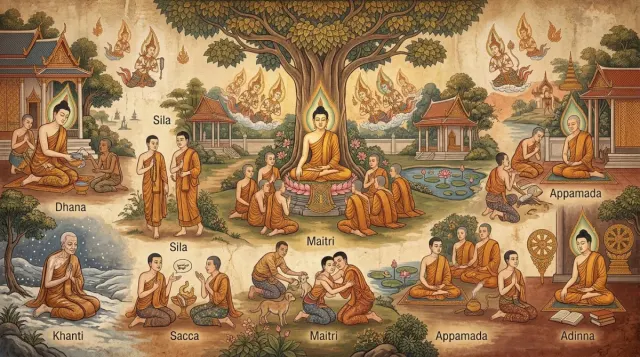
Seven qualities of a friend worth keeping, even if they send you away — lovable, respected, admirable, able to…

The Pairs on Phenomena ask whether wholesome, unwholesome and indeterminate states arise together and in which…