
The Discourse to Kandaraka: The Person Who Torments No One
KandarakasuttaṃAn elephant trainer's son remarks that animals are easy to read but humans are a tangle. The Buddha describes …


Metteyyavaggo
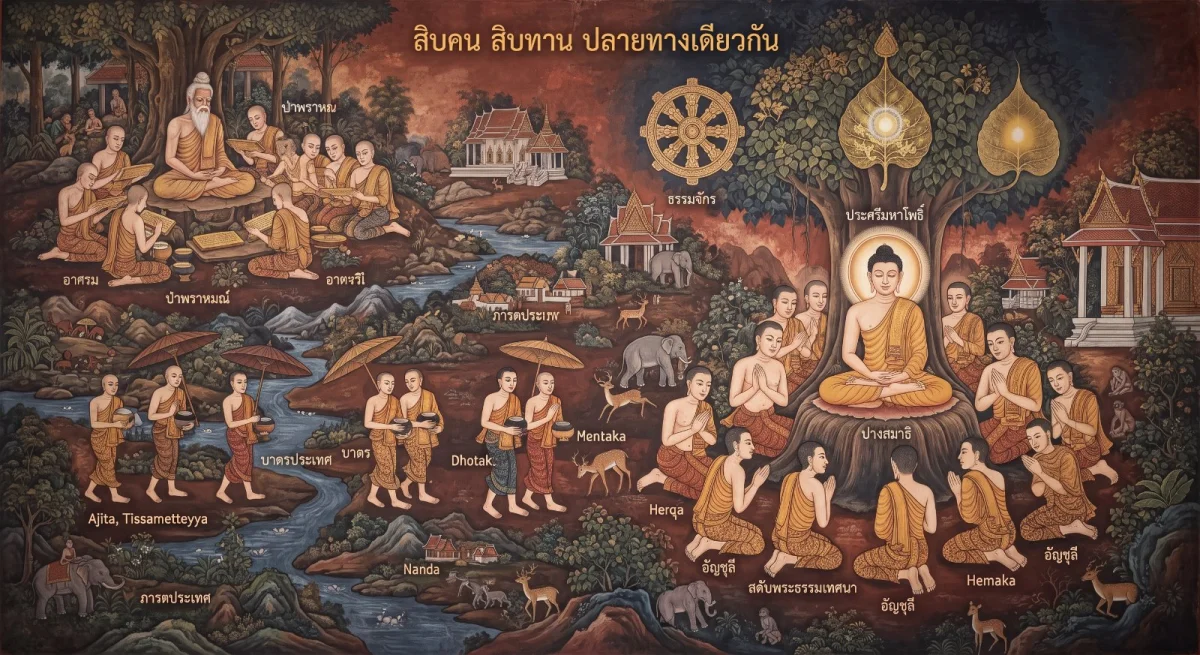
The Metteyya vagga collects the apadānas of ten elders who had been pupils of the brahmin Bāvarī. Each recounts a different past deed — a bridge, ghee, a lotus pavilion, a seat, a welcome at the door. No two of them began the same way.
The forty-first vagga of the Apadāna, the Metteyya vagga in the Khuddaka Nikāya, collects the apadānas of ten elders: Tissametteyya, Puṇṇaka, Mettagū, Dhotaka, Upasīva, Nandaka, Hemaka, Todeyya, Jatukaṇṇika and Udena. The verses themselves state that these men would become pupils of a brahmin named Bāvarī, and would then approach Gotama Buddha and ask him subtle questions.
What stands out is that their past deeds are all different. One was an ascetic tending a fire; one cremated the body of a self-awakened one; one filled a bowl with ghee; one built a bridge across a river; one built a hermitage; one was a deer hunter who made a pavilion of lotus flowers; one created a jewelled seat and offered a rose-apple; one built a leaf hut; one was a merchant's son who welcomed the Buddha into his house; and the last offered a single lotus in full bloom.
This page gives an overview of the vagga, not the questions and answers of the Pārāyana. The apadāna verses list the fruits of merit at length in the idiom of this collection; what is worth taking is the intention and the act done from where each person already stood, not a calculation of returns.
In the apadāna of Tissametteyya he was an ascetic tending a fire in hope of the brahma world. The Buddha Padumuttara came and asked for firewood, then could not light it, as a display of power. He said his own offerings were three: for the cessation of conditioning states, for burning up defilements, and for abandoning envy and stinginess.
If the rituals you keep have not reduced craving, envy or stinginess at all, it is worth asking what you are doing them for.
In the apadāna of Dhotaka he found he had no offering fit to give, so he thought he should build a bridge across the river instead. He spent hundreds and thousands to have it built, and then went to ask the Buddha to accept it.
If you have nothing to give, build something that makes other people's journey or work easier — a guide, a ramp, a system others can carry on using.
In the apadāna of Nandaka he says he was formerly a deer hunter searching the great forest for game when he came upon a self-awakened one. He planted four sticks at four corners, made a pavilion and roofed it with lotus flowers, paid homage, left his bow right there, and went forth.
A turning point needs no auspicious date. If you can already see that what you are doing harms others, putting it down today is worth more than another ten years of planning.
In the apadāna of Mettagū he lived in a hermitage near Mount Asoka and saw the Buddha Sumedha coming for alms. He took the bowl and filled it with ghee and oil. The verses stress both the giving and the settling of the mind alongside it.
Give what is in front of you without waiting for something better. What gives the act its value is the intention at the moment of giving.
In the apadāna of Jatukaṇṇika he was a merchant's son with three mansions. The verses list at length those who came to his house: travellers, orphans, beggars, ascetics and brahmins, followers of various sects, dozens of trades, and people of many foreign lands and tongues. When he saw the Buddha's radiance through his window, he hurried down and invited him in the middle of the street.
A door — of a house or of the mind — habitually left open means you don't miss the important thing that arrives unannounced.
Upasīva tells of building a hermitage and a leaf hut near Mount Anoma, and Udena of a hermitage near Mount Paduma. Hemaka was an ascetic named Anoma who created a jewelled seat by psychic power for the Buddha Piyadassī and offered him a large rose-apple.
Preparing a seat, a place to stay or a quiet corner for a visitor is a gift they feel immediately, and it costs little.
The prediction verses in this vagga state that these men would be born as brahmins' sons, become pupils of the brahmin Bāvarī who had mastered the three Vedas, then approach Gotama Buddha, ask subtle questions, and come to full understanding of the taints.
People from very different backgrounds can meet at the same question. Respect a path unlike your own instead of ranking whose start was better.
Read the ten accounts in sequence and you see there is no single template for beginning. Some began with money, some with labour, some by opening their house, some with one flower they happened to be carrying.
What they share is not the size of the gift but acting at once, with a clear mind, from exactly where they were standing. The hunter had nothing to offer but four sticks and some lotuses; he made a pavilion out of them and set his bow down right there.
One caution: don't read the lists of benefits as an exchange rate. These verses praise wholesome action in the idiom of the collection; they are not a promise that giving a certain thing yields a certain reward.
Tap to read the actual passage on the page cited.
An elephant trainer's son remarks that animals are easy to read but humans are a tangle. The Buddha describes …

The second chapter of the Dhammasaṅgaṇī answers that rūpa is the four great elements plus twenty-three kinds o…

An elephant who looks after his blind mother is captured to be a royal elephant, but will not take food becaus…

A crocodile lies in wait to catch the monkey king, but the monkey notices something is wrong and escapes. The …