
The Eight Liberations
Aṭṭha vimokkhāEight temporary liberations through concentration — from contemplating form up to the cessation of perception …


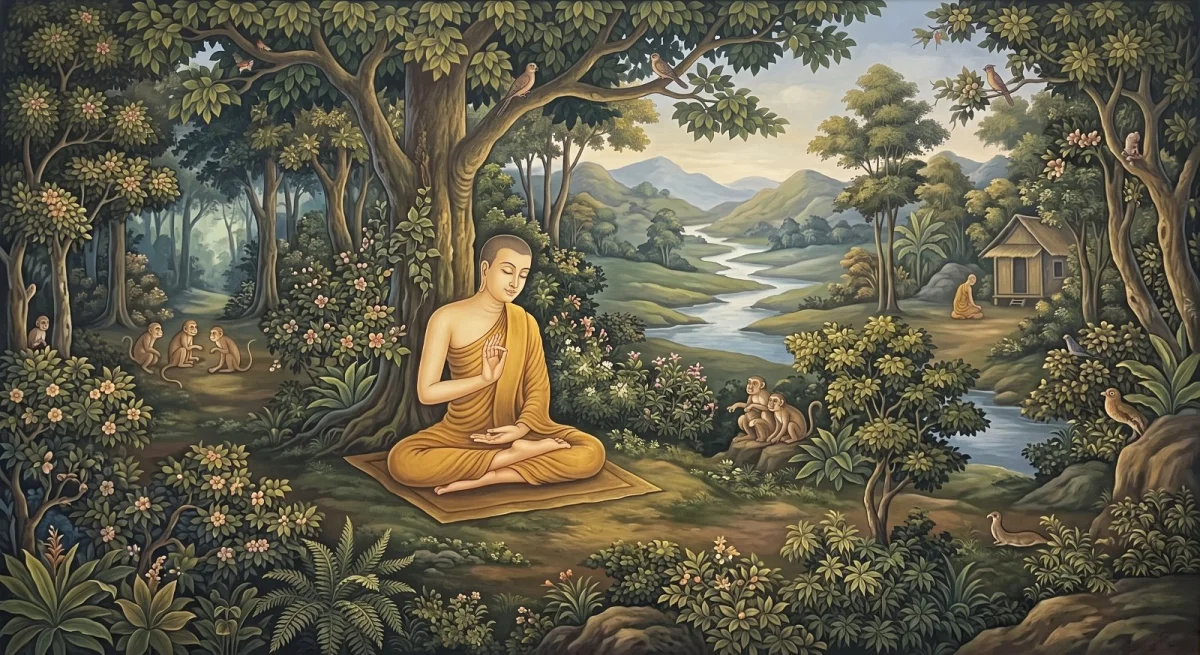
Subhūtittherāpadānaṃ
Subhūti's past life according to the Apadāna: a matted-hair ascetic living alone on Mount Nisabha, living on what fell by itself, who admonished himself with the simile of a funeral-pyre log when lust arose, and lived heedfully until the Buddha Padumuttara came and taught him recollection of the Buddha.
The Apadāna is a text of the Khuddaka Nikāya in the Sutta Piṭaka that collects verses of the Buddha, paccekabuddhas, monks and nuns telling of merit in past lives. Most scholars regard it as a later text within the Tipiṭaka, so it is best read as devotional teaching and inspiration.
The Apadāna of Subhūti opens the Subhūti Chapter and is longer than most apadānas. He tells that he was once a matted-hair ascetic living alone in a hermitage on Mount Nisabha, who would not corrupt his livelihood even at the cost of his life. When a mind tinged with lust arose, he examined and admonished himself in firm words, and lived heedfully for a very long time until the Buddha Padumuttara came. He prepared a seat of flowers; the Buddha sat for seven days while he stood paying homage for seven days. Then the Buddha taught him to develop recollection of the Buddha and foretold that he would be a disciple named Subhūti.
The prediction matches the Etadagga Pāḷi of the Aṅguttara Nikāya, where Subhūti is said to be foremost in two ways: in dwelling without conflict and in being worthy of offerings. That he was the younger brother of Anāthapiṇḍika comes from the commentary. The words of self-admonition in this Apadāna belong to the life of a forest renunciant; general readers should apply the principle with kindness toward themselves, not as harsh self-criticism.
Living alone on Mount Nisabha, he did not pick fruit, roots or leaves to eat, relying only on what fell by itself. He says he would not corrupt his livelihood even at the cost of his life, kept his mind content, and avoided improper ways of seeking. This was the practice of a forest ascetic, not something ordinary people need to imitate.
Hold to honesty in how you earn a living, even when a dishonest shortcut would pay more.
When a mind tinged with lust arose, he examined it himself and tamed it himself, alone, without waiting for anyone to stop him.
When craving or anger arises while you are alone, notice it and name it, for example "this is craving", before acting on it.
He told himself: if you still lust after what is enticing, resent what provokes resentment, and are deluded by what deludes, leave this forest. This is a dwelling for the pure; do not defile the pure.
In a role you have chosen, such as teacher, nurse or parent, ask yourself from time to time whether today you are giving that role worth or diminishing it.
A log from a funeral pyre is of no use anywhere, in the village or the forest; no one counts it as firewood. He warned himself that one who is neither a householder nor a restrained renunciant has slipped out of both ways, like that log.
Once you choose a path, commit to it fully rather than staying half-in so you get neither. When you take a break, really rest; when you work, really work.
He reminded himself that if he returned to household life, he had no wealth buried by his parents; he would have to do his own work until sweat poured from his body to make a living. This doesn't disparage lay life; it refuses to let the mind pretend another path is easier.
When you want to abandon a goal halfway, write out both the benefits and the hardships of the alternative, not just its attractive side.
He restrained his defiled mind with various Dhamma talks, held his mind back from evil, and lived heedfully for a very long time, until the Buddha Padumuttara saw him seeking the highest good and came to him.
Keep two or three short teachings or reminders that work for you, and use them at once when your mind starts drifting in a bad direction.
He prepared a flower seat. The Buddha sat for seven days while he stood in homage for seven days. On emerging from concentration, the Buddha said: develop recollection of the Buddha, unsurpassed among meditations; developing this mindfulness you will fill your mind. So he always developed recollection of the Buddha.
Before sleep, recall one quality of the Buddha, such as his kindness or his effort, and ask how you could follow it tomorrow.
The prediction says the Buddha Gotama would declare him foremost in two ways: among those worthy of offerings, and in dwelling without conflict, which matches the Etadagga Pāḷi.
Be someone others feel good about helping, because they know you will make good use of what you receive, and live alongside others without making enemies.
What makes this Apadāna special is the conversation with oneself. He lived alone with no one to warn him, so he had to be his own reminder. Today, many of our hardest challenges also arise when no one is watching, like a screen late at night or cutting small corners at work.
His method isn't simply suppression. It is asking whether we are tarnishing what we have chosen, and looking at the alternatives realistically without fooling ourselves that another path is easier.
When you speak to yourself, use the firmness you would use with a friend you love: direct but not hurtful. If the critical voice inside becomes so harsh that it causes suffering or depression, talk to a professional, or call the Thai mental health hotline 1323; outside Thailand, contact a local helpline.
Tap to read the actual passage on the page cited.
Eight temporary liberations through concentration — from contemplating form up to the cessation of perception …

Some thoughts make us blind, others give us eyes. Greed, hatred and delusion are enemies born within, yet peop…

Five qualities that make speech good — timely, true, gentle, beneficial and spoken with kindness. Useful both …

After checking terms one by one, the Aggregates Pairs turn their questions like a wheel. Is form an aggregate?…