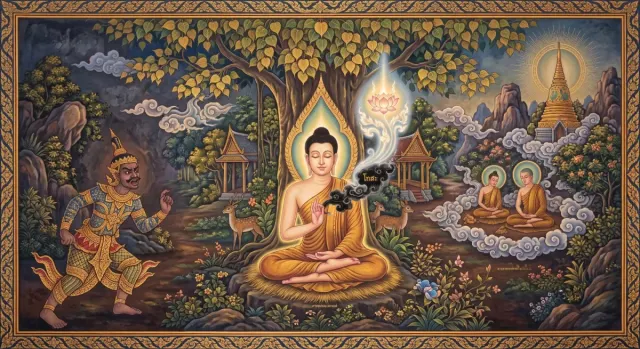
The Cullabodhi Jātaka: Anger Arises but Is Not Allowed to Stay
CullabodhijātakaṃAn ascetic admits that anger really did arise in his mind, but he checked it at once, as heavy rain settles du…


Bhārasuttaṃ
The burden, the carrier, taking it up and laying it down — a short discourse that explains all suffering through the image of someone carrying a heavy load, and says that putting it down is happiness.
In the Bhāra Vagga of the Khandha Saṁyutta, the Buddha teaches that the burden is the five aggregates subject to clinging; the carrier of the burden is the person of such a name and clan; taking up the burden is craving that leads to renewed existence; and laying down the burden is the remainderless cessation of that craving.
The discourse closes with the verse: "The five aggregates are truly burdens, and the carrier of the burden is the person. Taking up the burden is suffering in the world; laying the burden down is bliss" — a chant familiar in Thailand as "Bhārā have pañcakkhandhā".
Notice that the burden is not simply the five aggregates, but the five aggregates subject to clinging. What makes us carry them is craving.
Form, feeling, perception, formations and consciousness, grasped as "me" and "mine", are the heavy load to be carried.
Notice every "my" you say in a day. Each one is something you're carrying.
The carrier of the burden is the person of such a name and such a clan — what is conventionally called an individual.
Our names, positions and roles are labels for who is carrying, not the burden itself.
Craving that leads to renewed existence, accompanied by delight and lust, delighting here and there: craving for sensual pleasures, for existence and for non-existence.
A load isn't heavy unless it's lifted. What lifts it is the wanting for things to be or not be. Watch that wanting instead of fighting what happens.
The remainderless fading away and cessation of that craving — giving it up, relinquishing it, being freed from it, not clinging to it — which the Buddha called bliss.
Setting down one small thing at a time really does bring lightness — such as letting go of needing others to understand you on matters that don't matter.
This image applies every day. Most mental exhaustion comes not from what happens but from holding on — this body must be how I want, this feeling must not arise, this thought must be right.
Notice the moments in a day when you feel "heavy" and ask which aggregate you're carrying: worry about appearance (form), not wanting to feel bad (feeling), clinging to an image of someone (perception), clinging to your own ideas (formations). Just seeing that you're carrying it already begins to set it down.
Tap to read the actual passage on the page cited.
An ascetic admits that anger really did arise in his mind, but he checked it at once, as heavy rain settles du…

Three consecutive discussions in chapter three. One side held that the fleshly eye, when supported by Dhamma, …

Perception broken into eighteen elements — six sets of three (sense faculty, object, consciousness) — showing …

A water-carrier asks a brahmin who bathes in cold water every day to wash away evil: if water could do that, f…