
The Simile of the Quail: The Rotten Creeper
LaḍukikopamasuttaṃA small thing the mind refuses to release can bind as tightly as the rotten creeper that holds a quail, while …


Gilānasuttaṃ
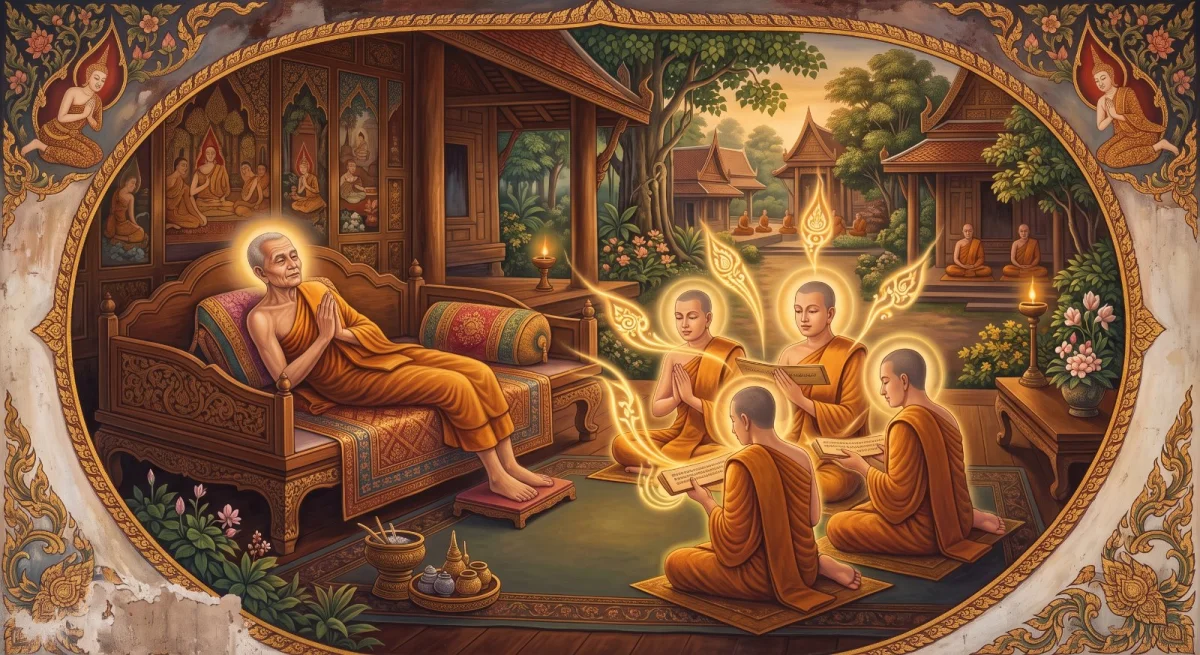
Mahākassapa, Mahāmoggallāna and the Buddha himself were once gravely ill. On hearing the seven factors of awakening they rejoiced and recovered — the source of the Bojjhaṅga Paritta often chanted for the sick.
In the Gilāna chapter of the Bojjhaṅga Saṃyutta, Saṃyutta Nikāya, three Gilāna Suttas stand side by side. In the first, Mahākassapa is gravely ill at the Pipphali Cave. In the second, Mahāmoggallāna is gravely ill on Vulture's Peak. Both times the Buddha comes out of seclusion in the evening to visit, asks how they are, and hears that the painful feelings are increasing, not subsiding.
The Buddha then says that the seven factors of awakening, well taught by him, when developed and cultivated lead to direct knowledge, to awakening, to nibbāna. Each elder says, "Indeed, the factors of awakening!", rejoices, and recovers from that illness.
In the third, the Buddha himself is gravely ill. Mahācunda comes to see him, and the Buddha asks him to recite the factors of awakening. When Mahācunda finishes, the Teacher is pleased and recovers from that illness. These three discourses are the source of the Bojjhaṅga Paritta chant.
When Mahākassapa is gravely ill at the Pipphali Cave, the Buddha comes out of seclusion in the evening, goes to his dwelling, sits on the prepared seat, and asks whether he is bearing up and whether the painful feelings are subsiding. The elder answers honestly that he cannot bear up and the pain is growing severe.
When visiting someone who is ill, ask about their condition with care and listen to their honest answer, without rushing to reassure them they'll soon be fine.
The Buddha says the seven factors of awakening, well taught by him, when developed and cultivated, lead to direct knowledge, to awakening, to nibbāna. The seven are mindfulness, investigation of states, energy, rapture, tranquillity, concentration and equanimity; this edition abbreviates the middle factors.
When you're resting through an illness, slowly recall the seven factors one by one. Use them as a place for the mind to rest instead of sinking into the pain.
Mahākassapa says, "Indeed, the factors of awakening!", is delighted, rejoices in the Blessed One's words, and recovers from that illness. The discourse says only this; it does not explain how the recovery happened.
Joy and encouragement are part of recovery. Care for the mind alongside taking medicine and resting as your doctor advises.
The second discourse tells the same story: Mahāmoggallāna is gravely ill on Vulture's Peak, the Buddha visits and speaks of the seven factors of awakening, and the elder rejoices and recovers. Even a chief disciple of great psychic power fell ill like anyone else.
Illness doesn't mean you practise badly or lack merit. Even arahants fell ill. Don't add guilt on top of your own pain.
In the third discourse the Buddha himself is gravely ill. Mahācunda comes to see him, and the Buddha says, "Cunda, let the factors of awakening occur to you." Mahācunda recites the seven factors, the Teacher is pleased, and he recovers from that illness.
When you are the one who is ill, you can accept Dhamma or encouragement from those around you, even if they are junior to you.
The discourse stresses that these are factors "developed and cultivated". Those who hear them in the discourses are great disciples with much practice, so hearing them while ill is not starting to learn afresh, but recollecting a Dhamma they had already developed.
Practise mindfulness and calm on days when you're well. When a day of illness or bad news comes, the mind will have a trained place to hold on to, without starting from zero.
The Bojjhaṅga Paritta chant, which begins "Bojjhaṅgo satisaṅkhāto", was composed from the events of these three Gilāna Suttas. It belongs to the collection of protective chants compiled later and is not the wording of the discourses themselves. Thai monks often chant it when visiting the sick.
If you chant or play the Bojjhaṅga Paritta for someone who is ill, briefly tell them its meaning too: it is the story of the Buddha and his disciples whose minds grew steady on hearing the Dhamma.
These discourses record events as the Tipiṭaka tells them; they are not advice to use hearing the Dhamma in place of medical care. The monastic discipline itself allows monks to use medicines, so when ill, see a doctor and receive normal treatment.
What we can take from them is that a clear mind with joy and mindfulness is a strength that helps us through illness. Visiting the sick with words that steady the mind therefore has value, both for the patient and for the family.
In Thai tradition, monks often chant the Bojjhaṅga Paritta when visiting the sick. Listeners benefit fully when they understand the meaning of the seven factors, rather than hearing it only as a sacred sound.
Tap to read the actual passage on the page cited.
A small thing the mind refuses to release can bind as tightly as the rotten creeper that holds a quail, while …

Eight verses of Mahākaccāna: not taking on more work than needed, the subtle dart of honour, no one is a thief…

Baka the Brahmā holds that his Brahmā world is permanent and that there is no escape from suffering beyond it.…

A portion of meat set aside for a monk was given to a crying child, so the householder offered to buy somethin…