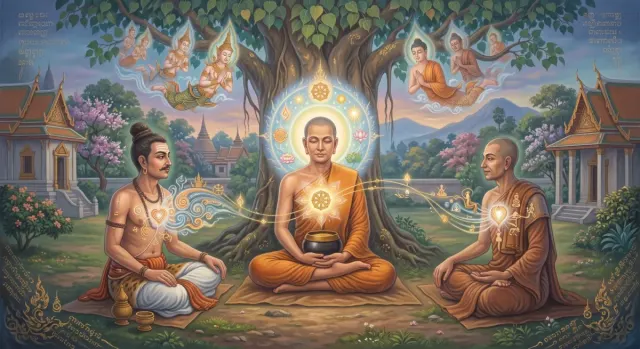
The Discourse to Sabhiya: A True Monk, Ascetic or Brahmin Is Measured by the Mind
SabhiyasuttaṃThe wanderer Sabhiya brings questions that famous teachers couldn't answer to the Buddha: what makes one a bhi…



Candūpamasuttaṃ
The Buddha teaches monks to approach families like the moon, withdrawn in body and mind, always a newcomer, never impudent, with a mind that does not stick, like a hand waved in space, and to teach out of compassion rather than to win devotion, holding up Mahākassapa as the example.
In the Candūpama Sutta of the Kassapa Saṃyutta, Saṃyutta Nikāya, the Buddha tells the monks to approach families like the moon, drawing back body and mind, always newcomers, not impudent towards families, like a man looking into an old well, a pit on a mountain or a broken river. He says Kassapa approaches families in this way.
Then he waves his hand in space and says that just as the hand is not caught, held or bound by space, so the mind of a monk visiting families should not be caught. He then contrasts impure teaching of the Dhamma, given so that people will show devotion to oneself, with pure teaching, given because the Dhamma is good and out of compassion.
In the Santuṭṭha Sutta, the first discourse of the Kassapa Saṃyutta, the Buddha says Kassapa is content with whatever robes, almsfood, lodging and medicine he gets, and tells the monks to train following Kassapa's example.
Mahākassapa is content with whatever robes, almsfood, lodging and medicine he gets, and speaks in praise of contentment. He doesn't seek them in improper ways, isn't agitated when he doesn't get them, and when he does, uses them without being tied to them, seeing the danger and understanding the escape.
Before buying something new, ask whether the old one still works, and whether you could still be at ease if you didn't get what you want.
The Buddha tells monks to approach families like the moon, drawing back body and mind, that is, not getting over-involved physically or mentally. He says Kassapa is like the moon and approaches families in this way.
When visiting someone's home, stay in the spaces your host invites you into, don't open cupboards, don't ask overly personal questions, and know when to leave.
He tells them to be always newcomers and not impudent towards families. However long the acquaintance, keep the same courtesy as on your first visit.
With close friends or long-standing clients, still say thank you, still ask permission, and don't assume anything goes. Familiarity isn't a licence to stop being considerate.
The Buddha compares it to a man drawing back body and mind as he looks into a decrepit well, a pit on a mountain or a broken river: looking with care, not leaning in so far that he falls.
When helping with someone else's family matters, such as a friend's relationship troubles, help as much as you're asked, without plunging in so far that you become a party to the dispute.
The Buddha waved his hand in space and said that just as the hand is not caught, held or bound by space, so the mind of one visiting families is not caught, thinking: may those who want gain get gain, may those who want merit make merit; and he is as pleased with others' gains as with his own.
When you help someone, help and then let go. Don't remind them of the favour, and when they do well through someone else, be sincerely glad for them.
A monk who teaches thinking, "May people listen, gain confidence, and show their confidence towards me," teaches impurely. A monk who teaches because the Dhamma is well proclaimed by the Blessed One, hoping people will understand it and practise accordingly, teaches purely.
Before sharing knowledge or giving advice, ask yourself whether you want them to understand, or want them to see how clever you are.
A monk who teaches purely does so because the Dhamma is good, and out of compassion, sympathy and kindness. The Buddha says Kassapa teaches in this way and tells the monks to train following Kassapa's example.
When teaching your children, guiding a new colleague or answering questions in an online group, start from goodwill towards them, not from wanting to win or be praised.
This teaching was given to monks who go on alms round and visit lay families, but the same principles apply to everyone: visiting friends or relatives, helping out at an event, or working inside someone else's organisation.
The image of the moon is entering politely and humbly, not acting overly familiar, and not treating someone else's home as your own. The image of the hand in space is helping without expecting anything or any attachment in return.
The point about teaching applies to all teaching and advice. First ask yourself whether you are helping them understand, or wanting them to admire you.
Tap to read the actual passage on the page cited.
The wanderer Sabhiya brings questions that famous teachers couldn't answer to the Buddha: what makes one a bhi…
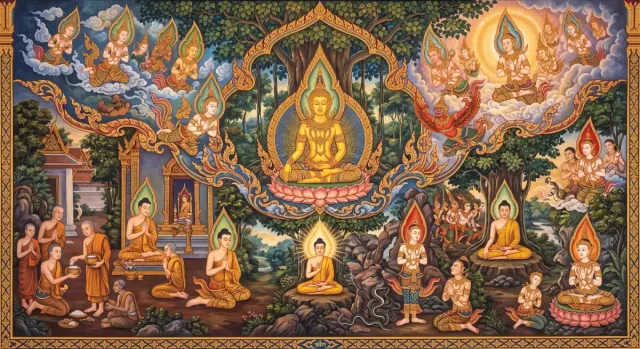
Generosity, virtue, renunciation, wisdom, energy, patience, truthfulness, determination, loving-kindness and e…
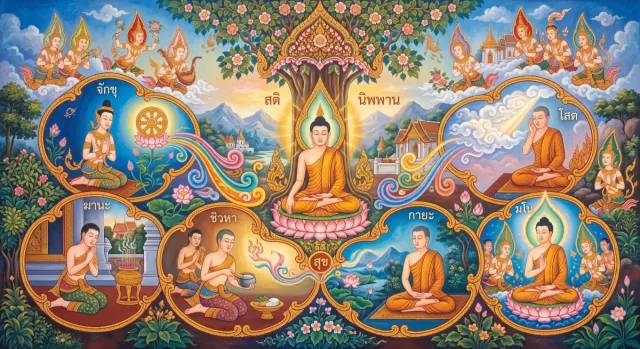
A set of short discourses in the Saḷāyatana Saṃyutta: the eye, ear, nose, tongue, body and mind, untrained, br…

Sixteen mirrors for the mind from the Anumāna Sutta — habits that make people stop correcting us, and how to c…