
The Discourse on Wives: Seven Kinds of Life Partner
BhariyāsuttaṃThe Buddha tells Sujātā, a daughter-in-law in Anāthapiṇḍika's house, that there are seven kinds of wife: like …


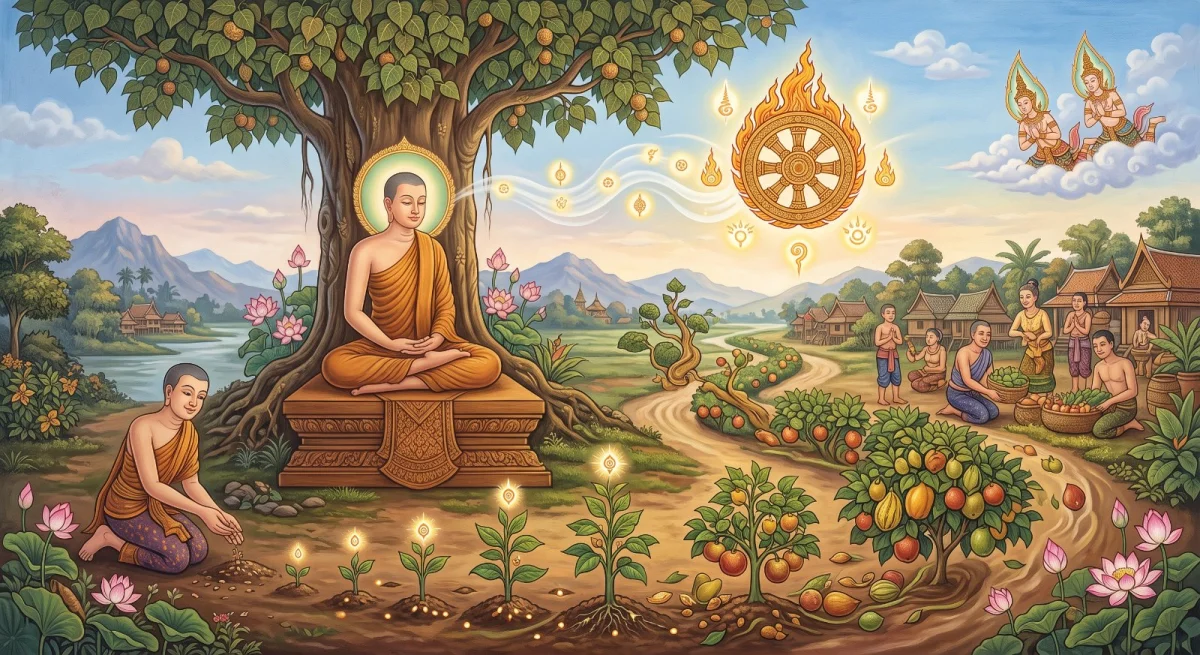
Na cetanāya karaṇīyaṃ
A virtuous person need not wish, "may non-remorse arise in me", because it arises naturally. It then leads on to gladness, rapture, a calm body, happiness, concentration, knowing and seeing things as they are, disenchantment, dispassion, and finally the knowledge and vision of liberation. Things flow into things for going to the far shore.
In the Cetanā Sutta of the Nissāya Vagga, Book of Elevens, Aṅguttara Nikāya, the Buddha says that for one who is virtuous, accomplished in virtue, there is no need for the intention, "may non-remorse arise in me." It is natural that non-remorse arises in one who is virtuous. He continues step by step in the same form, up to one who is dispassionate needing no intention to realise the knowledge and vision of liberation, because it is natural that it happens.
The sequence matches the discourse just before it in the same chapter, where Ānanda asks what virtue is for. But the Cetanā Sutta stresses another angle: no step needs to be forced or wished for. When the causes are in place, the result follows by itself.
The sutta ends: thus things flow into things, things fill up things, for going from the near shore to the far shore.
One who is virtuous, accomplished in virtue, need not intend, "may non-remorse arise in me." When you haven't done anything to feel guilty about, nothing weighs on the mind.
Instead of trying to forget guilt, look at whether something still needs fixing or an apology. Once done, relief comes by itself.
At every step the Buddha says that for one whose causes are in place, the result arising is natural. It is not a reward to be asked for, nor something to be forced.
When practice seems not to be working, go back to the causes rather than pressuring yourself to feel a certain way.
One without remorse need not intend for gladness to arise; one who is glad need not intend for rapture to arise. Joy and contentment arise in their own order.
After a day of honest work, notice the small contentment that comes by itself, without needing to top it up with pleasure from elsewhere.
One whose mind is full of rapture need not intend, "may my body become calm"; one whose body is calm need not intend, "may I feel happiness", because it is natural that this happens.
If you can't sleep, instead of forcing yourself to sleep, first clear the mind, for example by writing down what is on it, and let the body relax on its own.
One who is happy need not intend, "may my mind become concentrated"; the mind of a happy person naturally becomes concentrated. Concentration doesn't come from squeezing the mind, but from a mind at ease.
Before meditating, don't start by tensing up. Let the mind be at ease first, perhaps by recalling good things you have done, then rest it on the breath.
One whose mind is concentrated need not intend, "may I know and see things as they are"; one who is concentrated naturally knows and sees things as they are.
When facing a hard decision, let the mind settle first. Clarity tends to come by itself when the mind isn't muddied, more than from going round in circles while agitated.
One who knows and sees things as they are becomes disenchanted; one who is disenchanted becomes dispassionate; one who is dispassionate realises the knowledge and vision of liberation. Every step is natural, with no need to wish for it.
When you truly see the harm in something, letting go becomes easier by itself; you don't have to rely only on willpower to cut it off.
The sutta concludes: thus things flow into things, things fill up things, for going from the near shore to the far shore. Each step passes naturally to the next.
Give importance to the step in front of you, such as keeping your precepts well today, and trust that the next step will follow when the causes are ready.
People new to meditation often try to force the mind to be calm or to produce rapture, and the harder they try, the more tense they become. This discourse says the place to put effort is the cause. If daily life is clean and nothing weighs on the mind, ease, contentment and calm will follow in their own order.
The principle applies beyond meditation too. Trust in a family or team doesn't come from demanding "trust me", but from being consistently trustworthy.
This doesn't mean doing nothing. Virtue still has to be kept with intention. What needs no forcing are the results that follow once the causes are in place.
Tap to read the actual passage on the page cited.
The Buddha tells Sujātā, a daughter-in-law in Anāthapiṇḍika's house, that there are seven kinds of wife: like …

The Dhātukathā, the third book of the Abhidhamma Piṭaka, asks again and again how many aggregates, bases and e…
Eight verses of Mahākaccāna: not taking on more work than needed, the subtle dart of honour, no one is a thief…

Mahānāma explains to Anuruddha the household work that never ends; Anuruddha persuades King Bhaddiya, who barg…