
The Analysis of the Sense Bases: Twelve Doors the World Comes Through
ĀyatanavibhaṅgoThe second Vibhaṅga analyses the twelve sense bases three times over: a single short paragraph saying all of t…


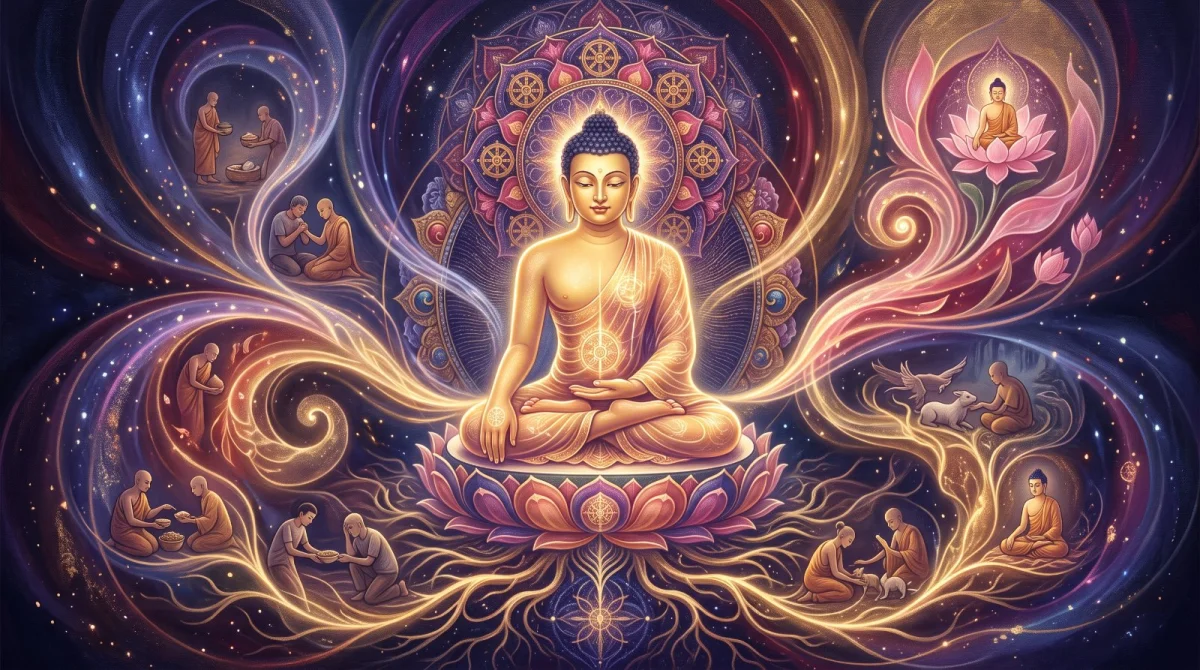
Pubbe manussabhūto samāno
The discourse on the thirty-two marks of a great man. What can actually be used is the list of deeds the discourse gives as the source of each mark — from bringing safety to many people to earning a living without cheating.
In the Lakkhaṇa Sutta of the Dīgha Nikāya, Pāṭika Vagga, the Buddha sets out the thirty-two marks of a great man and says that one endowed with them has only two destinies: if he stays in the household life he becomes a righteous wheel-turning monarch; if he goes forth he becomes a perfectly awakened Buddha.
What separates this discourse from ordinary physiognomy comes next. The Buddha says that seers outside the teaching also remember the thirty-two marks, but they do not know by what action each mark was obtained. He then goes through them one by one: in a former birth, a former existence, when the Tathāgata was a human being, this is what he did — and so he obtained this mark.
The deeds listed are all things an ordinary person can do: making those around one safe, helping others, teaching so that people learn quickly, being free of anger, reconciling those who have fallen out, and earning a living honestly. This page takes only the deeds.
To be plain about it: the thirty-two marks themselves belong to the ideas of that era about the body of a great man, and the summary verses after each item are described within the discourse itself as spoken by the ancient elders. What is usable in daily life is the list of deeds.
The Buddha says that even seers outside the teaching remember the thirty-two marks of a great man, but they do not know by what accumulated action those marks arise. The discourse therefore traces each one back to a deed.
When you admire someone's results, get curious about what they do repeatedly to get them. What you can copy is the method, not the outcome.
In a former birth, as a human being, the Tathāgata brought happiness to many people, dispelled dread, terror and fear, arranged lawful protection, shelter and guard, and gave gifts together with what goes with them.
Ask whether the people who work with you, or live with you, feel safer when you are there — or more careful.
He gathered people with the four bases of kindness: giving, kindly speech, acting for their benefit, and treating himself as equal to them.
Use all four this week: give something, speak well to someone, actually pitch in, and don't place yourself above the person you are helping.
He taught craft, knowledge, conduct or action carefully, with the thought: how might these people understand quickly, succeed quickly, and not struggle for long?
When training someone, measure how fast they can do it, not how completely you explained it. If they are still lost, the method is wrong.
He approached ascetics or brahmins and asked: what is wholesome and what unwholesome, what blameworthy and what blameless, what should be practised and what not, and what action of mine would lead to long harm or to long welfare and happiness?
Before a decision with long consequences, ask someone who has walked that road. Ask specifically what they regret doing and what they are glad they did.
He was without anger and without resentment; even when spoken to harshly by many, he was not offended, did not become angry, hostile or vengeful, and showed no anger, hatred or bitterness. He also gave fine soft coverings and fine cloth for clothing.
When criticised by a group, reply a day later. In between, take out only the parts that are true and act on those; let the rest go.
Two deeds belong together here. In one, he reunited relatives, friends and companions long separated and long absent — mother with child, father with child, brother with sister — and rejoiced when they were together again. In the other, he abandoned divisive speech: he did not carry what he heard here to there to divide people, but reconciled those who had fallen out and encouraged those already united.
If you know two people who drifted apart over something small, be the one who gets them in a room again — and never be the one who passes on the words that split people.
He abandoned wrong livelihood and lived by right livelihood, refraining from cheating with scales, with false goods and with measures, from taking bribes, from deception and fraud, and from maiming, killing, imprisoning, highway robbery, plunder and extortion.
Find the small places in your work where you could take advantage and no one would know, and decide not to. That is where right livelihood actually begins.
Read this discourse as a list of habits worth accumulating, not a list of features to check in a mirror. Every one of them is a behaviour you can repeat daily without money or position.
One more deed, not in the list below but worth keeping: the Buddha says he wished for the welfare, the benefit, the comfort and the security of many people, thinking, how might these people grow in faith, in virtue, in learning, in generosity, in wisdom, and in wealth and grain. Wanting others to grow in every direction, not only in the directions that benefit us, is rarer than it sounds.
And beware of reading it backwards. The discourse says these deeds lead to good results; it does not say to judge people by their looks. Judging a person's worth by outward appearance is something other discourses in the Dīgha Nikāya reject outright.
Tap to read the actual passage on the page cited.
The second Vibhaṅga analyses the twelve sense bases three times over: a single short paragraph saying all of t…
The seventeenth chapter of the Vibhaṅga gathers minor defilements and failings into groups: intoxication with …

One side holds that dependent origination and the four noble truths are unconditioned, since a discourse says …

Sāriputta's five ways of dissolving resentment toward five kinds of people — choose to attend to what is good …