
The Janavasabha Sutta: Three Openings to Happiness, and Care for Lay Followers
JanavasabhasuttaṃĀnanda worries that the deceased lay followers of Magadha have not been spoken of, so the Buddha considers the…


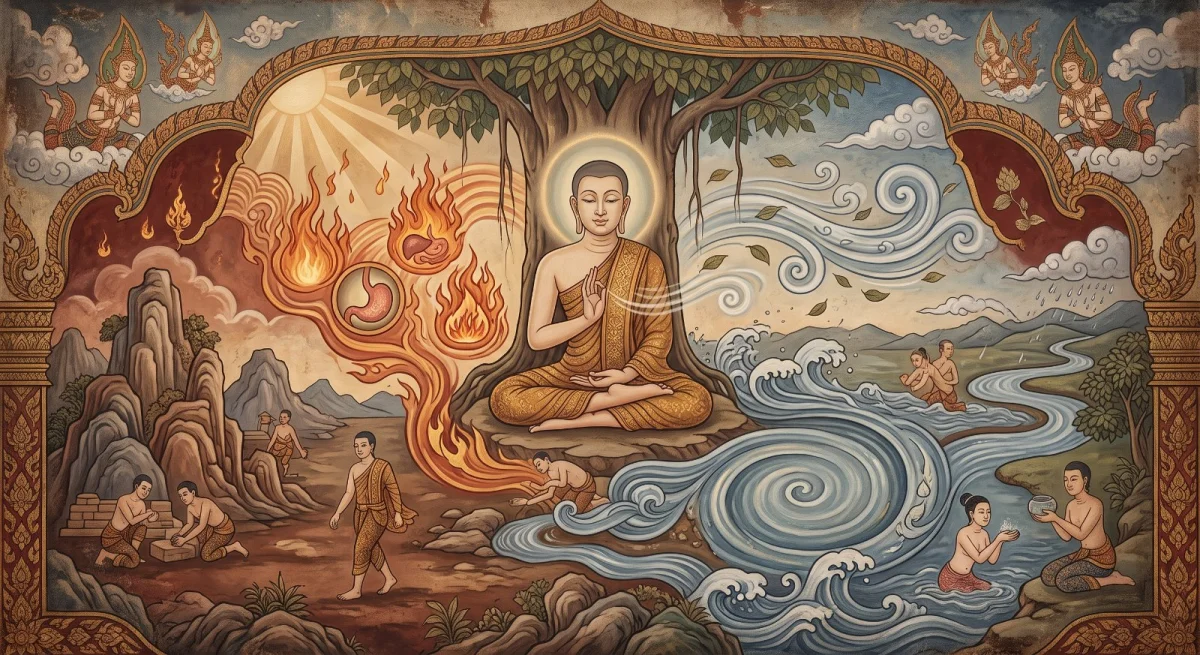
Paṭhavīsamaṃ bhāvanaṃ
How to hold the mind when struck, from the instructions to Rāhula — make the mind like earth, water, fire and wind.
In the Mahārāhulovāda Sutta the Buddha told Rāhula to develop a mind like each of the four elements, because the earth is not troubled or repelled whether people throw clean things or filth upon it — and water, fire and wind are the same.
This is not training to be unfeeling. It is training the mind to be wide enough that what strikes it cannot overturn the whole of it — when the mind is large, what arrives is smaller by comparison.
Earth is not troubled by whatever is thrown on it. A mind trained this way can receive what strikes it without having to change itself every time.
When harsh words come, breathe and recall that you are earth, not a glass that a single word can break.
Water washes the clean and the filthy alike and keeps nothing. A mind like water lets what is finished flow on.
Close the day by reviewing and then releasing. What cannot be fixed today need not be carried overnight.
Fire burns the beautiful and the ugly alike without partiality. A mind like fire is a mind not bent by liking or disliking.
When judging a matter involving both someone you like and someone you don't, hold both to exactly the same standard.
Wind moves through everything and grasps none of it. A mind like wind does not store old matters to chew over as a burden.
When you catch the third loop of the same thought, genuinely put it down and go do something else — not merely tell yourself to stop.
Use it as an image when you are struck: before replying, picture the earth receiving both the fragrant and the foul without changing its nature, and then choose your reply.
In the same discourse he goes on to prescribe loving-kindness, compassion, gladness, equanimity, contemplation of unattractiveness, perception of impermanence and mindfulness of breathing alongside it — because a wide mind needs both coolness and understanding.
Tap to read the actual passage on the page cited.
Ānanda worries that the deceased lay followers of Magadha have not been spoken of, so the Buddha considers the…

A king sends his minister Sayha to invite a friend who has gone forth to return and take high office, but he d…

When a house is on fire, only what is carried out can still be used. Life, burning with ageing and death, is t…

The eight-factored uposatha is not just a list of prohibitions but a resolve: "The arahants abstain like this …